If you are looking for the single best language-learning app, here is the honest surprise: there usually is not one. The best app depends entirely on your goal — building a habit, reading real content, memorizing words, or speaking with people — and most fluent learners end up using a small stack rather than one tool. This guide sorts the well-known apps by what each does well, so you can build the right kit for you.
What is the best app to learn a language?
The honest answer is that it depends on your goal, and the “best” is usually a small stack of two or three apps rather than one. No single app builds a habit, delivers real reading, drills vocabulary, and gives you speaking practice equally well. Pick the tool that fits the job in front of you.
This is not a dodge. It is the most useful thing anyone can tell you before you spend money and months on the wrong tool. The apps you have heard of — Duolingo, Anki, Babbel, Pimsleur, Memrise, Busuu, LingQ, Rosetta Stone, the language-exchange apps, and oqou — were built with different theories of learning and different jobs in mind. Comparing them head to head and crowning one winner is a bit like asking whether a hammer is better than a screwdriver. It depends on what you are trying to build.
What actually moves you toward fluency is well understood, even if no app fully delivers it alone. You need a large volume of language you can mostly understand — what linguists call comprehensible input — encountered again and again until the patterns sink in. You need a way to remember the words you meet, ideally through spaced repetition. And at some point you need to produce the language yourself, out loud and in writing, with real people. A good app helps with one or two of these. A good routine covers all of them, usually by combining apps.
So instead of ranking these tools from best to worst — which would be misleading, since your winner and your neighbor’s winner might be different — this article organizes them by goal. Figure out what you actually need this month, find the app known for that, and skip the rest until you need it. If you want the underlying philosophy first, our guide to the best way to learn a language lays out the principles the apps are all trying, with varying success, to serve.
What should a good language-learning app actually do?
A good app should get you consistent exposure to the language, help you understand it, and help you remember what you meet. The best ones give you real or realistic input, meaningful practice rather than busywork, a way to review vocabulary over time, and enough motivation to keep showing up. No single app nails all of these, which is why goals matter.
Before you compare specific apps, it helps to have a short checklist of what genuinely matters. Marketing pages emphasize streaks, badges, and lesson counts, but those are proxies, not the point. Here is what actually drives progress, and what to look for.
It gets you consistent exposure
Languages are learned through repeated contact over time, not in a weekend. The most valuable thing an app can do is get you to come back tomorrow, and the day after. Some apps — Duolingo most famously — are engineered almost entirely around this. Whatever else you think of gamification, a method you actually keep using beats a “better” one you abandon in a week.
It gives you real or realistic language
There is a difference between drilling isolated sentences and meeting language as it is actually used. Real understanding comes from seeing words and grammar in context, across paragraphs and conversations, not as puzzle pieces. Apps that connect you to authentic material — articles, books, stories, real speech — give you something a fixed lesson tree cannot: unlimited, level-appropriate input with no ceiling.
It helps you remember, not just encounter
Meeting a word once does almost nothing. You remember words by meeting them again at expanding intervals, which is the core idea behind spaced repetition. A good app either builds review in or makes it easy to move the words you learn into a review system. Without this, vocabulary leaks out as fast as it comes in.
It matches practice to the skill you want
Recognizing the right answer from four options is a different skill from producing a sentence out loud. Understanding a slow, clean lesson is different from following two native speakers at full speed. The best app for you is the one whose practice most closely resembles the thing you are ultimately trying to do — read a novel, hold a conversation, pass an exam, or order dinner on a trip.
It respects your time, attention, and privacy
Practical things matter too. Does it work offline on a commute? Does it drown the learning in ads or dark-pattern nudges? Does it quietly harvest your data? These are not the difference between fluency and failure, but they are real, and they shape whether a tool fits into your actual life.
The best apps by goal: a quick comparison
Here is a category-level map of the well-known apps, organized by what each is generally known for and how it broadly works. Read it as a guide to strengths, not a ranking — every app here does something well, and the right choice depends on which job you are hiring it to do this month.
A few honest caveats before the table. Features change constantly, so treat these as descriptions of what each app is known for at a category level, not a spec sheet. Prices, free tiers, and supported languages shift over time, so always check the current details yourself. And “best for” means best for that specific goal — not best overall.
| App | Best for | How it generally works |
|---|---|---|
| Duolingo | Building a daily habit and starting the basics | Short, gamified lessons with streaks, points, and reminders that keep beginners coming back |
| oqou | Reading real content and learning vocabulary in context | Import any book, article, or PDF; tap any word for an instant in-context meaning; save words and review them with spaced repetition, on device and private |
| LingQ | Reading and listening to large volumes of input | A large library plus imported texts and audio, with tap-to-look-up words and a system for tracking known and unknown vocabulary |
| Anki | Long-term memorization through flashcards | Fully customizable spaced-repetition flashcards you build or download; algorithm schedules each card for review just before you would forget it |
| Memrise | Vocabulary drilling, often with real-speaker clips | Flashcard-style courses with spaced repetition and short videos of native speakers using words and phrases |
| Babbel | Structured, practical lessons for everyday use | Guided, curriculum-style lessons focused on useful conversation, grammar in small doses, and review, generally on a subscription |
| Busuu | Structured lessons plus feedback from a community | Course-based lessons combined with exercises the native-speaker community can correct, adding a light output element |
| Pimsleur | Audio-first speaking and listening on the go | Structured audio lessons built around graduated recall and speaking prompts, designed to be done hands-free while walking or driving |
| Rosetta Stone | Immersive, translation-free beginner exposure | Pairs images with words and phrases in the target language, avoiding your native language to build direct associations |
| Tandem / HelloTalk | Speaking and chatting with real people | Language-exchange platforms that connect you with native speakers to text, call, and correct each other for free or low cost |
Notice how little overlap there is. A flashcard tool and a reading tool and an audio course are not really competing — they are covering different parts of the same journey. The sections below dig into each goal so you can decide which ones belong in your kit.
Which app is best for building a habit and the basics?
For most beginners, Duolingo is genuinely the best at this, and it is worth saying plainly. Its short, gamified lessons and relentless streak mechanics get people to show up day after day — the single hardest problem in language learning. As a low-friction on-ramp for the first few hundred words, it is hard to beat.
Credit where it is due. Duolingo does the thing most learners fail at: consistency. Millions of people who would have quit after a week are still tapping through lessons months later, and that momentum is worth a great deal. The app removes nearly all friction from starting — no textbook, no class, no tutor, just tap a language and go. It teaches core vocabulary and basic sentence patterns, eases the self-consciousness beginners feel about pronunciation, and wraps the early grind in a game loop that makes it feel achievable. For a capable free tier you can open on a bus, that is a lot of value.
Where it is the right tool
Reach for Duolingo (or a similar gamified app like the vocabulary-focused Memrise) when you are starting from zero, when you struggle to build a daily habit, or when you want a gentle warm-up that keeps a language in your life without much effort. In those roles it is excellent, and there is no shame in leaning on it heavily in your first weeks.
Where it is honestly not enough
Its weaknesses are the mirror image of its strengths. Bite-sized, gamified lessons are great for habit but poor for volume. You get short, often decontextualized sentences instead of extended real language, very little sustained reading, almost no open-ended speaking, and a curriculum that tends to plateau below the level real material demands. Many committed learners hit a wall: a long streak, a comfortable feeling inside the app, and then near-total confusion the moment they open a real newspaper or hear two native speakers talk. That gap is normal, and it is the sign that you have outgrown the shallow end. We cover this in depth in is Duolingo enough, but the short version is: keep it for the habit, and add something with more depth.
Which app is best for reading and vocabulary in context?
For reading real content and learning words in context, reading-based tools like oqou and LingQ are the strongest fit. Instead of a fixed lesson tree, they let you read authentic material — books, news, articles, PDFs — and tap unfamiliar words for instant meaning, so you get large amounts of comprehensible input while the vocabulary you meet actually sticks.
This category deserves attention because reading is arguably the most practical way to get the one thing fluency most requires: a large volume of language you can mostly understand, on your own schedule and budget. Books, news, and stories give you real vocabulary in real context, grammar doing actual work, and an effectively unlimited supply of material at every level. The classic problem — that reading in a new language is exhausting because you stop every few seconds to look words up — is exactly what these tools are built to remove.
How reading tools work
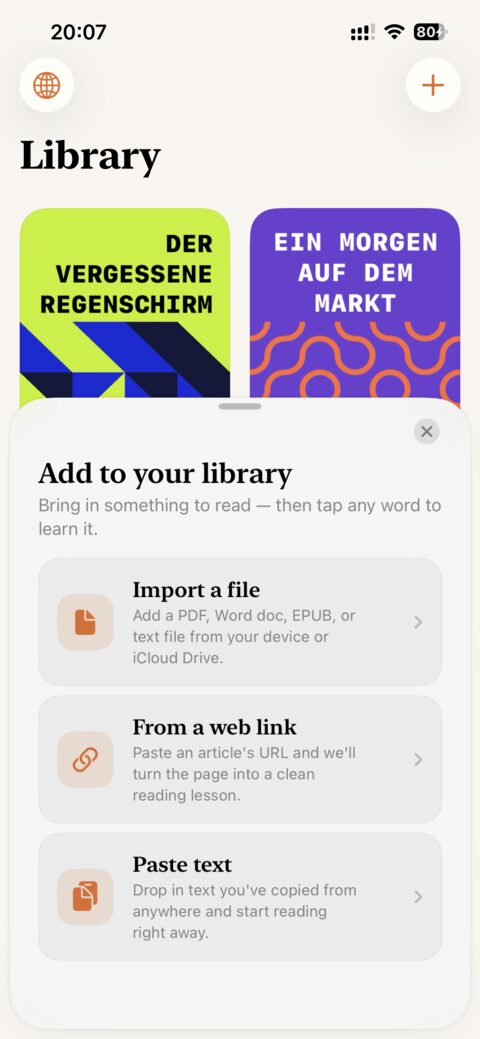
With a tool like oqou, you read whatever you actually want — a novel, a news story, an article, even a PDF you imported — and tap any word for an instant, in-context meaning. There is no dictionary app to switch to, no losing your place, no breaking the flow. Words you want to remember get saved and come back later through spaced-repetition review, so the vocabulary you meet while reading converts into vocabulary you keep. In oqou’s case this happens on device and stays private, and an optional Pro tier adds richer, AI-generated explanations of tricky phrases and premium voices for listening. LingQ works on a similar principle, pairing a large library and imported content with tap-to-look-up words and a system that tracks which words you know.
Why context beats isolated sentences
When you read, words arrive embedded in meaning. You do not memorize that a word equals a translation; you watch it do its job across paragraphs, notice the company it keeps, and absorb its shades of meaning. Meet the same word a dozen times in different sentences and it stops being a flashcard you recognize and becomes a word you simply know. That depth — nuance, register, real usage — is exactly what decontextualized drills cannot give you. Our full method lives in learning by reading, but the core idea is that context is not a nice-to-have; it is where real vocabulary is built.
Where reading tools fit in your kit
Reach for a reading app once you have a small foothold in the language — a few hundred words and the basic sentence shapes — and you want to grow past the plateau that exercise apps leave you at. It is the natural next step after Duolingo, and it scales all the way to native content. If your streak is long but real language still feels out of reach, this is usually the missing piece. Turn anything you want to read into a lesson with oqou and start closing the gap between practicing a language and actually acquiring it.
One honest note: reading tools are not a complete solution on their own either. They are superb for input and vocabulary, but they will not, by themselves, force you to speak. That is why they pair so well with the other categories below rather than replacing them.
Which app is best for spaced-repetition flashcards?
For pure, customizable spaced-repetition flashcards, Anki is the long-standing favorite. Its algorithm schedules each card for review right before you would forget it, and you can build decks around exactly the words you need. It is powerful and free on most platforms, though the interface is famously plain and the setup takes effort.
Spaced repetition is one of the best-supported ideas in learning: instead of cramming, you review material at expanding intervals — a day, then a few days, then a week, then a month — so each review lands just as the memory starts to fade. That timing is what moves a word from fragile short-term recall into durable long-term memory. Anki is the tool most associated with doing this seriously.
What makes Anki strong
Anki is endlessly customizable. You control the cards, the formatting, the media, and much of the algorithm’s behavior. You can add images and audio, download shared decks for your language, and tailor everything to your exact gaps. For learners who want maximum control and are willing to invest in setup, nothing matches its flexibility. Memrise occupies a friendlier, more guided corner of the same space, wrapping spaced repetition in ready-made courses and clips of native speakers, which suits people who would rather not build their own decks.
The honest catch with flashcards
Flashcards remember words; they do not, by themselves, teach you how words live. A card that pairs a word with a single translation can give you shallow recognition without the contextual depth that reading provides. The best practice is to build cards from words you met in real context — a sentence from something you were reading — rather than memorizing decontextualized lists. Anki also asks for real effort: you have to make or curate decks and stick with daily reviews, and its stripped-down interface will not hold your hand.
A note on built-in review
Not everyone wants to run a separate flashcard app. This is one reason reading tools increasingly build review in: oqou, for instance, saves the words you tap while reading and brings them back through spaced-repetition review automatically, using the exact sentence you found them in as context. That does not make Anki obsolete — power users will still prefer its control — but if you would rather not maintain decks by hand, having review attached to your reading closes the loop with far less friction. Either way, some form of spaced repetition belongs in your routine.
Which app is best for structured lessons and audio?
For a guided curriculum, Babbel and Busuu are known for practical, structured lessons aimed at real conversation. For audio-first learning you can do hands-free, Pimsleur is the classic choice, built around listening and speaking aloud. Rosetta Stone takes a different, immersive route, teaching through images without translation.
Some learners simply want a path laid out for them — a sequence of lessons that starts at the beginning and builds logically, without having to assemble their own materials. That is a legitimate preference, and several apps are built exactly for it. They trade the open-ended freedom of reading tools for the reassurance of structure.
Structured lessons: Babbel and Busuu
Babbel is generally known for well-designed, practical lessons that focus on useful everyday conversation, with grammar introduced in small, digestible doses and regular review. It tends to feel more grown-up and less gamified than the streak-driven apps, which many adult learners appreciate. Busuu covers similar ground — structured, course-based lessons — but adds a distinctive twist: a community of native speakers who can correct your written and spoken exercises, giving you a light dose of real feedback and output that most self-study apps lack. Both are typically subscription-based, and both are strongest in the beginner-to-intermediate range.
Audio-first learning: Pimsleur
Pimsleur is the best-known name in audio-based courses. Its lessons are designed to be done entirely by ear — while walking, driving, or doing chores — and are built around graduated recall, prompting you to produce words and phrases from memory at expanding intervals. If your main constraint is time, or you want to train your ear and mouth without staring at a screen, this format is genuinely useful. The trade-off is that it is heavier on speaking and listening than on reading, and the pace can feel slow to learners who want to move fast.
Immersive exposure: Rosetta Stone
Rosetta Stone built its reputation on a translation-free, immersive method: it pairs images with words and phrases in the target language and asks you to infer meaning directly, without leaning on your native language. Supporters like that it pushes you to think in the language early; critics note that pure image-matching can be ambiguous and that it is thin on grammar explanation. It is best thought of as one flavor of structured beginner exposure among several, not a complete path to fluency.
How to place these in your kit
Structured and audio apps are excellent scaffolding, especially early on or when you want guidance rather than a blank page. Just keep their limits in mind: like all app-bounded lessons, they eventually plateau below the level real material demands, and they cannot supply the sheer volume of authentic input that reading and listening to real content provide. Use them to build a foundation, then graduate to real language.
Which app is best for speaking practice?
For actually speaking with people, language-exchange apps like Tandem and HelloTalk are the best-known option, connecting you with native speakers to text, call, and correct one another. For faster, more focused progress, one-on-one tutoring through an online marketplace is hard to beat — though it costs more than an app subscription.
Here is a truth every app category quietly dances around: no amount of tapping, drilling, or listening fully substitutes for producing the language yourself, with another human, in real time. Input builds comprehension and gives you the raw material; output — speaking and writing — is what turns a large passive vocabulary into an active one you can reach for under pressure. At some point you have to open your mouth.
Language-exchange apps
Tandem and HelloTalk connect you with native speakers who want to learn your language in return. You chat by text, exchange voice messages, correct each other’s mistakes, and sometimes call. The appeal is obvious: real, low-cost or free practice with real people, on your own schedule. The catches are just as real — conversations can fizzle, quality varies wildly, and you are relying on a stranger’s patience and availability rather than a trained teacher. Used with a bit of persistence, though, they are a genuine way to get speaking reps and cultural context you cannot get from any lesson.
Tutoring marketplaces
If you can spend a little money, one-on-one lessons with a tutor — booked through the various online tutoring marketplaces — are among the most efficient ways to improve speaking. A good tutor tailors each session to you, corrects you in real time, and holds you accountable in a way an app never will. It is the most human option on this list, and often the fastest for conversation, but it is also the most expensive and the least spontaneous, since you have to schedule it.
A realistic sequence for speaking
Speaking gets dramatically easier once you have absorbed a lot of input, because you finally have something to say and the words to say it with. So a sensible order for many learners is: build a base with a habit app, pile up comprehensible input through reading and listening, and then lean into speaking through exchange apps or tutoring — while continuing to read. Do not wait for perfection to start talking, but do not expect an exchange app to carry you if your input foundation is thin.
What's the best free option?
There is no single best free app, but you can assemble a genuinely strong free routine. Duolingo’s free tier builds the habit and basics, Anki is free on most platforms for spaced repetition, and language-exchange apps offer free speaking practice. Many reading tools, including oqou, are free to try, with optional paid tiers for extra features.
Cost should rarely be the reason you do not learn a language, because the free landscape is better than it has ever been. The trick is to stop looking for one free app that does everything and instead combine free (or free-to-start) tools that each cover a different job.
A capable no-cost stack
- Habit and basics: Duolingo’s free tier is genuinely useful for getting started and staying consistent, ads and all.
- Spaced repetition: Anki is free on desktop and Android and is the gold standard for flashcards, if you are willing to build or download decks.
- Reading and vocabulary: Many reading tools let you start for free. oqou is free to try, works on device, and keeps your reading private, with an optional Pro tier only if you want AI explanations and premium voices — so you can build the core reading habit without paying anything.
- Speaking: Tandem and HelloTalk offer free text and voice exchange with native speakers, which is the cheapest speaking practice there is.
- Free reading material: Public-domain books, news sites, blogs, and articles in your target language cost nothing and give you unlimited input to feed into a reading tool.
When paying is worth it
Free will take you remarkably far. You might choose to pay when a subscription clearly saves you time or friction — removing ads, unlocking a structured curriculum you would otherwise have to assemble, adding AI explanations for tricky passages, or booking a tutor for the speaking practice no free tool fully replaces. Spend money where it buys you something specific, not out of a vague hope that a paid app will make learning happen for you. The habit is still on you.
How do you combine apps into one system that works?
The trick is to assign each app one job and let them cover each other’s weaknesses. Use a habit app to stay consistent, a reading tool for the volume of real input, spaced repetition to remember words, and exchange or tutoring for speaking. A short daily routine that touches input, review, and eventually output beats any single app used alone.
Almost every learner who reaches fluency, whether they planned it or not, ends up doing some version of this. They start narrow, then add tools as their needs change, and they keep the pieces that each do one thing well. The roadmap below turns that into a concrete sequence you can actually follow.
- 1Start with a habit (weeks 1–4) — Pick one low-friction app like Duolingo and do a short daily lesson to build the streak, learn your first few hundred words, and get comfortable with the sounds. The only goal right now is showing up every day.
- 2Add real reading (from week 2–3) — As soon as you have a small foothold, start reading real content in a tap-to-translate tool like oqou. Read things you actually care about, tap unknown words for in-context meaning, and let the volume of input do the heavy lifting.
- 3Lock in review (ongoing) — Feed the words you save while reading into spaced repetition — either your reading app’s built-in review or Anki — and do a few minutes daily. Reviewing words in the context you met them is what makes them stick.
- 4Start speaking (from month 2–3) — Once you have some words and patterns, begin producing the language. Use a language-exchange app or a tutor, and do not wait to be “ready.” Let the gaps you hit tell you what to read and review next.
- 5Shift the balance upward (month 3+) — Shrink the beginner app to a quick warm-up, make reading and listening to real content the core, and keep speaking regularly. Nudge every text and conversation slightly above your comfort level so you keep growing.
A simple daily rhythm
You do not need hours. Twenty to forty focused minutes on most days is plenty, and it might look like this:
- 5 minutes — warm-up. A quick habit-app lesson to keep the streak and shake off the rust. Treat it as a warm-up, not the main event.
- 15–25 minutes — real reading. Open something you want to read at roughly your level, tap unfamiliar words for instant meaning, keep the momentum, and save the words worth remembering.
- 5 minutes — spaced-repetition review. Run your saved words so the day’s reading converts into lasting vocabulary.
- A couple of times a week — speaking. A short exchange chat, a tutor session, or just narrating your day out loud to activate what you have absorbed.
Why the combination beats any single app
Look back at the comparison table and you will see why this works: the apps barely overlap. A habit app handles psychology and scaffolding. A reading tool handles substance and scale. Spaced repetition handles memory. Exchange apps and tutors handle production. Each covers the others’ blind spots, and none asks you to abandon the rest. That division of labor — not any one magic app — is what actually carries people to fluency. If you want the principles behind this whole approach, our guide to the best way to learn a language goes deeper.
The single most common mistake is trying to make one app do everything and blaming yourself when it stalls. It was never going to. Give each tool one job, make real reading the engine, and the plateau most learners get stuck at simply stops being a wall. Add oqou to your kit and let the books, news, and articles you already want to read become the input that moves you forward.
Frequently asked questions
What is the single best app to learn a language?
There is not one, honestly — it depends on your goal. Duolingo is best for building a habit, reading tools like oqou or LingQ for input and vocabulary in context, Anki for spaced repetition, and exchange apps or tutors for speaking. Most fluent learners use a small stack of two or three, not a single app.
Is Duolingo the best app for learning a language?
It is arguably the best at one specific job: getting beginners to build a daily habit and learn the basics with very little friction. It is not, on its own, enough to reach fluency, because it lacks the volume of real, extended input that comprehension requires. Keep it for the habit and add a reading tool for depth.
What is the best app for learning a language by reading?
Reading-based tools are the strongest fit, since they let you read authentic books, news, and articles while tapping any word for an instant in-context meaning. oqou and LingQ are the best-known examples. They turn real content into comprehensible input and, in oqou’s case, save and review your words with spaced repetition automatically.
Can I learn a language for free with apps?
Yes. You can assemble a strong free routine: a free habit-app tier for the basics, Anki for spaced repetition, a reading tool that is free to try for input, exchange apps for speaking, and free public-domain books and news for material. Paying is optional and worth it mainly when it removes friction or buys you a tutor.
How many language-learning apps should I use at once?
Usually two or three, each with a clear job — not a dozen you rotate through randomly. A common effective kit is one habit or reading app as the core, a spaced-repetition system for memory, and, once you are past the basics, an exchange app or tutor for speaking. More than that tends to scatter your effort rather than help.
The best app is really the best routine — a couple of tools that each do one thing well and add up to consistent input, review, and eventually real conversation. If reading real content is the piece you are missing, that is the highest-leverage place to start. Try oqou and turn anything you want to read into a lesson that actually moves you toward fluency.