If you have ever searched for the single best way to learn a language, you already know how noisy the answers get. Every app, course, and polyglot on the internet swears their method is the one. The honest truth is quieter and more useful: there is no magic method, but there is a reliable recipe. This guide walks you through what actually works, why, and how to build it into a routine you will keep.
What is the best way to learn a language?
The best way to learn a language is to combine three things: lots of input you can mostly understand, real practice producing the language yourself, and enough consistency that both become habits. No single tool, app, or class does all of that alone. The winners are the people who show up steadily and mix methods.
That answer is deliberately unglamorous, because the glamorous answers are usually wrong. There is no secret app, no five-minute-a-day shortcut, and no perfect textbook that makes the work disappear. What there is, instead, is a small set of ingredients that decades of learners and researchers keep coming back to. When you understand what those ingredients are and why they matter, you stop chasing methods and start building a routine that quietly compounds.
Here is the whole thing in one breath. You need a large and growing amount of comprehensible input — language you meet through reading and listening that you understand most of. You need output — actual speaking and writing, where you take the words you have absorbed and make them do work. And you need consistency — a habit small enough that you keep it on your worst days, because language is built by repeated contact over months, not by heroic weekend sprints. Everything else in this article is a detail hanging off those three ideas.
Notice what is missing from that list: any particular product. Apps, classes, tutors, podcasts, graded readers, flashcard systems — these are all delivery mechanisms for the three ingredients. A great app is one that gets more comprehensible input into your day and helps you remember it. A great class is one that pushes you to produce the language and gives you feedback. None of them is the method; they are ways to run the method. Once you see it that way, the endless “which app is best” debates matter a lot less than the question that actually decides your outcome: are you getting input, producing output, and doing it consistently?
Why is there no single “best” method?
There is no single best method because learners differ, languages differ, and goals differ. A method perfect for a beginner memorizing a script is wrong for an intermediate learner who needs speaking reps. Your time, your motivation, your native language, and what you want to do with the language all change the right mix. The best method is the one you will actually sustain.
Think about how many variables are in play. Someone learning Spanish as an English speaker starts with thousands of near-identical cognates and a familiar alphabet; someone learning Japanese from English faces three writing systems and almost no shared vocabulary. A learner who wants to read novels needs a very different diet from one who wants to chat with in-laws at dinner. A student with two focused hours a day should structure things differently from a commuter who has fifteen scattered minutes. When people argue that their method is universally best, they are usually just describing what worked for their situation and assuming yours matches.
Why the “one weird trick” promises fail
The language-learning market runs on the fantasy of a shortcut, because shortcuts sell better than patience. But the promises fall apart under gentle pressure:
- “Learn like a child.” Adults are not children. You will not spend ten thousand hours immersed with no other responsibilities, and you also have advantages a child lacks — abstract reasoning, an existing language to map onto, and the ability to look things up. Copying a toddler's process ignores your actual strengths.
- “Fluent in three months.” You can make real, exciting progress in three months. But “fluent” is doing a lot of quiet work in that sentence, and the timelines that sound impressive usually redefine the word until it means “can order coffee.”
- “Just do our app for five minutes a day.” Five minutes a day is a wonderful habit anchor and a terrible total dose. It keeps a streak alive; it does not, by itself, build a working command of a language.
- “Grammar is all you need” (or “grammar is useless”). Both extremes are wrong. Grammar study speeds up your understanding of patterns you are already meeting in input; it cannot substitute for the input itself.
None of this means methods do not matter. Some approaches are clearly more efficient than others, and a bad routine can waste months. The point is subtler: the difference between a good method and a slightly better method is small compared with the difference between doing something every day and doing nothing. Chase the habit first, then optimize the method inside it. And be honest with yourself about what you will keep doing — a “perfect” plan you abandon in two weeks loses to a decent plan you run for a year.
What does research actually suggest works?
Research and long experience point to a few durable ideas: you acquire language mainly by understanding messages (comprehensible input), you build active skill by producing the language (output and speaking), and you remember more by reviewing at spaced intervals. No study crowns one method, but these principles show up again and again across approaches that work.
Let us take them one at a time, honestly and without overclaiming. These are well-known concepts with strong support and ongoing debate — not laws of physics, but the closest thing the field has to shared ground.
Comprehensible input
The idea most associated with linguist Stephen Krashen is that we acquire language when we understand input that is a little beyond our current level — often written as “i plus one.” You do not learn a word by studying a definition of it so much as by meeting it, understood, in enough real contexts that your brain quietly builds a model of what it means and how it behaves. Reading and listening to material you mostly understand is the engine of this process. It is why comprehensible input is the phrase you will see everywhere serious learners gather, and why so many effective routines are built around getting more of it. The practical version: spend real time with content you understand roughly 95 to 98 percent of, and let volume do the heavy lifting.
Output and speaking practice
Input builds a huge, mostly passive store of language. Output turns some of that store into something you can use in real time. When you speak or write, you are forced to retrieve words, assemble grammar under pressure, and notice the gaps between what you want to say and what you can say. That noticing is valuable — it sends you back to your input with sharper attention. Most people find that comprehension runs ahead of production for a long time, which is normal; you will understand far more than you can say. But production does not develop on its own from input alone. You have to practice producing, ideally with feedback, to make the passive active.
Spaced repetition
Memory fades on a predictable curve, and the reliable countermeasure is to review material at increasing intervals — a day later, a few days later, a week, a month. Reviewing right before you would have forgotten is far more efficient than cramming, and it is the principle behind spaced-repetition flashcard systems. The nuance worth stating: spaced repetition is fantastic for locking in vocabulary you have already met in context, and much weaker as a way to meet words for the first time. Words learned in isolation on a card tend to stay shallow; words you first met inside a story you cared about, then reinforced with spaced review, tend to stick with their meaning and feel intact.
Put the three together and the shape of an effective routine appears on its own. Get large amounts of input you understand. Practice producing the language. Review the highest-value pieces at spaced intervals so they do not leak away. That is not a method someone is selling you; it is the common core underneath most methods that work.
Is immersion the best way to learn?
Immersion is powerful but not automatically best, and it is not the only path. Living in a country surrounds you with input and forces daily practice, which accelerates learning — if you engage. But passive immersion, where you retreat to your own language, wastes the opportunity. You can also build strong “immersion at home” without moving anywhere.
The romantic story is that you move abroad, absorb the language through your skin, and emerge fluent. It happens — but not by magic, and not for everyone. People live in a country for years and never get past survival phrases, because they organize their life around their native language: expat friends, subtitled shows, a job in English. Immersion is not a location. It is the amount of comprehensible, engaged contact you have with the language, and you can raise or lower that dial anywhere.
Why immersion works when it works
When immersion delivers, it is because it stacks all three ingredients at once. Input is everywhere — signs, menus, overheard conversations, the radio in a taxi. Output is unavoidable — you have to ask for things, answer questions, handle small problems in the language. And consistency is built in, because there is no off switch; every day forces contact. That combination, sustained, is genuinely hard to beat. The catch is the word “engaged.” Immersion only compounds if you actually process the input and take the speaking reps instead of hiding from them.
Building immersion at home
The good news for anyone who cannot relocate: you can reconstruct most of what makes immersion work from your couch. The pieces are available anywhere with a phone and some intention. You can find a fuller playbook in our guide to learning by reading, but the essentials look like this:
- Change your inputs. Switch a phone or app to the target language, follow accounts that post in it, and make some of your daily scrolling and reading happen in the language.
- Feed yourself content you enjoy. Shows, podcasts, YouTube, books, and news in the language — chosen for interest first, so you keep coming back.
- Create output pressure. A weekly tutor call, a language exchange, or a habit of writing a few sentences a day gives you the “you must produce” part that living abroad would force.
- Reduce native-language leakage. Not to zero — that is unrealistic — but enough that the target language gets real hours, not scraps.
Done seriously, home immersion closes a surprising amount of the gap. It will rarely match the intensity of the real thing, but it is available today, it is cheap, and it does not require quitting your job. For most people, a strong home setup plus occasional real-world practice beats waiting years for a move that may never come.
Class vs. app vs. self-study vs. immersion — which is best?
None of them is best in isolation; each covers different gaps. Classes give structure and feedback but move slowly. Apps give convenience and habit but shallow depth. Self-study gives freedom and volume but no accountability. Immersion gives intensity but needs the others for structure. The strongest learners blend two or three to cover each other's weaknesses.
It helps to see the trade-offs side by side. Read the table not as a ranking but as a map of what each approach is good and bad at, so you can assemble a combination that fits your life.
| Approach | Best for | Strengths | Weaknesses |
|---|---|---|---|
| Classes / courses | Learners who want structure and accountability | Clear progression, expert feedback, speaking practice with others, deadlines that keep you moving | Expensive, fixed pace (often too slow), limited hours per week, group time not tailored to you |
| Apps | Building a daily habit and squeezing in micro-sessions | Convenient, gamified, great for consistency and vocabulary, low cost, always in your pocket | Can stay shallow, limited real speaking, easy to mistake streaks for progress if used alone |
| Self-study | Motivated learners who want volume and control | Cheap or free, unlimited input, follows your interests, scales to as many hours as you want | No accountability, easy to plateau, no feedback on your errors, requires real discipline |
| Immersion | Fast progress when you can fully engage | Massive input, forced output, built-in consistency, cultural context you cannot fake | Access and cost, overwhelming for beginners, wasted without engagement, weak on explicit structure |
The pattern in that table is that each approach's weakness is another's strength. A class fixes self-study's lack of feedback. An app fixes a class's lack of daily contact. Self-study fixes an app's lack of volume. Immersion fixes everyone's lack of intensity, while borrowing structure from the others. This is exactly why the “which one” framing is a trap. The useful question is which combination covers your particular gaps.
Sensible combinations
A few pairings that tend to work well, depending on your situation:
- Busy beginner: an app for daily habit and core vocabulary, plus a couple of hours a week of self-study input (easy reading and listening) to add volume.
- Intermediate who can't speak yet: heavy self-study input, plus a weekly tutor or exchange to force output and get feedback.
- Serious learner with time: a structured course for the backbone, self-study input for volume, and home immersion to raise intensity.
- Traveler before a trip: an app for survival phrases now, then real immersion on the ground — with the app as a fallback for new words.
Whatever you pick, the same three ingredients should be visible in the mix. If your combination has no real input, add reading and listening. If it has no output, add speaking or writing. If it has no consistency, shrink the daily commitment until it is impossible to skip. The tools are interchangeable; the ingredients are not.
What's the best way to build vocabulary?
The best way to build vocabulary is to meet words in real context first, then reinforce the useful ones with spaced repetition. Words learned inside stories and articles you care about arrive with meaning, grammar, and feel already attached. Isolated word-list memorization is faster to start but tends to stay shallow and fade.
Vocabulary is where the “input plus spaced review” idea becomes very concrete, so it is worth getting the order right. Most people do it backwards: they grab a list of “the 1,000 most common words,” drill them on flashcards, and wonder why the words feel lifeless and refuse to show up when they speak. The problem is not effort; it is sequence. A word memorized from a two-column list is a thin thing — a sound glued to a translation, with no sense of when to use it, what it collocates with, or how it bends in a sentence.
The alternative is to let reading and listening do the introductions. When you meet a word inside a sentence you understand, you get far more than a definition. You see its neighbors, its grammar, its register, and a real example you can remember. Meet the same word a few more times across different texts, and it starts to feel obvious. This is why volume of comprehensible input is the single most powerful vocabulary tool you have — it hands you thousands of these context-rich encounters without any list-making at all.
Where spaced repetition fits
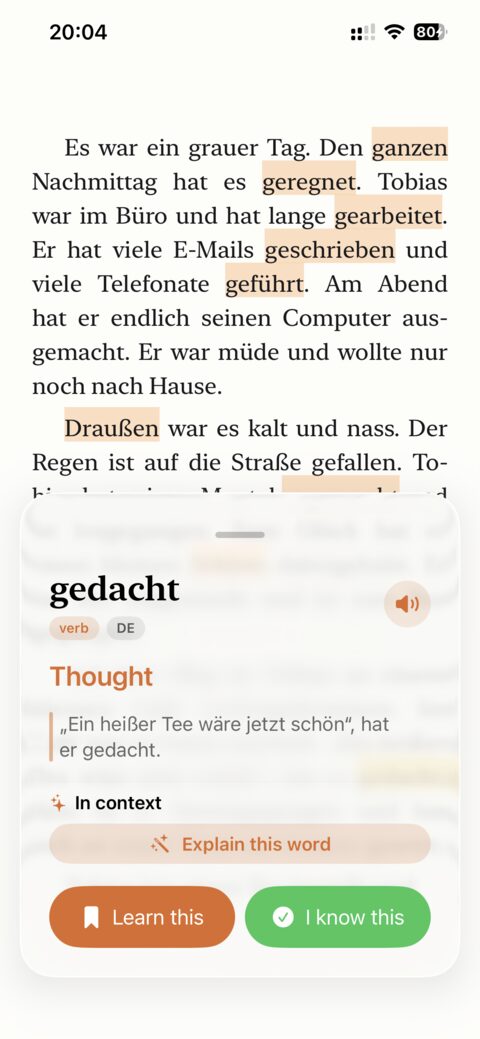
Context does the introducing; spaced repetition does the keeping. Some useful words will not appear often enough in your reading to stick on their own, and a good review system catches exactly those. The trick is to save words from your real reading, so each card carries the sentence you met it in, and then let spaced intervals surface it again right before you would forget. That combination — met in context, saved with its sentence, reviewed on a schedule — is about as good as vocabulary learning gets. It respects how memory actually works and it never divorces a word from its meaning.
This is exactly the loop oqou is built around. You read anything you like — books, news, imported PDFs — and when you hit a word you do not know, you tap it for an instant, in-context meaning, save it with one tap, and it drops into a spaced-repetition review deck automatically. Everything happens on-device and stays private, so your reading is yours. It turns ordinary reading into vocabulary building without breaking your flow or asking you to keep a separate word list.
Practical rules for vocabulary
- Read a lot, slightly below your ceiling. Material you understand around 95 to 98 percent of gives you enough new words to grow and enough context to guess them.
- Save selectively. You cannot review everything. Prioritize words that are frequent, useful to your goals, or that keep tripping you up.
- Keep the sentence. A card with the original sentence is worth several bare word-translation cards.
- Review briefly and often. A few minutes of spaced review most days beats a giant weekly session.
- Let common words teach themselves. You do not need flashcards for the words you meet constantly — reading drills those for free.
What's the best way to practice speaking?
The best way to practice speaking is to actually speak, early and often, with someone or something that gives you feedback — even before you feel ready. Build a base of input first so you have words to reach for, then get regular reps through tutors, exchanges, or self-talk. Fluency in speech comes from speaking, not from more studying.
Speaking is the skill people most want and most avoid. It is uncomfortable because it exposes the gap between what you understand and what you can produce, in real time, in front of another person. But that discomfort is the whole point — it is the friction that builds the skill. You cannot think your way to fluent speech from the safety of flashcards. At some point you have to open your mouth, make mistakes, and keep going.
Don't wait too long, but don't rush it either
There is a genuine tension here. Speaking from day one, before you have any input, means gluing together phrases you do not really understand and reinforcing bad habits. But waiting until you feel “ready” usually means waiting forever, because comprehension always outpaces production and you will never feel ready enough. The sensible middle: spend your earliest weeks building a base of comprehensible input, then start speaking well before you feel comfortable — because the discomfort never fully goes away, and the only cure is reps.
Ways to get speaking reps
- Tutors and paid conversation partners. The highest-value option for most people: someone patient, available on your schedule, who corrects you and keeps the conversation in your range. Even one session a week changes things.
- Language exchanges. Free, and you help someone with your language in return. Less structured and less corrective than a tutor, but great for volume and lowering your fear of talking.
- Self-talk and shadowing. Narrate your day in the language, describe what you see, or repeat aloud after audio to train your mouth and ear. Zero social pressure, and you can do it anywhere.
- Writing as a bridge. Writing is slow-motion output. It lets you practice retrieval and construction without real-time pressure, and it surfaces the same gaps speaking will, so you can fix them before you are on the spot.
Whatever the format, the mechanism is the same: retrieval under pressure, followed by noticing what you could not say, followed by going back to input to fill the gap. Speaking and input are not rivals for your time — they feed each other. Every conversation shows you exactly which words and structures to hunt for next, and every hour of input gives your next conversation more to reach for.
Why does consistency beat intensity?
Consistency beats intensity because language is built by repeated contact over time, and memory is reinforced by frequent, spaced exposure. Fifteen focused minutes every day gives your brain more chances to encounter, retrieve, and consolidate the language than a single long weekend session — and it is far easier to sustain for the months real progress takes.
This is the least exciting principle in the article and possibly the most important. People love to plan intense study binges: a whole Saturday, a two-week “sprint,” a summer of grinding grammar. These feel productive and occasionally are. But they collide with two facts. First, forgetting happens between sessions, and a huge gap after a binge lets most of the gains leak away before you return. Second, binges are hard to repeat, so they tend to be followed by long silences — and the silence is where progress dies.
The compounding logic
Daily contact wins for reasons that stack:
- It fits the forgetting curve. Frequent exposure means you keep meeting words and structures right around the time you would otherwise forget them, which is precisely when review does the most good.
- It builds a real habit. Something you do every day at a set time stops requiring willpower and starts running on autopilot. A weekly marathon never gets that automaticity.
- It keeps momentum warm. When you return daily, you pick up where you left off. After a two-week gap, you spend the first sessions just recovering lost ground.
- It survives real life. A fifteen-minute commitment bends around busy days; a two-hour one gets cancelled the moment life gets hard, which is often.
How to make it stick
Consistency is a design problem, not a character flaw. If you keep failing to keep a habit, the habit is usually too big or too vague. Shrink it and anchor it:
- Set a floor, not a ceiling. Commit to a minimum so small you cannot fail — one page, five minutes, ten review cards. On good days you will do more; the floor is there to protect the streak on bad days.
- Attach it to something you already do. Reading with your morning coffee, reviewing on the train, listening while you cook. A new habit glued to an old one needs far less willpower.
- Make it enjoyable. Read and watch things you would consume anyway, in the target language. If your daily dose is a chore, you will drop it; if it is a pleasure, you will protect it.
- Track lightly. A simple streak or a checkmark is enough motivation for most people, as long as you do not let one missed day become a spiral. Miss a day, resume the next. Never miss twice.
The learners who succeed are almost never the most talented or the ones with the most free time. They are the ones who found a small daily contact they enjoy and simply refused to stop. Intensity is optional and comes and goes. Consistency is the thing that turns months of small contacts into a language you actually have. If you take one idea from this whole article, take this one: pick a routine you can sustain, and then sustain it.
Try oqou free on the App Store and turn the reading you already do into a daily language habit — tap any word for its meaning in context, save it, and let spaced review keep it.
The best way to learn a language, step by step
Here is a concrete routine that puts the principles together: build a small base, feed yourself comprehensible input daily, capture and review vocabulary, add speaking practice, and keep the whole thing consistent. It is not the only path, but it reliably works, and every step maps to input, output, or consistency.
Treat the roadmap below as a default you adapt, not a law. The order matters more than the exact numbers — base first, then input, then review, then output, all wrapped in a habit you can keep. If you want a deeper look at what the finish line actually involves, our guide to how to become fluent goes further into the later stages.
- 1Build a small base — Spend your first weeks on the writing system, pronunciation, and a few hundred of the most common words, so you have enough to start understanding real input.
- 2Read and listen daily — Feed yourself comprehensible input you enjoy at the 95–98% level, and let volume build your vocabulary and grammatical intuition.
- 3Capture and review words — Save useful new words in context as you go, and reinforce them with a few minutes of spaced repetition most days.
- 4Start speaking early — Before you feel ready, get regular output reps through a tutor, an exchange, or self-talk, and let the gaps guide your next input.
- 5Keep it consistent — Protect a small daily minimum you can hit on your worst days, and let months of steady contact compound into real ability.
Making the roadmap fit you
Two learners running the same five steps will still study differently, and that is fine. Adjust along a few axes:
- Your starting language. If your target shares roots with a language you know, step one is short and you can reach real input fast. If it does not, give the base more time and be patient with early reading.
- Your goal. Reading-focused goals lean harder on steps two and three; conversation goals pull step four earlier and heavier. Weight the routine toward what you actually want to do.
- Your available time. More time means more input volume and more speaking reps, not a fundamentally different plan. Less time means a smaller daily floor — but the floor still holds.
- Your stage. Early on, input dominates. Later, output and deliberate practice on your specific weak spots earn a bigger share.
What does not change is the skeleton. Every effective language routine, however it is dressed up, is some version of “understand a lot, produce regularly, and keep showing up.” The tools you use to run it — a class, an app, a stack of books, a country — are yours to choose and to mix. Choose the ones you will actually use, and remember that the best method is always the one you keep doing.
Frequently asked questions
How long does it take to learn a language?
It depends heavily on the language, your starting point, and how many hours you put in, so any single number is misleading. A language closely related to your own can reach comfortable conversation in several months of steady daily work; a very different one takes considerably longer. The honest answer is that consistent contact over many months to a few years is what real ability requires — there is no shortcut around time on task.
What is the best age to learn a language?
Any age is a good age, and adults have real advantages despite the myth that only children can learn well. Children may end up with more native-like accents given enough immersion, but adults learn grammar and vocabulary faster because they can reason, map onto a language they already know, and study deliberately. Your age is not the obstacle; your consistency is.
Is it better to focus on one language at a time?
For most people, yes — especially at the start. Learning one language to a solid level is hard enough, and splitting your limited daily time across two usually means neither gets the volume it needs. If you are already advanced in one and genuinely motivated, adding a second can work, ideally two languages that are not easily confused. But if you are unsure, go deep on one first.
Do I need to study grammar?
A little grammar helps a lot; a lot of grammar helps less than people think. Light grammar study speeds up your understanding of patterns you are already meeting in input — it gives names and shortcuts to things you are half-noticing anyway. What it cannot do is replace the input itself. Use grammar as a support that clarifies your reading and listening, not as the main event.
Can I learn a language just by reading?
Reading alone builds an enormous vocabulary and strong comprehension, but it will not fully develop your speaking or listening on its own. It is arguably the most efficient way to grow your receptive command of a language, and it feeds everything else — but you still need listening practice for the sounds and real conversation to turn knowledge into speech. Reading is the engine; pair it with output and listening for the complete skill set.
There is no secret method waiting to be found — just a recipe that works when you follow it. Get input you understand, practice producing the language, review what matters, and keep showing up. If you want a simple way to make the input-and-review part of that a daily habit, download oqou on the App Store and start turning whatever you read into words you actually remember.