Becoming fluent isn't a trick or a talent — it's a process almost anyone can finish with the right ingredients and enough patience. Fluency grows from a large amount of language you understand, a real habit of speaking it, and the stubbornness to keep showing up long after the novelty wears off. This guide lays out what "fluent" really means, the stages you'll pass through, and an honest, doable path from your first words to comfortable, confident use.
How do you become fluent in a language?
You become fluent by feeding your brain a large amount of language you can understand, practicing real speaking often, and keeping that up consistently over months and years. There's no shortcut around the volume — but there's no secret talent required either. Comprehensible input, regular output, and stubborn consistency are the three levers that do almost all of the work.
If you strip away the marketing and the myths, fluency comes down to a small number of things done repeatedly. You expose yourself to enormous quantities of the language in a form you can actually follow — reading and listening to material that's challenging but not baffling. You force yourself to produce the language too, in conversation and writing, so the words move from "I recognize that" to "I can say that." And you do both of these often enough, for long enough, that the language stops being a subject you study and becomes a thing you simply do.
Notice what's not on that list: a special language gene, a perfect accent from day one, or a magic app that installs French while you sleep. Plenty of people who believe they're "bad at languages" have simply never given themselves enough hours of real input, or never practiced speaking, or quit during the long middle stretch where progress feels invisible. The learners who make it aren't unusually gifted. They're the ones who found material they genuinely enjoyed, so the hours were pleasant rather than punishing, and who kept going.
Throughout this article we'll lean on a few well-established ideas from language learning: comprehensible input (understanding messages slightly above your current level), extensive reading and listening (large volumes of enjoyable material), output (speaking and writing to activate what you know), and spaced repetition (reviewing words at expanding intervals so they stick). None of these is a silver bullet on its own. Together, run consistently, they're how ordinary people reach fluency.
What does "fluent" actually mean?
Fluency means using a language smoothly for a real purpose — understanding and being understood without constant hesitation. It's not perfection, and it's not sounding native. Most people who say they want to "be fluent" mean something around confident, independent everyday use: holding conversations, reading real material, and handling daily life without translating in their head.
The word gets used loosely, which causes a lot of needless discouragement. People imagine "fluent" means flawless, accent-free, and native-like — a standard so high that they feel like failures at every earlier stage. But that's not what fluency is. A fluent speaker still makes mistakes, still meets unfamiliar words, still occasionally gropes for a phrase. What defines them is flow: the language comes out at a natural pace, comprehension keeps up in real time, and communication doesn't stall.
It also helps to separate the different flavors of "fluent," because they aren't the same skill and they don't arrive together:
- Conversational fluency — you can chat about everyday topics, follow most casual speech, and keep a conversation going comfortably. This is what most learners are really aiming for, and it arrives earlier than people expect.
- Reading fluency — you can get through real books, news, and articles without a dictionary in your hand every sentence. This demands a bigger vocabulary than conversation, because writing draws on rarer words.
- Professional or academic fluency — you can work, study, or present in the language, handling formal register and specialized terms. This adds domain vocabulary on top of the general foundation.
- Native-like fluency — you pass, more or less, for a native speaker. This is rare among adult learners, takes many years, and — importantly — is not required to live a full life in another language.
A useful reference point is the CEFR, the six-level scale from A1 (beginner) to C2 (mastery). It describes what you can do rather than how many words you know. When someone says "fluent," they usually mean somewhere around B2 — independent, confident, able to function without hand-holding, even if far from perfect. That's a realistic and genuinely rewarding target, and it's much closer than the intimidating idea of "native-like" suggests. Aim for functional and comfortable, not flawless, and the whole project stops feeling impossible.
What are the stages from beginner to fluent?
The path runs roughly through five stages: absolute beginner, advanced beginner, intermediate, upper-intermediate, and advanced. Early on you build a core of common words and simple grammar; in the middle you consume huge amounts of input and start speaking; near the top you refine, expand vocabulary, and handle nuance. Each stage feels different and needs a slightly different focus.
Knowing the stages matters because each one has its own trap and its own reward. Beginners underestimate how fast the first milestones come. Intermediate learners overestimate how "stuck" they are. Advanced learners forget how far they've traveled. A map helps you recognize where you are, aim your effort correctly, and stop comparing your stage to someone else's. Here's a rough guide — treat the CEFR touchpoints and vocabulary figures as approximations, since everyone's path wobbles.
| Stage | Rough CEFR | Approx. vocabulary | What it feels like | Main focus |
|---|---|---|---|---|
| Absolute beginner | A1 | ~0–500 word families | Everything is new; you catch scattered words | Sounds, greetings, the 500 most common words |
| Advanced beginner | A2 | ~500–1,500 | Simple exchanges work; slow and effortful | High-frequency words, present tense, short texts |
| Intermediate | B1 | ~1,500–3,000 | You get by; conversations are possible but tiring | Volume of input, first real speaking practice |
| Upper-intermediate | B2 | ~3,000–6,000 | Comfortable in daily life; often called "fluent" | Wide reading and listening, regular conversation |
| Advanced | C1–C2 | ~8,000+ | Reading and working feel natural; nuance arrives | Rare vocabulary, register, precision, polish |
Two things about this table are worth dwelling on. First, the useful milestones — the ones that let you actually use the language — come surprisingly early, around B1–B2, thanks to how word frequency works. A small core of common words carries a huge share of everyday communication, so you can hold real conversations long before you're anywhere near the top of the table. If you want the numbers behind this, our guide on how many words you need breaks the vocabulary math down honestly.
Second, the stages get slower as you climb. Going from zero to A2 can feel thrilling because every week brings visible gains. The stretch from B1 to C1 is longer and flatter — the famous "intermediate plateau" — because you're now learning rarer words and finer distinctions that each add a little less. This isn't a sign you've stalled; it's the normal shape of the curve. Expecting it keeps you from quitting right when the payoff is closest.
- 1Build a beachhead (months 1–2) — Learn the sounds and the 500–1,000 most common words. Get comfortable with the present tense and a handful of everyday phrases so you can form simple sentences.
- 2Start reading and listening daily (months 2–5) — Move into graded readers, simple articles, and slow podcasts. Tap unknown words, save the keepers, and review them so your vocabulary compounds.
- 3Open your mouth (months 4–8) — Begin real speaking: self-talk, a tutor, or a language partner. Clumsy output now beats polished silence later. Aim for regular, low-stakes practice.
- 4Go to real material (months 6–18) — Graduate to native books, news, shows, and unscripted conversation. Let breadth of input replace drills as your main engine of growth.
- 5Refine and live in it (year 1+) — Chase precision, register, and rare vocabulary through wide reading and lots of talking. Use the language for things you care about, not just to study it.
How do you get enough input to become fluent?
You get enough input by making reading and listening a daily habit and slowly cranking up the volume — hundreds of hours of material you can mostly understand. Read and listen to things you genuinely enjoy, kept at a level that's challenging but followable, and the sheer quantity does the teaching. Input is the raw fuel of fluency, and most people simply don't get enough of it.
The idea underneath this is comprehensible input: you acquire a language largely by understanding messages that are a little above your current level. When you follow a story, a conversation, or an article and meet new words in a context clear enough to guess or absorb them, your brain quietly builds the language. The key word is comprehensible — input you can't follow at all is just noise, and input that's too easy stops teaching you. You want the sweet spot: mostly understood, with a manageable sprinkling of the new.
Reading is the most efficient input engine for most self-learners, and it's worth understanding why. Text moves at your pace — you can slow down, reread, and look things up without missing anything. It exposes you to a far wider vocabulary than everyday speech, including the rarer words that reading fluency depends on. And because common words appear constantly, reading sorts vocabulary by frequency automatically: you meet the useful words first, over and over, without needing a list. Our deeper guide on learning by reading covers how to pick material at the right difficulty so you stay in that comprehensible-but-challenging zone.
Listening is the essential partner to reading. It trains you to process the language in real time, at the speed people actually talk, and it teaches the music of the language — rhythm, stress, and the way words blur together in natural speech. Reading alone can leave you able to decode a page but lost in a live conversation. So pair them: podcasts, audiobooks, shows, and — a powerful combination — listening to something while you read the same text, so sound and meaning lock together.
A few principles keep your input effective:
- Choose things you actually like. Interest is what lets you rack up hours without burning out. A trashy thriller you can't put down teaches you more than a worthy classic you abandon on page ten.
- Stay near the edge of comfortable. If you understand almost nothing, drop down a level; if you understand everything effortlessly, step up. The productive zone is where you follow the gist but keep meeting new words.
- Prioritize volume over perfection. You don't need to understand every word. Getting the overall meaning while some details slip past is normal and still teaches you — extensive input is a numbers game.
- Build immersion into your day. You don't have to move abroad. Surrounding yourself with the language at home — media, labels, background listening — adds up. Our guide to immersion at home shows how.
The honest truth about input is that the totals are large — think hundreds of hours across the journey — but they accumulate painlessly when the material is enjoyable. Twenty minutes of reading and twenty minutes of listening a day, sustained, quietly becomes the ocean of input fluency requires. You don't have to find the hours all at once. You just have to keep the tap running.
How do you build the vocabulary fluency needs?
You build it by meeting words in context through lots of reading and listening, then locking them in with spaced repetition — reviewing each word at expanding intervals, just before you'd forget it. Context teaches meaning, usage, and tone all at once; spaced review turns fleeting encounters into lasting memory. Together they beat memorizing isolated word lists.
Vocabulary is the ingredient that most directly sets a ceiling on what you can understand, so it deserves a deliberate strategy. The problem is that meeting a word once almost never fixes it — you read it, nod, and forget it by the next page. The solution isn't to read more slowly or grind flashcards of bare definitions; it's to combine the strengths of context and review.
Learning words in context matters because a word is more than a definition. It has a typical company it keeps, a register, a shade of meaning that a dictionary gloss flattens. When you learn break from a sentence about breaking a promise versus breaking a leg versus taking a break, you absorb how the word actually behaves — knowledge that pure memorization strips away. This is why words met while reading tend to stick and stay usable, a point we explore in learning by reading.
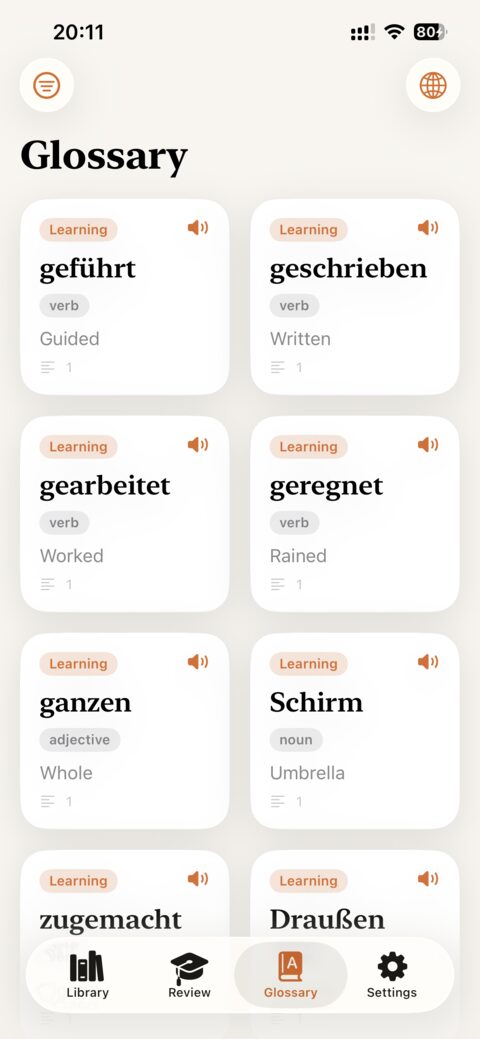
Spaced repetition is what defeats forgetting efficiently. Left alone, memory of a new word decays fast. A spaced-repetition system schedules each review at the moment you're about to forget — soon at first, then at ever-longer intervals as the word settles in. This wrings the most retention from the least review time, and it's the mechanism that converts gross exposure into net vocabulary that actually grows instead of leaking away.
The practical loop that ties it together is simple: read something you enjoy, tap or note the words you don't know — ideally keeping the sentence they lived in — and review those saved words with spaced repetition over the following days and weeks. Reading supplies the words in frequency order and in context; saving captures what's worth studying; spaced review makes it permanent. That's exactly the loop oqou is built around — you read anything, tap any word for an instant in-context meaning, save the keepers, and review them later, all on your device and private by default.
These figures are worth internalizing because they're encouraging. A conversational core of roughly 2,000 to 3,000 word families is a genuinely reachable target, and it's enough to talk about daily life. Comfortable reading asks for more — commonly cited around 8,000 to 9,000 — because comfortable reading tends to require knowing about 95% to 98% of the words on the page. Both numbers arrive faster than you'd guess, since a small set of frequent words covers a huge share of anything you'll read or hear. Focus early effort on those high-frequency words and the rest compounds.
Want to turn everything you read into vocabulary practice, with a tap to understand any word? That's what oqou is for. Download oqou on the App Store and start building fluency from the material you already love.
How do you develop speaking fluency?
You develop speaking fluency through output — actually producing the language, out loud, as often as you can. Talk with tutors or partners, narrate your day to yourself, and practice thinking in the language instead of translating. Input builds understanding, but only speaking builds the fast, automatic retrieval that fluent conversation demands. There's no way around opening your mouth.
This is where many learners get stuck, and it's usually not a knowledge problem — it's a practice problem. You can have a large passive vocabulary and still freeze in conversation, because recognizing a word when you read it and producing it on demand at speaking speed are different skills. Passive vocabulary comes from input; active vocabulary — the words you can actually reach for mid-sentence — comes from output. If you never practice producing the language, that active layer stays thin no matter how much you read.
The good news is you don't need a native speaker on standby to start. Speaking practice comes in tiers you can climb as your confidence grows:
- Self-talk and narration. Describe what you're doing, out loud, in the language: "I'm making coffee, the cup is on the table, it's raining outside." It feels silly and it works — it turns idle moments into low-pressure production practice, and it surfaces exactly which everyday words you're missing.
- Thinking in the language. Push your inner monologue into the target language for small stretches. When you catch yourself mentally translating from your native language, you're building a habit that slows you down; thinking directly, even clumsily, builds the fast pathway fluency needs.
- Writing. Journaling or texting in the language is output with a pause button — you get to produce the language while having time to reach for words, which strengthens the same retrieval muscles at lower pressure than live talk.
- Tutors and language partners. Regular conversation with a real person — a paid tutor, a language exchange, a patient friend — is the highest-value practice there is. It forces real-time retrieval, gives you feedback, and, crucially, gets you used to the discomfort of communicating imperfectly, which is where fluency actually lives.
The single biggest obstacle to speaking is the fear of making mistakes. Here's the reframe that helps: mistakes aren't evidence you're failing — they're the mechanism by which you improve. Every fluent speaker built their skill on a mountain of errors. If you wait until you're "ready" to speak, you'll wait forever, because readiness comes from speaking, not before it. Start ugly, start now, and let the fluency form through use.
One practical sequencing note: you don't have to speak from day one, and a short "silent period" of building comprehension first is perfectly fine. But don't let it stretch into months. As soon as you have a small core of words, start producing — even badly — because the gap between understanding and speaking only widens the longer you postpone it. The learners who become conversationally fluent are almost always the ones who were willing to sound like a beginner out loud.
How long does it take to become fluent?
For a committed learner studying most days, conversational fluency (around B1–B2) commonly takes somewhere from six months to a couple of years, and higher, reading-and-working fluency several years. It depends heavily on the language's distance from ones you know, your hours per week, and your consistency. Ranges are wide because individuals genuinely vary.
Any honest answer here has to come with caveats, because the internet is full of wildly optimistic timelines. The biggest single factor is how related your target language is to one you already speak. For an English speaker, languages like Spanish, French, Italian, and Portuguese share enormous amounts of vocabulary and structure, so they come faster. Languages like Japanese, Korean, Mandarin, and Arabic have far less overlap and a new writing system, so they take substantially longer for the same result. A realistic timeline for one language can be two or three times another's.
The other big factors are entirely in your hands:
- Hours per week. Fluency is roughly a function of total quality hours. Someone doing two focused hours a day will get there in a fraction of the calendar time of someone doing two hours a week — even if the second person "studies" for years.
- Consistency. Twenty minutes every day beats a three-hour cram every Sunday, because language is built through repeated, spaced exposure. Steady habits also protect against forgetting, which quietly erases the gains of stop-start study.
- Method. Time spent on comprehensible input and real speaking is worth far more per hour than time spent on, say, passively re-reading grammar tables. Efficient methods compress the timeline.
The most useful mental model is to stop thinking in calendar months and start thinking in accumulated hours of real contact with the language. Fluency arrives when the hours add up, whether that takes one year of intense daily work or three years of a gentle steady habit. This is freeing, because it means slow-but-steady genuinely works — you don't need to be fast, you need to not stop. And the encouraging part, again, is that the useful milestones come early: you'll be having real conversations and enjoying real material long before you'd call yourself fully fluent.
What stops most people from becoming fluent?
Four things stop most people: too little input, avoiding speaking, getting demoralized by the intermediate plateau, and — above all — quitting. Almost nobody fails because they're incapable. They fail because they don't get enough hours, never practice output, misread normal slow progress as failure, or let a busy month become a permanent stop.
It's worth naming these clearly, because once you can see the trap you can step around it. Each of the four has a specific fix.
Too little input. The most common reason people stall is simply not enough contact with the language. They do a lesson here and there, drill some flashcards, and wonder why fluency never comes — but they've never immersed themselves in the volume of reading and listening that acquisition requires. The fix is to make input a daily, enjoyable habit and to raise the volume over time. If the material is fun, the hours stop feeling like work, and the input problem solves itself.
Avoiding speaking. Many learners build solid comprehension and then hide from conversation, waiting to feel "ready." That readiness never arrives on its own, and their speaking stays frozen while their understanding races ahead. The fix is to start producing early and often, at whatever tier you can manage — self-talk, writing, a weekly tutor — and to accept that sounding like a beginner is the toll you pay on the road to sounding fluent.
The intermediate plateau. Somewhere around B1–B2, progress flattens. You're no longer thrilled by daily gains, the new words are rarer and harder to retain, and it feels like you've stopped improving. Many people quit right here — tragically, because they're closer than they think. The fix is to expect the plateau, trust that steady input and output are still working beneath the surface, and change up your material to stay engaged. The plateau is a stage to pass through, not a wall.
Quitting. This is the real killer, and the other three all feed into it. Language learning is a long game, and life interrupts — a busy season at work, a rough month, a lost streak. The learners who succeed aren't the ones who never miss; they're the ones who treat gaps as normal and come back. A missed week isn't failure. Abandoning the language for good is the only true failure, and it's entirely avoidable. Build a habit small enough to survive your worst weeks, and you'll still be going when the fast learners who burned out have long since stopped.
The thread connecting all four is sustainability. The winning strategy isn't maximum intensity; it's a pace you can actually keep for years, built around material you enjoy so the motivation renews itself. Protect the habit loosely, forgive the gaps, and let consistency compound. That's what separates the people who become fluent from the equally capable people who don't.
What does a realistic path to fluency look like?
A realistic path is a simple loop repeated for a long time: read and listen to enjoyable material daily, save the words you don't know and review them with spaced repetition, and speak regularly from early on. Start small, raise the difficulty as you grow, forgive missed days, and let the hours accumulate. Consistency and enjoyment beat intensity and willpower.
Let's make it concrete, because a plan you can picture is a plan you can follow. Here's what a sustainable week looks like for a self-learner aiming at fluency:
- Read every day, even just ten to fifteen minutes, in material slightly above your comfort level but still enjoyable. Tap and save unknown words as you go instead of breaking your flow to look things up laboriously — capture and keep moving.
- Listen most days, to podcasts, audiobooks, or shows. Listening while reading the same text is an especially powerful combination for locking sound to meaning.
- Review your saved words in a short spaced-repetition session most days. Short and frequent beats long and rare — five minutes daily outperforms an hour on Sunday.
- Speak or produce regularly, whether that's self-talk during chores, a journal entry, or a weekly session with a tutor or partner. Start this earlier than feels comfortable.
- Raise the difficulty gradually as your coverage climbs, so you keep meeting new, useful words instead of plateauing on the ones you already know.
What makes this loop work is that each part covers another's weakness. Reading exposes you to words but lets many slip away; spaced review catches them. Input builds understanding but not speech; output activates it. And enjoyment keeps the whole thing running long enough to matter. You're not relying on heroic motivation — you're relying on a system that turns a pleasant daily habit into steady, compounding progress.
Expect the shape of the journey: fast, exciting early gains; a longer, flatter middle where you have to trust the process; and then a gradual emergence into comfortable, natural use. Expect to miss days and to have weeks where nothing seems to move. None of that means it's not working. As long as you keep returning to the loop, the language keeps building — and one day you'll notice you understood a whole conversation, or finished a book, without thinking about it as a lesson at all.
That's the quiet promise of learning by reading: fluency accumulates as a by-product of doing something you enjoy, rather than as a grind you have to force. Get oqou on the App Store and start turning the books, articles, and news you already want to read into a private, on-device path to fluency.
Frequently asked questions
Can adults really become fluent, or is it too late?
Adults absolutely can become fluent. The idea that there's a hard cutoff after childhood is overstated — the main childhood advantage is accent and the sheer number of immersion hours kids get, not some vanished ability. Adults actually learn faster in some ways, using existing literacy and study skills. What you need isn't youth; it's enough input, real speaking practice, and the persistence to keep going.
How many hours a day should I study to become fluent?
There's no single right number, and consistency matters more than any daily total. Even 30–60 minutes a day, sustained for years, will carry you to fluency if it's mostly real input and speaking rather than passive review. More hours compress the timeline, but a modest daily habit you can actually keep beats an ambitious plan you abandon. Pick a pace you can sustain through busy weeks.
Do I need to live abroad to become fluent?
No. Living abroad helps by forcing immersion and speaking, but plenty of people reach fluency without ever moving, and plenty of people live abroad for years without becoming fluent because they never engage. You can build rich immersion at home through reading, listening, media, and online conversation. What matters is the volume of real contact with the language, not your postal code.
What's more important for fluency, input or speaking?
You need both, and they do different jobs. Input — reading and listening — builds comprehension and the vocabulary that sets your ceiling; without a large amount of it, you'll have nothing to say. Speaking activates that knowledge into fast, automatic production; without it, you'll understand but freeze in conversation. Lead with input, add output early, and keep both running. Neglecting either one stalls fluency.
How do I know when I'm actually fluent?
Fluency isn't a certificate that arrives on a specific day — it creeps up on you. Good signs: you follow conversations without straining, you reach for words without translating in your head, you finish a book or episode and realize you weren't "studying," and speaking feels like communicating rather than performing. If you can live parts of your life in the language comfortably, you're fluent, imperfections and all.
Becoming fluent isn't reserved for the gifted or the young — it's the reliable result of understanding a lot of language, speaking it often, and refusing to quit. Pick material you love, build a small daily loop you can keep, and let the hours quietly add up. If you'd like a private, on-device way to read anything, tap any word for an instant meaning, and review with spaced repetition, give oqou a try.