Mandarin Chinese has a reputation for being one of the hardest languages an English speaker can pick up, and that reputation is only half deserved. The grammar is surprisingly gentle. The tones and the characters are the real work. This guide walks you through where to start, how the tones and hanzi actually function, and how reading — tapping any word for an instant meaning — turns the mountain into a staircase you can climb.
Is Mandarin Chinese hard to learn?
Mandarin is genuinely hard for English speakers, but not in the ways you might expect. There are no verb conjugations, no genders, no plurals, and no tenses to memorize. The difficulty lives in two places: the tones, which change meaning through pitch, and the writing system, which uses thousands of characters instead of an alphabet.
Let's start with the good news, because it's more encouraging than most people realize. Chinese grammar is refreshingly economical. A verb never changes its form. "I go, you go, he goes, we went, they will go" all use the same word: 去 qù. Time is expressed with a word like "yesterday" or "tomorrow," not by reshaping the verb. Nouns don't have gender, they don't take plural endings, and there are no articles like "a" or "the" to fuss over. Sentence order is mostly subject-verb-object, just like English: 我 爱 你 wǒ ài nǐ literally maps to "I love you," word for word. If you've ever wrestled with French verb tables or German cases, Mandarin grammar will feel almost suspiciously light.
So where does the difficulty come from? Two features that have no equivalent in English. The first is tone. Mandarin is a tonal language, which means the pitch contour of a syllable is part of the word itself, not just emotional coloring. The classic example is the syllable "ma," which can mean mother, hemp, horse, or scold depending on the tone you use. Get the tone wrong and you haven't said the word with an accent — you've said a different word. For a brain trained on a non-tonal language, this takes real practice to hear and produce reliably.
The second is the writing system. Chinese doesn't spell words out with letters that map to sounds. Instead it uses characters (hanzi, 汉字), where each character represents a syllable and usually a unit of meaning. You can't sound out a character you've never seen the way you can guess at an unfamiliar English word. There are thousands of them, and literacy means recognizing enough to cover the text in front of you. This is the part that scares people off, and it's also the part where the right tools change everything.
The U.S. Foreign Service Institute, which trains American diplomats, classifies Mandarin as a Category IV or "super-hard" language — its most demanding tier — and estimates roughly 2,200 hours of study to reach professional working proficiency. That's about four times the estimate for Spanish or French. It sounds daunting, but keep it in perspective: those hours are spread across years, and the FSI number targets a high bar aimed at diplomatic work. Getting to a point where you can read simple stories, hold a basic conversation, and enjoy the language happens far sooner. The characters, in particular, front-load their difficulty — the first few hundred are slow, and then patterns start to click.
How long does it take to learn Chinese?
There's no single answer, but the FSI estimate of around 2,200 hours to professional proficiency is the most-cited benchmark for English speakers. At an hour a day, that's several years. But you'll hit meaningful, motivating milestones much sooner — a few hundred hours gets you reading graded stories, ordering food, and following simple conversations.
The chart below shows how Mandarin compares to other languages on the FSI scale. Notice that Mandarin sits in the top row alongside Japanese, Korean, and Arabic — the languages that take English speakers the longest, mostly because of tones and non-alphabetic writing.
Approx. hours to professional proficiency (FSI estimates, for native English speakers)
Here's the important nuance those numbers hide: the 2,200 hours is not a wall you hit before anything works. It's a long ramp with plenty of usable footing along the way. In the first 50 to 100 hours you can learn pinyin, get the four tones under control, and start recognizing your first few hundred characters. By a few hundred hours you can read graded readers, understand simple podcasts, and hold slow conversations about everyday topics. The higher reaches — reading a newspaper cover to cover, following fast native speech, writing essays — are what push the total up.
Two factors move your personal timeline more than anything else. The first is consistency: 30 focused minutes every day beats a four-hour cram session on Sunday, because language memory is built through repeated, spaced exposure rather than intensity. The second is how much comprehensible input you get — that is, how much Chinese you read and listen to that's just slightly above your current level. Learners who spend most of their time reading and listening to material they can mostly follow tend to progress faster than those who only drill flashcards or grammar rules in isolation. If you want a deeper look at the timeline question across languages, we go into it in how long it takes.
A realistic, encouraging way to frame it: think in seasons, not sprints. Give Mandarin a year of steady daily contact and you'll be genuinely reading — not fluently, but really reading, with a dictionary tap here and there. Give it two or three and the characters that once looked like random ink start to feel like old friends.
Where should you start with Chinese?
Start with pinyin and the four tones, before you touch a single character. Pinyin is the romanization system that spells out Mandarin sounds using the Latin alphabet, with tone marks on top. It's your bridge into pronunciation. Spend your first week or two getting comfortable with pinyin and hearing the tones, and everything after that gets easier.
It's tempting to dive straight into characters because they're the exotic, impressive part of Chinese. Resist that urge for a little while. If you learn characters before you can pronounce them correctly, you'll cement bad tones that are painful to fix later. Pinyin gives you a reliable way to know how every syllable sounds, so you build the audio foundation first and hang the characters on it afterward.
Pinyin looks familiar but has a few traps. Several letters don't sound the way an English speaker expects. The "q" in qù sounds like the "ch" in "cheese." The "x" in xièxie (thank you) is a soft "sh." The "c" in cài (vegetable/dish) is a "ts" sound as in "cats." The "zh," "ch," "sh," and "r" are retroflex sounds made with the tongue curled back. Spend a session or two with an audio source — a good app, a teacher, or native recordings — matching each pinyin spelling to its actual sound. This small investment pays off for the entire rest of your journey.
Your very first phrases are a good place to anchor pinyin and tones together. Learn nǐ hǎo 你好 (hello), xièxie 谢谢 (thank you), and zàijiàn 再见 (goodbye), and say them out loud with deliberate attention to the tone marks. Notice that nǐ hǎo is written with two third tones but is actually pronounced with the first syllable rising — a real tone-change rule you'll meet again. Starting with a handful of real, useful phrases keeps the abstract work of pinyin grounded in things you'll actually say.
One more early decision: pick simplified or traditional characters, and don't agonize over it. If your goal is mainland China or Singapore, or you just want the most widely used set, choose simplified. If you're drawn to Taiwan, Hong Kong, or classical texts, choose traditional. We'll come back to the difference, but for now know that most learners choose simplified, and you can always read the other set later once you know one.
How do the tones work, and how do you master them?
Mandarin has four main tones plus a neutral tone, and each one changes a syllable's pitch in a specific way. Tone one is high and flat, tone two rises, tone three dips down then up, tone four falls sharply, and the neutral tone is short and light. Because tone is part of the word, mastering it early is essential — not optional polish.
The single most famous illustration is the "ma" set, which every learner meets sooner or later. It shows how one syllable becomes four completely different words purely through pitch:
| Tone | Name | Pinyin mark | Pitch movement | Example | Meaning |
|---|---|---|---|---|---|
| 1st | High level | mā | High and flat, like holding a note | 妈 | mother |
| 2nd | Rising | má | Rises, like asking "huh?" | 麻 | hemp |
| 3rd | Dipping | mǎ | Dips low, then rises | 马 | horse |
| 4th | Falling | mà | Falls sharply, like a firm command | 骂 | to scold |
| Neutral | Light | ma | Short, soft, unstressed | 吗 | question particle |
A helpful mental trick: map the tones onto English intonation you already use. First tone is the steady tone you hold when a doctor asks you to say "aaah." Second tone is the rising pitch of a surprised "what?" Third tone is the drawn-out, dipping "well…" when you're hesitating. Fourth tone is the sharp, falling "No!" you'd use to stop a dog. You already produce all these pitches — you just need to attach them to syllables on purpose rather than by emotion.
Third tone deserves a special warning, because in real speech it's rarely the full dip-and-rise you learn in isolation. When a third tone is followed by another syllable, it usually flattens into a low tone. And when two third tones come back to back — as in nǐ hǎo 你好 — the first one changes to a second tone, so it's actually pronounced "ní hǎo." This is called tone sandhi, and you don't need to memorize the rules as rules; you'll absorb them by hearing and imitating enough real speech.
How do you actually master tones? Three habits do most of the work. First, always learn a new word together with its tone, never the bare syllable — treat the tone as an unremovable part of the spelling. Second, practice in pairs and phrases rather than single syllables, because tones behave differently in connected speech than in isolation. Third, record yourself and compare to a native model. Your ears will improve faster than your mouth at first, and hearing the gap is what closes it. Tones feel impossible in week one, hard in month one, and mostly automatic by month six — as long as you keep listening.
How do you learn Chinese characters?
You learn characters by understanding their internal logic rather than memorizing them as random pictures. Most characters are built from smaller reusable parts called radicals and components, and many contain a hint about meaning plus a hint about sound. Once you know a few hundred common building blocks, new characters stop looking like chaos and start looking like combinations.
A character is not a single indivisible squiggle. Take 妈 mā (mother): it's made of 女 (woman) on the left, which tells you the meaning is related to women or family, and 马 mǎ (horse) on the right, which hints at the sound. This meaning-plus-sound structure, called a phono-semantic compound, describes the large majority of Chinese characters. Once you notice it, characters become far less intimidating. You'll start seeing the water radical 氵in words about liquids (河 hé river, 海 hǎi sea), the heart radical 心 or 忄in words about emotion (想 xiǎng to think, 忙 máng busy), and the mouth radical 口 in words about speech and eating.
Radicals are the roughly 200 recurring components that dictionaries use to organize characters, and learning the most common few dozen is one of the highest-leverage things you can do. It turns memorization into pattern recognition. Instead of storing 3,000 unrelated images, you store a smaller set of parts and the ways they combine. This is why learners who study radicals early tend to pick up new characters much faster than those who brute-force each one.
Now, simplified versus traditional. In the 1950s and 60s, mainland China introduced simplified characters to boost literacy by reducing the number of strokes in many common characters. Taiwan, Hong Kong, and Macau kept the traditional forms. Compare 学 (simplified) with 學 (traditional) for "learn," 爱 with 愛 for "love," 门 with 門 for "door," or 马 with 馬 for "horse." Many characters are identical in both systems, and the two share the same grammar and pronunciation — only the shapes of certain characters differ. Pick one to actively learn; you'll be able to read the other with much less effort once your first system is solid.
The question every learner asks is: how many characters do I actually need? The honest answer is "it depends on your goal," and the table below gives realistic targets. The often-cited figure of roughly 2,000 to 3,000 characters to read a newspaper is a good north star for general literacy.
| Your goal | Characters (approx.) | What it unlocks |
|---|---|---|
| Survival & basics | ~300–500 | Menus, signs, greetings, simple texts and chat |
| Everyday reading | ~1,000 | Most common words, graded stories, social media |
| Read a newspaper | ~2,000–3,000 | News, general articles, most non-technical prose |
| Comfortable / near-native | ~3,500+ | Novels, essays, specialized and literary texts |
Notice how much the first thousand characters buy you. Because a small set of characters appears constantly, knowing around 1,000 already covers a large share of everyday text. This connects to the 95–98% coverage guideline: research on reading suggests you need to know about 95 to 98 percent of the words on a page to follow it comfortably and guess the rest from context. In Chinese, that coverage comes faster than the raw character counts suggest, because the most frequent characters do so much of the heavy lifting. Your job is to learn the common ones deeply, in the order you actually meet them — which is exactly what reading gives you.
What's the fastest way to learn Chinese?
The fastest way is to combine three things: lots of comprehensible input (reading and listening to material just above your level), regular speaking practice, and spaced-repetition review of the words and characters you meet. No single method wins alone. Input builds recognition and intuition, speaking builds production and tones, and spaced review makes it all stick.
Comprehensible input is the engine. The idea, popularized by linguist Stephen Krashen, is simple: you acquire a language most efficiently when you understand messages that are slightly beyond your current level — challenging enough to stretch you, easy enough to follow. For Chinese, this is where reading becomes your secret weapon. Every time you read a character in a real sentence, you're strengthening the link between its shape, its sound, its tone, and its meaning all at once. That four-way connection is exactly what makes characters stick, and it's much stronger than staring at a flashcard in isolation.
Here's why reading is especially powerful for Chinese specifically. In an alphabetic language, you can sound out new words and look them up easily. In Chinese, an unknown character is a dead end unless you can recognize it or type it — and typing a character you can't pronounce is nearly impossible with most input methods. This is the classic frustration that stalls Chinese learners: you hit a character you don't know, and the friction of looking it up is so high that you either give up or stop reading. Remove that friction and reading becomes the fastest path there is. Tap the character, get its meaning and pronunciation instantly, keep reading. That's the whole game.
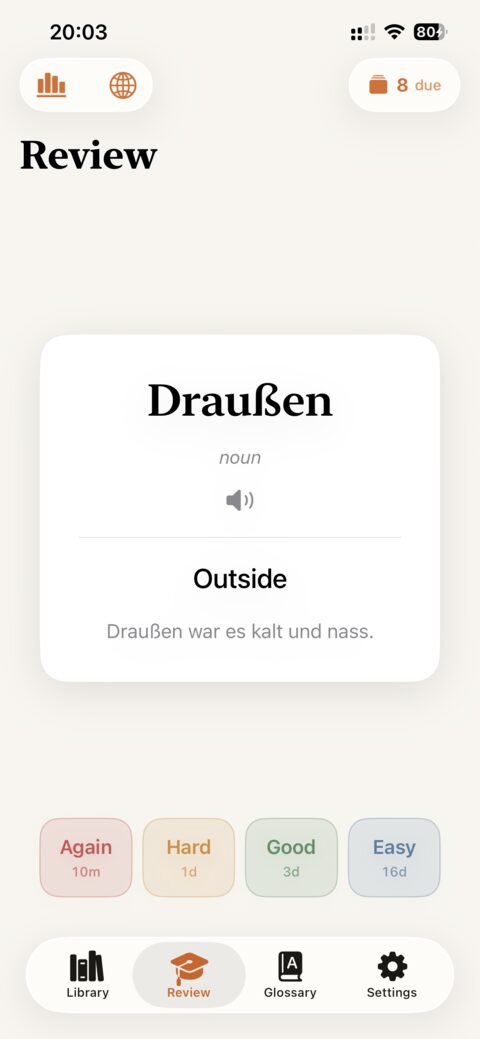
This is exactly what oqou is built for. You bring any Chinese text — a news article, a short story, a PDF, a page from a graded reader — and tap any character or word to get an instant, in-context meaning. No copying into a dictionary, no losing your place. You save the words you want to remember, and the app brings them back for review with spaced repetition, so the characters you meet while reading become the characters you actually know. It's on-device and private by default, and the optional Pro tier adds cloud AI explanations that can break down a tricky sentence or an idiom, plus premium voices for hearing tones pronounced naturally.
Don't skip speaking, though. Reading builds a huge recognition vocabulary, but tones and fluency need your own voice. Even ten minutes a day of reading aloud, shadowing native audio, or talking with a tutor or language partner keeps your production in step with your comprehension. The learners who progress fastest treat input and output as partners: they read widely to gather words and patterns, then use speaking to activate them. Combine that with honest daily consistency and you'll move faster than most people think possible for a "super-hard" language.
Download oqou on the App Store and turn any Chinese text into a lesson you can tap through.
How do you build Chinese vocabulary that sticks?
You build lasting vocabulary by learning words in context and reviewing them with spaced repetition, not by memorizing isolated lists. Context gives each word a home — a sentence, a story, a situation — so your brain has something to hook it to. Spaced repetition then schedules reviews right before you'd forget, which is how short-term recognition becomes long-term memory.
Context matters even more in Chinese than in most languages, for a few reasons. First, many characters carry multiple meanings and combine into two-character words whose sense isn't always obvious from the parts. 东西 (dōngxi) is literally "east-west" but means "thing." 马上 (mǎshàng) is literally "on a horse" but means "immediately." If you learn these as detached vocabulary items, they're brittle; if you meet them inside sentences, they make sense and stay. Second, Chinese words are often distinguished by tone and context rather than by unique spellings, so seeing them used correctly trains your ear and your intuition together.
One feature of Chinese that trips up beginners is measure words (classifiers). In English you can say "three dogs," but in Chinese you generally need a measure word between the number and the noun, chosen to fit the kind of thing you're counting. You say 一本书 yì běn shū (one "volume" book), 一个人 yí gè rén (one person, using the all-purpose 个 gè), 三只猫 sān zhī māo (three cats), and 两杯茶 liǎng bēi chá (two cups of tea). The measure word 个 gè is the safe default when you're unsure, and you'll gradually learn which nouns take which classifiers — again, best absorbed by seeing them in real sentences rather than memorized in a grid.
The practical workflow that builds sticky vocabulary looks like this. As you read, you tap and save the words worth keeping — not every word, just the useful, high-frequency ones and the ones you keep bumping into. Because you met them in context, each saved word comes with a sentence attached. Then spaced repetition takes over: the app shows you a word right around the moment you're likely to forget it, you recall it, and the interval before the next review stretches longer each time you succeed. Over weeks, a word moves from "I've seen this" to "I know this cold." This is the same principle behind flashcard systems, but done automatically and fed by your own reading, so you're only reviewing words you've actually encountered and chosen. For a broader look at vocabulary targets, see how many words you need.
A quick note on quality over quantity: it's better to know 800 words deeply — able to recognize them instantly and use them — than to have "studied" 3,000 you can't recall. Let your reading set the priorities. The words that appear most often in what you read are, almost by definition, the words most worth learning first.
How do you start reading in Chinese?
Start with material at your level and remove the friction of lookups. Begin with graded readers or pinyin-annotated texts written for learners, then graduate to real content — news, stories, articles — using tap-to-translate so an unknown character never stops you. Reading is the single richest source of characters, vocabulary, and grammar, and it's available to you far earlier than most people assume.
Graded readers are books written with a controlled vocabulary, so a beginner reader might use only the most common few hundred characters and stick to simple sentence patterns. They're the ideal on-ramp because they keep you inside the "comprehensible input" sweet spot: you understand most of it, and you stretch a little with each page. Series designed around HSK levels or common-character counts let you climb gradually. Pinyin-annotated texts — where the pronunciation sits above or beside each character — are another gentle entry point, though the goal is to wean off the pinyin so you're reading characters directly.
The catch with traditional reading, and the reason so many learners stall, is lookup friction. In Chinese it's brutal. When you hit a character you don't recognize, you can't type it (you don't know its pronunciation), and looking it up by radical and stroke count is slow. Do that fifteen times a page and reading stops being reading — it becomes a grim decoding exercise, and you quit. This is the exact bottleneck that keeps intermediate learners stuck for years.
Tap-to-translate dissolves that bottleneck, and for Chinese it's genuinely a game-changer rather than a nice-to-have. When any unknown character is one tap away from its meaning, pronunciation, and tone, you can read material slightly above your level without breaking your flow. You stay in the story, you keep the momentum, and — crucially — you get far more repetitions of common characters per hour than you would while fighting a paper dictionary. That density of exposure is what drives the characters into long-term memory. This is why we think reading, done with the right tools, is the most efficient path through Chinese, and it's the philosophy behind our whole approach to learning by reading.
A simple progression works well. Weeks one to a few: graded readers and short dialogues, tapping freely. A couple of months in: simple news written for learners, folk tales, and children's stories, tapping less as your recognition grows. Later: real articles on topics you already care about — sports, tech, cooking, whatever pulls you in — because interest carries you through the hard parts. Read what you'd want to read anyway, just in Chinese, and the practice stops feeling like practice.
What does a realistic Chinese learning plan look like?
A realistic plan front-loads pronunciation, builds characters through reading rather than rote lists, and keeps a daily habit small enough to actually sustain. Think in phases: sounds first, then core characters and reading, then widening input and real conversation. The roadmap below is a sane sequence, and the key is consistency over intensity.
- 1Nail the sounds (weeks 1–3) — Learn pinyin thoroughly and drill the four tones plus neutral until you can hear and produce them. Learn 30–50 survival phrases out loud. Don't rush into characters yet.
- 2First 300 characters & radicals (months 1–3) — Learn the most common radicals and your first few hundred high-frequency characters, always with their tone. Start reading beginner graded readers, tapping every unknown character.
- 3Read daily, review daily (months 3–9) — Push toward ~1,000 characters through steady reading. Save new words in context and let spaced repetition recycle them. Add short listening: podcasts and dialogues for learners.
- 4Start speaking for real (months 6–12) — Begin regular conversation with a tutor or partner. Shadow native audio to lock in tones. Read simple real news and stories on topics you enjoy.
- 5Widen and deepen (year 2+) — Grow toward 2,000–3,000 characters through native articles, novels, and video. Read broadly, speak often, and let interest — not obligation — drive what you consume.
The most important line in that whole plan is the smallest one: do something every day. Language memory is consolidated through repeated, spaced contact, so a modest daily dose beats heroic weekend marathons every time. Thirty minutes a day — say, fifteen minutes reading and tapping, ten minutes reviewing saved words, five minutes speaking or shadowing — adds up to more than 180 hours a year, and it's genuinely sustainable in a busy life. If you can only manage fifteen minutes some days, take the fifteen. Streaks of imperfect days beat perfect plans you abandon.
Notice how reading threads through every phase after the first. That's deliberate. Reading is where you meet characters in their natural habitat, gather vocabulary in context, and internalize grammar patterns without studying grammar as such. Layer speaking on top so your tones and fluency keep pace, and use spaced repetition as the connective tissue that keeps everything from leaking away. This three-part loop — read, speak, review — is the whole strategy, repeated at gradually higher levels.
Finally, set milestone goals that are concrete and motivating rather than vague. "Read my first full graded reader," "understand a whole short news article without tapping more than five times," "hold a five-minute conversation about my weekend," "read a children's story to the end." Hitting real reading and speaking milestones is far more encouraging than watching an hour counter tick, and it keeps you honest about whether you're actually using the language or just studying it.
Frequently asked questions
Do I have to learn to write characters by hand? Not necessarily. In daily life, most Chinese is typed using pinyin input, where you type the sound and select the character — which only requires recognition, not handwriting. If your goals are reading, texting, and conversation, prioritize recognizing characters. Handwriting is a rewarding skill and helps some people remember shapes, but it's optional for modern literacy, and you can add it later if you want it.
Should I learn simplified or traditional characters? Choose based on your goal and pick just one to study actively. Simplified is used in mainland China and Singapore and is the more common choice for learners. Traditional is used in Taiwan, Hong Kong, and Macau, and in classical texts. The grammar and pronunciation are identical; only certain character shapes differ. Once you know one system well, reading the other takes far less effort than starting from scratch.
Can I learn Chinese without learning tones? No, and it's better to accept that early. Tones are part of the words themselves — mā, má, mǎ, and mà are four different words, not one word said four ways. Skipping tones leads to being misunderstood constantly. The good news is you don't master them through drills alone; consistent listening, imitation, and speaking make tones increasingly automatic, and most learners find them far less scary after a few months.
How many characters do I need to read comfortably? For general reading like news and articles, aim for roughly 2,000 to 3,000 characters, the commonly cited range for newspaper literacy. But you'll be reading graded material and simple stories long before that — around 1,000 characters already covers a large share of everyday text, because the most frequent characters appear constantly. Learn the common ones deeply through reading and your coverage grows faster than the raw numbers suggest.
Is it worth using an app to learn Chinese by reading? For Chinese specifically, a reading app that offers instant tap-to-translate removes the single biggest bottleneck: lookup friction. Because you can't easily type or sound out an unknown character, being able to tap it for meaning, pronunciation, and tone keeps you reading real material without stalling. Pairing that with spaced-repetition review of saved words turns everything you read into vocabulary you retain, which is exactly what oqou is designed to do.
Mandarin rewards patience and daily contact more than raw talent. Get the sounds right, learn characters where they live — inside sentences you actually want to read — and let a steady habit compound. If you'd like a reading companion that makes every character one tap away and turns your saved words into lasting memory, try oqou on the App Store and start reading Chinese today.