Here's the honest ballpark: an easier language for English speakers (Spanish, French) can reach a solid working level in roughly 6 months to 2 years of steady daily effort, while a harder one (Japanese, Arabic) often takes 3 to 5 years or more. A basic conversational level comes far sooner — sometimes a few months. The truth is that "how long" depends almost entirely on your language, your hours, and your consistency. Let's turn those vague promises into realistic numbers you can plan around.
How long does it take to learn a language?
For an easier language, a committed learner giving it an hour a day often reaches a comfortable working level in roughly 1 to 2 years; harder languages commonly take 3 to 5 years or more. A basic conversational level can arrive in a few months. The single biggest variables are which language you pick and how consistently you show up.
That range is wide on purpose, because a single number would be a lie. The same "18 months" that gets one person reading novels leaves another still fumbling through introductions — the difference is hours logged, method, and the gap between their native language and the target. What we can do is anchor the estimate to something concrete rather than wishful thinking.
The most useful anchor is time on task: the total hours you actually spend engaged with the language. The U.S. Foreign Service Institute (FSI), which trains American diplomats, has published rough hour estimates for reaching professional working proficiency in dozens of languages. Those figures — commonly cited as somewhere around 600 hours for the easiest languages and roughly 2,200 for the hardest — are the closest thing the field has to a shared yardstick. They describe intensive classroom learning by motivated adults, so treat them as guidelines for a serious pace, not a ceiling or a promise.
It's also worth naming, up front, why individual results vary so wildly around any average. Two people can log identical hours and finish in very different places, because so many factors quietly tilt the curve. Some of the biggest ones:
- Languages you already know. Every prior language you've learned makes the next one easier, and any language related to your target hands you free vocabulary and structure. A Spanish speaker learning Italian is playing on a different difficulty setting than a monolingual English speaker.
- Quality of your hours. An hour of engaged reading, speaking, and reviewing is worth several hours of passive background noise. Time on task only counts when you're actually processing the language.
- Motivation and environment. A concrete reason to learn — a partner, a job, a move abroad — keeps you showing up, and showing up is most of the battle. Access to native speakers and real material speeds things up further.
The rest of this article does two things with that yardstick. First, it clarifies what "learn a language" even means, because "conversational" and "fluent" and "professional" sit at very different distances. Second, it converts those hour estimates into real calendar time at different daily paces, so you can see what your own schedule actually buys you. Throughout, remember the recurring theme: consistency moves the timeline more than raw intensity ever does.
What does "learn a language" actually mean?
"Learning a language" isn't one finish line — it's a spectrum of goals. Ordering food and small talk is one level; holding a flowing conversation is another; working or studying entirely in the language is another still. Each takes dramatically more time than the last, so the honest answer to "how long" starts with deciding which version of "learned" you mean.
Because people use the word so loosely, it helps to borrow a common framework: the Common European Framework of Reference (CEFR). It describes ability in six levels, from A1 (absolute beginner) up to C2 (mastery). You don't need to memorize the details, but the rough shape is genuinely useful for setting expectations, because each jump is bigger than the one before.
- A1–A2 (Beginner / Elementary): You can handle predictable, everyday exchanges — greetings, prices, directions, simple needs. This is "survival" and early "travel" territory, and it arrives encouragingly fast.
- B1–B2 (Intermediate / Upper-intermediate): You can hold real conversations, follow most everyday speech, and get through unadapted texts with effort. B2 is what most people picture when they say "conversationally fluent" — independent, functional, imperfect but effective.
- C1–C2 (Advanced / Mastery): You operate comfortably in professional or academic settings, catch nuance and humor, and read widely with ease. This is where "fluent" in the fullest sense lives, and it's a multi-year climb.
The reason this matters for timelines is that the levels aren't evenly spaced. Getting from nothing to A2 is quick; getting from B2 to C1 can take as long as everything before it combined. So when someone says they "learned Spanish in six months," the meaningful question is: to what level? Six months to a chatty A2 is entirely believable. Six months to a polished C1 is not.
Conversational vs. fluent vs. professional
Three loose targets cover most people's actual goals, and separating them dissolves a lot of confusion:
- Conversational (roughly B1–B2): You can chat about daily life, travel, and familiar topics without freezing up. You'll still hit walls, but you can talk your way around them. This is the most popular goal, and the most reachable.
- Fluent (roughly B2–C1): Speech flows without constant translation in your head; you read for pleasure and follow films with only occasional gaps. This is a serious commitment but a realistic one.
- Professional (roughly C1–C2): You work, negotiate, or study entirely in the language, handling specialized vocabulary and formal register. This is the level FSI's hour estimates actually target — and it's why those numbers look large.
Keep that last point in mind as we go: the FSI hours describe professional working proficiency, not "can order a coffee." When you see "~600 hours for Spanish," that's the number for functioning at work, not for your first real conversation, which comes far sooner. If you want to go deeper on what fluency really involves, our guide on how to become fluent unpacks it in detail. And since vocabulary size sits underneath all of this, it's worth knowing roughly how many words you need for each target too.
How long does it take to reach a conversational level?
For an easier language, a basic conversational level (around A2–B1) is often reachable in roughly 3 to 6 months of daily practice, with a comfortable B2 taking closer to a year or more. Harder languages stretch this out considerably. Conversation arrives earlier than most learners expect, because everyday speech recycles a small core of common words.
This is the most encouraging milestone in the whole journey, so it's worth understanding why it comes so quickly. Ordinary conversation is astonishingly repetitive. A relatively small set of high-frequency words — the equivalents of go, want, have, thing, good, know, because, time — makes up the overwhelming majority of what people actually say. Learn that core, plus the specific vocabulary of your own daily life, and you can start having real exchanges long before you feel "done."
Several features of speech make the conversational target more forgiving than it looks on paper:
- Conversation is interactive. If a word escapes you, you can point, describe it another way, or simply ask. That safety net lets you function with a much smaller vocabulary than reading requires.
- Context carries you. Ordering food, buying a ticket, or chatting about your weekend are predictable situations with predictable words. Learn the language for the situations you're actually in and you punch above your weight.
- Chunks do heavy lifting. Phrases like "do you mind if" or "I was going to" are learned as whole units and make you sound fluent while drawing on a small, reused stock of vocabulary.
The honest catch is the difference between recognizing a word and producing it on demand. Conversation needs the active kind — words you can retrieve mid-sentence at speaking speed — which is harder to build than passive recognition. That's why input alone isn't quite enough for speaking: you also need to practice actually speaking, even badly, so retrieval gets faster. A smaller vocabulary you own completely will serve a live conversation better than a larger one you can only half recall.
So a realistic conversational timeline for an easier language, at about an hour a day, might look like: simple exchanges within a couple of months, genuinely comfortable small talk around the six-month mark, and a functional B2 somewhere past the one-year point. For a harder language, roughly double or triple those spans. And for any language, expect the timeline to stretch if your practice is sporadic — conversation is built through frequent, repeated use, not occasional bursts.
One reason this milestone rewards patience is that early progress is lumpy. The first few weeks feel thrilling because everything is new and every session adds obvious ability. Then comes a stretch where you know enough to notice how much you don't know, and progress feels slower even though it isn't. Push through that dip and you reach the point where conversations start to flow — where you stop translating in your head and start simply responding. That shift, more than any word count, is what "conversational" really feels like from the inside, and it's closer than it seems when you're in the frustrating middle.
How long does it take to reach fluency?
Reaching genuine fluency — roughly B2 to C1, where speech flows and you read for pleasure — typically takes an easier language learner around 1.5 to 3 years of consistent effort, and a harder language considerably longer. "Fluent" isn't a fixed point but a zone, and the last stretch toward it is slower than the exciting early gains.
Fluency feels further away than conversation for a structural reason: the returns diminish as you climb. The first few hundred words and the present tense unlock a lot; the subjunctive mood, idiomatic nuance, and the rarer half of the vocabulary unlock progressively less per hour of study. This isn't a reason to be discouraged — it's just why the road from "I can chat" to "I can handle anything" is longer than the road to "I can chat" in the first place.
A few honest truths shape the fluency timeline:
- The intermediate plateau is real. Many learners feel stuck around B1–B2, where they're good enough to communicate but not yet comfortable. Progress here is quieter — it's happening, but it's less visible than the rush of the beginner stage. Pushing through is mostly about sustained input at a level that stretches you.
- Reading accelerates the back half. Once you can read, you gain access to unlimited input at your own pace, and that's where the rarer vocabulary and complex structures get absorbed. Learners who read widely tend to reach fluency faster than those who rely on lessons alone.
- Skills mature at different rates. You'll likely read and listen comfortably before you speak and write with the same ease, because comprehension outpaces production. Being "fluent" in reading months before you're "fluent" in speaking is completely normal.
Put concretely: an easier-language learner giving it a steady hour or two a day might feel genuinely fluent — comfortable in most conversations, reading novels with a dictionary at hand less and less often — somewhere in the two-year neighborhood, earlier with more hours and immersion, later with a lighter schedule. A harder language like Japanese or Arabic can easily double that. And "fully polished, near-native" fluency, if you want it, is often a lifelong work in progress rather than a box you tick. The good news is that you get to use the language, enjoyably, long before you reach the far end of that spectrum.
Why do some languages take much longer than others?
Some languages take far longer because they sit at a greater distance from the one you already know. For an English speaker, Spanish shares vocabulary, alphabet, and grammar patterns, so much transfers for free. Japanese or Arabic share almost none of that, so nearly everything — script, sounds, structure — must be built from scratch. That distance is the single biggest driver of the timeline.
The FSI captures this by sorting languages into difficulty categories for native English speakers, based on roughly how many hours its intensive courses take to reach professional working proficiency. The chart below shows the rough shape of those estimates. They're guidelines drawn from a specific, intensive learning environment — not guarantees for every learner — but they illustrate the pattern vividly.
Approx. hours to professional proficiency (FSI estimates, for native English speakers)
Notice the spread: the hardest languages are estimated at roughly three to four times the hours of the easiest. That's not because Japanese is "harder" in some absolute sense — a Korean speaker would find it far easier than Spanish — but because it's distant from English. Distance shows up in several specific ways:
- Vocabulary overlap. Thousands of English and Spanish words are cognates — nation/nación, family/familia — so you start with a hidden head start. With Japanese, almost none of your existing vocabulary transfers, so every word is genuinely new.
- Writing system. Spanish uses the same alphabet you already read. Mandarin asks you to learn thousands of characters; Arabic uses a different script written right to left. Learning to read at all can add hundreds of hours before you're even reading fluently.
- Grammar and sounds. Familiar structures — word order, verb patterns, tense systems — transfer partially between related languages. Unfamiliar ones (tones in Mandarin, cases in Russian, entirely different sentence structure in Japanese) each demand fresh mental wiring.
It's also worth noting what these categories do not measure. FSI's hours reflect distance from English, not how "beautiful," "logical," or "worth learning" a language is, and they say nothing about how the journey feels. Many learners find that a distant language, precisely because so little transfers, forces habits — daily reading, patient review, comfort with not understanding everything — that make them stronger learners overall. A harder language is a longer road, not a worse one, and the milestones along the way are just as rewarding.
The practical takeaway isn't "avoid hard languages" — plenty of people happily learn Japanese — it's to calibrate your expectations to your target. If you pick a Category IV language, budget three or four times the patience you'd need for Spanish, and don't measure yourself against a friend learning Italian. Same effort, very different curves, and both are entirely normal.
How much daily practice do you need, and how does it change the timeline?
There's no minimum, but the math is unforgiving in a motivating way: your total hours are fixed by the language, so your daily pace decides only how fast you get there. Thirty minutes a day and three hours a day reach the same destination — one just takes six times longer. Consistency, not any magic daily number, is what protects the timeline.
To make this tangible, the table below converts study hours into rough calendar time. It uses two milestones from the FSI figures: about 600 hours (the neighborhood of professional proficiency for the easiest languages) and about 1,100 hours (harder, Category III languages like Russian). These assume you actually study every day — the idealized case — so real life, with its missed days, will stretch them somewhat. Read them as relative comparisons, not stopwatch promises.
| Practice per day | Time to reach ~600 h (easiest languages) |
Time to reach ~1,100 h (harder languages) |
|---|---|---|
| 15 minutes | ~6.5 years | ~12 years |
| 30 minutes | ~3.5 years | ~6 years |
| 1 hour | ~1.5–2 years | ~3 years |
| 2 hours | ~10 months | ~1.5 years |
| 3 hours | ~6–7 months | ~1 year |
| 4 hours (immersion-like) | ~5 months | ~9 months |
A few things jump out of that table, and they're worth sitting with. First, the difference between 15 minutes and one hour is enormous — not because an hour is "better" per minute, but because the extra hours simply accumulate faster. If you're serious about a timeline, protecting an hour a day changes everything. Second, even a modest 30 minutes a day gets you to a usable level of an easy language in a few years — slow, but real, and far better than the stop-start approach most people take.
Now the crucial caveat the table can't show: this assumes every hour is roughly equal and every day happens. Neither is quite true. A distracted hour of passive scrolling isn't worth an engaged hour of reading and speaking. And nobody sustains a perfect streak — the learners who succeed are the ones who show up most days and treat gaps as normal rather than as failure. A sustainable 30 minutes you keep for two years beats an ambitious two hours you abandon in a month. That's the whole reason consistency outranks intensity: an intense plan you quit produces zero hours, while a modest plan you keep produces hundreds.
There's also a quality dimension. Hours spent on things you find genuinely engaging — a show you love, a book you can't put down — tend to be more effective and far more repeatable than hours of drudgery, because you'll actually come back tomorrow. The best study schedule isn't the most heroic one; it's the one you'll still be following six months from now.
If you want a concrete template, a sustainable daily hour might split into something like: twenty to thirty minutes of reading something slightly above your level, tapping and saving the words you don't know; ten minutes reviewing your saved words with spaced repetition; and the remainder on listening or speaking — a podcast on your commute, a few sentences out loud, a short exchange with a tutor or language partner a couple of times a week. You don't need to do all of it every single day. The point is a repeatable loop of input, capture, review, and output that keeps every core skill ticking over. Miss a day and just resume; the loop is forgiving as long as you keep returning to it.
And if an hour genuinely isn't available, don't conclude the whole project is hopeless. Fifteen honest minutes a day, kept for years, still carries you to a usable level — the table above proves it, even if slowly. Far more people fail from quitting than from studying too little each day. Pick the amount you can defend against a busy week, and let the calendar do the rest.
Can you learn a language faster?
Yes — not by cheating the hours, but by making them count. The learners who move fastest do a few things consistently: they get large amounts of understandable input (especially reading), they practice most days rather than in bursts, and they choose material they actually enjoy so the habit sticks. You can't skip the hours, but you can make each one denser and keep the streak alive.
The most powerful lever here is comprehensible input — exposure to language you can mostly understand, at a level that stretches you slightly without drowning you. The idea is simple: you acquire a language largely by understanding messages in it, so the more understandable input you get, the faster the language settles in. Reading is arguably the most efficient form of this for self-learners, because you control the pace, you can re-read, and text exposes you to far more vocabulary than everyday speech does.
The reason input at volume works so well is that it does several jobs at once. It teaches vocabulary in context — not just a word's meaning but how it's actually used, its tone, and the words it travels with. It exposes you to grammar patterns so many times that they start to feel right before you can explain why. And because common words appear constantly, high-volume reading naturally teaches you the most useful vocabulary first, without you needing to plan it. It's a self-organizing curriculum. Our full guide to learning by reading goes deeper on how to pick material that keeps you in that comprehensible-but-challenging zone.
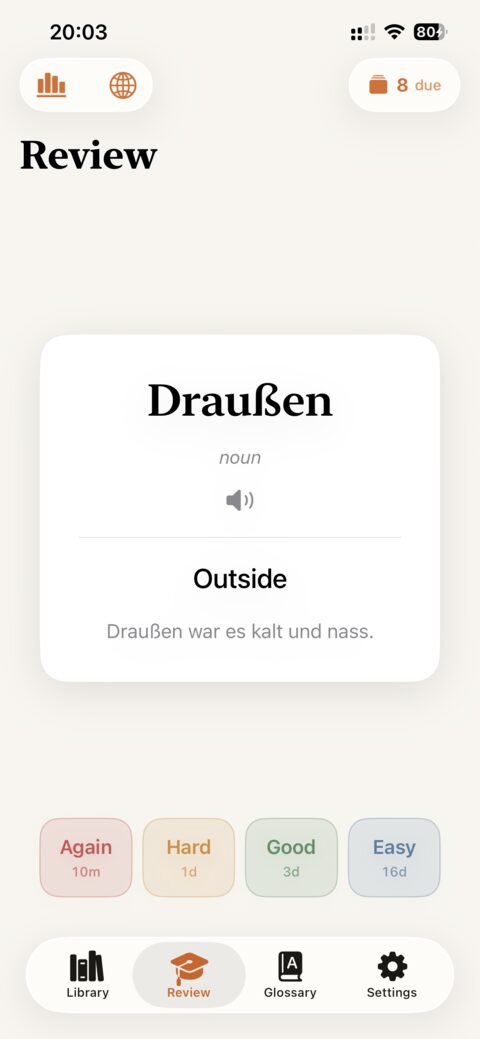
Input alone, though, has a leak: you meet a word, half-learn it, and forget it before you see it again. That's where the second accelerator comes in — spaced repetition, which schedules quick reviews of words at expanding intervals, right before you'd naturally forget them. It turns fleeting exposure into durable memory with remarkably little time. Combine the two — read a lot, save the words you don't know, and review them — and you convert raw reading into steady, measurable vocabulary growth. That loop is exactly what oqou on the App Store is built around: tap any word for an instant in-context meaning, save it, and review it later with spaced repetition, all on your device.
A few more honest accelerators worth naming:
- Immersion, real or simulated. Living where the language is spoken multiplies your daily hours without extra willpower. Can't travel? You can approximate it by flooding your day with the language — reading, podcasts, shows — so the hours pile up naturally.
- Speak early and often. If speaking is a goal, don't wait until you feel "ready." Early, imperfect speaking builds the retrieval speed that input alone won't, and it surfaces exactly which gaps to study next.
- Reduce friction. The faster you can look up an unknown word, the more you'll read and the less your momentum breaks. Small conveniences compound into a lot more hours over months.
It's worth being clear-eyed about the tradeoffs, too. Intensive immersion is the fastest route by the calendar, but it demands hours most people with jobs and families simply don't have. A gentler, reading-led approach is slower week to week, yet it's the one most self-learners can actually sustain for years — and sustained-for-years almost always beats fast-but-abandoned. The right "faster" for you is the densest method you'll genuinely keep doing, not the most aggressive one on paper. Speed that you quit isn't speed at all.
What you can't do is skip the total time on task — be skeptical of any promise of fluency in a week. But between someone who studies 600 aimless hours and someone who spends 600 engaged, well-structured hours reading and reviewing, the second is a different learner entirely. Same clock, very different results.
How long does it really take, realistically?
Realistically, for an easier language at about an hour a day, expect basic conversation in a few months, comfortable fluency in roughly two to three years, and professional-level polish beyond that. Harder languages roughly double or triple those spans. The numbers vary enormously by learner, so treat any estimate as a planning tool, not a deadline you can fail.
Let's assemble everything into a grounded picture. Take a motivated English speaker learning Spanish, giving it a genuine hour most days. A plausible arc looks like this: simple exchanges and travel survival within two or three months; comfortable everyday conversation around six months to a year; genuine fluency — reading for pleasure, following films, chatting without translating in your head — somewhere in the two-year range; and the polished, professional command FSI's ~600 hours targets a bit beyond that, depending on how the hours land. Add more daily hours and immersion, and the whole arc compresses. Study sporadically, and it stretches.
Now the same picture for a hard language — say Japanese — at the same hour a day. Everything shifts out: basic conversation might take six months to a year, comfortable fluency several years, and reading fluently is a project of its own because of the writing system. This isn't discouragement; it's calibration. A learner who expects Spanish-speed progress from Japanese will feel like they're failing when they're actually right on track. Match your expectations to your target and the same effort feels like success instead of struggle.
Three principles keep all of this realistic:
- Milestones beat finish lines. "Fluent" is fuzzy and far off; "I read my first short story" or "I ordered dinner without English" are concrete and close. Aim for the next usable milestone, and the big numbers take care of themselves.
- The useful stuff comes early. Because common words and structures do most of the work, you get to genuinely use the language — and enjoy it — long before you reach any theoretical endpoint.
- The plan you keep wins. A modest daily habit sustained for years always outruns an intense plan you drop. Protect a small, enjoyable routine and let the hours compound.
So how long to learn a language? Long enough that you need a method you can actually sustain — and short enough, at the milestones that matter, that you'll be surprised how soon you're reading and talking. If you'd like a private, on-device way to read anything, tap any word for an instant meaning, and review with spaced repetition, that's exactly what oqou was made for. Get oqou on the App Store and start turning your daily reading into steady progress.
Frequently asked questions
How long does it take to learn a language fluently?
For an easier language like Spanish or French, genuine fluency (roughly B2–C1) typically takes around 1.5 to 3 years of consistent daily effort. Harder languages like Japanese or Arabic often take two to three times longer. These are wide ranges — your hours per day, method, and prior language experience shift them substantially in either direction.
Can you learn a language in 3 months?
You can reach a basic conversational level (around A2) in an easier language in three months with intensive daily effort — enough to travel and hold simple exchanges. Full fluency in three months is not realistic for almost anyone. Be skeptical of "fluent in three months" claims; they usually redefine "fluent" to mean "conversational," which is a fair and achievable goal on its own.
How many hours a day should I study a language?
There's no required minimum, but roughly 30 minutes to an hour a day is a sustainable sweet spot for most people — enough to make steady progress without burning out. More hours genuinely speed things up, since total time on task drives the timeline. The key is choosing a daily amount you can actually keep for months and years, not the most ambitious number.
Why is it taking me so long to learn?
Usually it's one of three things: the language is distant from your native one (harder languages simply take more hours), your practice is sporadic rather than daily, or you've hit the intermediate plateau where progress gets quieter but hasn't stopped. Check your real weekly hours honestly, increase understandable input like reading, and remember that slow, invisible progress is still progress.
Is it too late to learn a language as an adult?
No. Adults learn languages successfully all the time, and in some ways learn faster than children because they can use grammar explanations, study strategically, and stay motivated by clear goals. Children may reach more native-like accents given years of immersion, but adults absolutely reach fluency. The main ingredients are time and consistency, both of which are fully within your control.
However long your language takes, the path is the same: understandable input most days, the words you meet saved and reviewed, and a habit gentle enough that you'll still be doing it a year from now. Pick your language, set a pace you can keep, and read something you enjoy today — the timeline takes care of itself once the habit does.