German has a reputation for being brutal, and that reputation is only half deserved. Yes, the grammar has moving parts English long ago discarded. But German and English are close cousins, so thousands of words are already half-familiar, and the spelling is refreshingly logical. This guide walks you through where to start, how to survive the cases, how to build vocabulary that sticks, and how reading real German can carry you further than any textbook.
Is German hard to learn for English speakers?
German is moderately hard for English speakers, but far from the hardest. English and German share a common Germanic ancestor, so much of the core vocabulary and sentence rhythm feels familiar. The real challenge is grammar: noun gender, four cases, and word order that moves verbs around. Those are learnable with steady exposure.
The honest answer is that German front-loads its difficulty. The first few months can feel like you are memorizing rules that seem arbitrary and endless. But once the system clicks, German becomes surprisingly predictable, and you stop translating in your head. Let's look at what actually helps you and what genuinely slows you down.
The shared roots that give you a head start
English is a Germanic language wearing a French coat. Strip away the Latin borrowings and you find a Germanic skeleton underneath, which is why so much everyday German looks like slightly misspelled English. Consider Haus (house), Wasser (water), Milch (milk), Finger (finger), Hand (hand), Buch (book), Garten (garden), Sommer (summer), and Freund (friend). You are not learning these from scratch; you are recognizing old relatives with a new accent.
The pattern goes deeper than nouns. Basic verbs line up too: trinken (to drink), singen (to sing), bringen (to bring), kommen (to come), helfen (to help). Even the little connective words that hold sentences together echo English: und (and), ist (is), war (was), hat (has). This overlap means a beginner reading real German already understands more than the raw vocabulary count suggests, and that head start keeps motivation high in the early weeks when it matters most.
The parts that are genuinely harder
Where German asks more of you is grammar. Three features cause most of the early friction. First, every noun has a gender, marked by the article der (masculine), die (feminine), or das (neuter), and there is no reliable way to predict which. Second, German has four cases, which change the articles and endings depending on a word's role in the sentence. Third, the verb does not always sit where an English speaker expects; in many sentences it lands at the very end.
None of these is impossible, but together they mean you cannot simply swap English words for German ones and get a correct sentence. You have to think about relationships between words in a way English lets you ignore. The good news is that reading exposes you to correct patterns thousands of times, so your ear and eye absorb the rules long before you can recite them.
The parts that are easier than you expect
German gives back as much as it takes. Spelling is nearly phonetic: once you learn the sounds of the letters and a few combinations like sch, ch, ei, and ie, you can pronounce almost any word you see, even a monstrous one you have never met. There are no silent minefields like English through and though. Vocabulary is often transparent because German builds long words out of small ones you already know. And German punctuation, capitalization of nouns, and sentence structure are consistent to a degree English never manages.
How long does it take to learn German?
Plan on several hundred hours to reach comfortable, conversational German, and roughly 750 to 900 hours to reach professional working proficiency, according to widely cited estimates from the U.S. Foreign Service Institute. German is a Category II language for English speakers, easier than Russian or Arabic, a little harder than Spanish or French.
Those numbers describe intensive classroom study, so treat them as a rough map rather than a promise. What they capture well is the relative difficulty: German is squarely in the moderate range for English speakers. What they hide is how much your habits matter. Someone who reads and listens to German every day will move faster per calendar month than the raw hours imply, because consistent exposure compounds.
Approx. hours to professional proficiency (FSI estimates, for native English speakers)
To make those hours concrete, imagine you invest an hour a day. In a year that is around 365 hours, enough to carry you from nothing to a solid intermediate footing where you can read simplified news, hold basic conversations, and enjoy graded stories. Push to two focused hours a day and you approach the professional-proficiency band inside two years. Slow down to twenty minutes a day and progress still happens; it just stretches across a longer calendar. The variable you fully control is consistency, not talent.
One more thing the hour counts do not show: the milestones do not arrive evenly. The jump from zero to "I can order food and understand signs" comes fast and feels thrilling. The plateau in the low intermediate range, where you understand a lot but still stumble to produce it, lasts longer and tests your patience. Knowing the plateau is coming helps you push through it instead of quitting. For a fuller breakdown of timelines and what each stage feels like, see our guide on how long it takes.
Where should you start with German?
Start with the sounds, a few hundred high-frequency words, the present tense of common verbs, and an early acceptance that nouns come with a gender. You do not need to master the cases before you speak or read a single sentence. Get the basics moving, then let real exposure teach you the rest gradually.
A common beginner mistake is trying to learn German in the "correct" order, marching through a grammar syllabus front to back before daring to use the language. That order feels safe but it is slow and joyless. A better sequence gets you understanding and producing simple German almost immediately, then layers in complexity as you meet it. Here is what to tackle first.
Get the sounds right early
German pronunciation is regular, so a small upfront investment pays off forever. Spend an hour or two learning how the vowels sound, including the umlauted ä, ö, and ü, and the sharp ß (which simply stands for a double s sound). Learn that w sounds like English v, that v often sounds like f, and that z sounds like ts. Because spelling maps cleanly to sound, nailing these rules early means every word you read afterward reinforces correct pronunciation instead of teaching you a wrong one.
Learn the highest-frequency words first
A small set of words does an outsized share of the work in any language. In German, learning the articles, pronouns, and the most common verbs unlocks the connective tissue of nearly every sentence. Prioritize words like sein (to be), haben (to have), werden (to become), machen (to make/do), gehen (to go), ich, du, er, sie, es, wir, and connectors like aber (but), weil (because), and wenn (when/if). Master these and you can already follow the shape of most sentences.
Get comfortable with the present tense
German verb conjugation is gentler than the Romance languages. Regular verbs follow a tidy pattern: take machen, drop the -en, and add endings to the stem — ich mache, du machst, er macht, wir machen, ihr macht, sie machen. Learn this pattern plus the handful of irregular heavy-hitters like sein and haben, and you can express an enormous amount in the present tense alone. Do not rush to the past tenses; the present carries beginners far.
Accept gender from day one, but do not agonize
Every German noun is der, die, or das, and the gender is not usually predictable from meaning. The practical move is to always learn a noun together with its article, as a single unit: not Tisch but der Tisch (the table), not Lampe but die Lampe (the lamp), not Fenster but das Fenster (the window). If you store the article with the word every time from the very start, gender stops being a separate thing to memorize later and becomes just part of the word.
What's the fastest way to learn German?
The fastest way combines large amounts of understandable input, especially reading, with regular speaking practice. Reading exposes you to correct grammar and new words in context, thousands of times, until the patterns feel natural. Speaking forces you to retrieve what you have absorbed. Together they beat any single method, and they scale with the time you give them.
There is no secret shortcut that skips the hours, but there are far more and far less efficient ways to spend them. The most efficient centers on comprehensible input: language slightly above your current level but still mostly understandable. When you understand the gist and only a few words are new, your brain infers the unknown pieces from context, and that inference is where durable learning happens. Below that threshold you are just decoding, which is exhausting and forgettable.
Why reading is such an efficient engine
Reading is uniquely good for German for a few reasons. It is self-paced, so you can sit with a tangled verb-final sentence until it makes sense, something a fast-talking podcast will not allow. It exposes you to the written case endings clearly, so den, dem, and des stop being abstract chart entries and become things you have seen in action a hundred times. And it lets you follow your own curiosity, which is the most durable fuel there is. The broader case for this approach is laid out in our guide to learning by reading.
How oqou fits into the fastest path
The traditional obstacle to reading real German early was the constant dictionary friction: stop, look up a word, lose the thread, repeat until you quit. oqou removes that friction. You read anything you like — books, news, PDFs — and tap any word for an instant in-context meaning. You save the words that matter to you, and the app brings them back with spaced repetition so they actually stick. Because the lookups are instant and in-context, you can read material that would otherwise be just out of reach, which is exactly where the fastest learning happens.
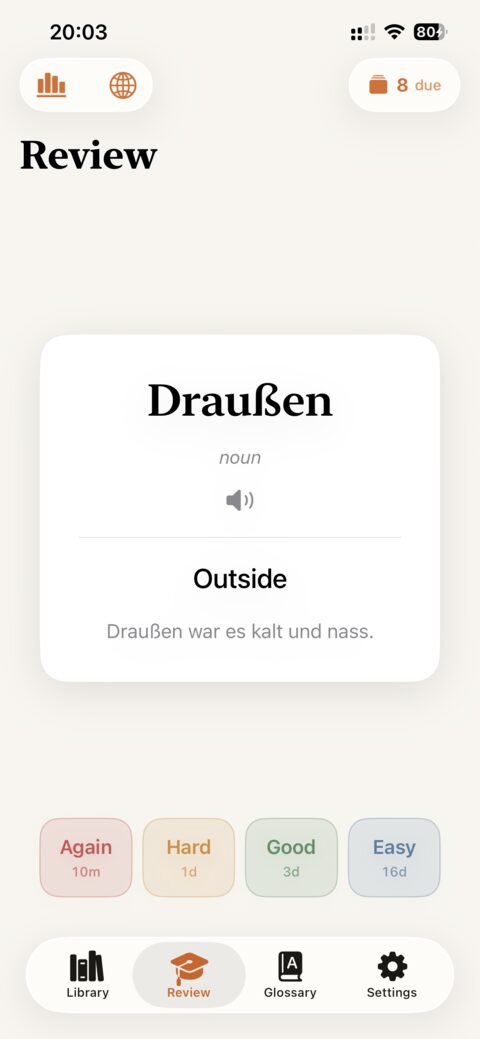
Pair that reading habit with speaking as soon as you can. You do not need a perfect grammar foundation to start talking; you need the willingness to make mistakes. Speaking pulls words from passive recognition into active use and reveals exactly which patterns you have not internalized yet. Reading fills the tank; speaking teaches you to drive. If you want to see how the reading side works on your own material, you can try oqou on the App Store and start tapping words in real German today.
How do you handle German grammar?
Handle German grammar by learning it in layers through exposure, not by memorizing every rule upfront. Focus early on the four cases, noun gender, verb-final word order, and adjective endings. Understand each well enough to recognize it, then let heavy reading and listening cement the patterns until you produce them without conscious effort.
German grammar looks intimidating on a chart and feels natural in a sentence you have read fifty times. That gap is the whole strategy: study just enough to make patterns recognizable, then get so much input that recognition turns into instinct. Let's walk through the four features that trip beginners up most.
The four cases
Cases are German's signature challenge. A case marks the grammatical role a noun plays in a sentence, and German changes the article (and sometimes the noun ending) to show that role. English does this only faintly, in pronouns — "he" versus "him" versus "his." German does it systematically. The four cases are the nominative (the subject), the accusative (the direct object), the dative (the indirect object), and the genitive (possession). Here is how the definite article the shifts across all four cases and the three genders plus plural.
| Case | Masculine | Feminine | Neuter | Plural |
|---|---|---|---|---|
| Nominative (subject) | der | die | das | die |
| Accusative (direct object) | den | die | das | die |
| Dative (indirect object) | dem | der | dem | den |
| Genitive (possession) | des | der | des | der |
See the pattern in action. In Der Hund sieht den Mann (the dog sees the man), der Hund is the subject in the nominative, and den Mann is the object in the accusative, so the masculine article shifts from der to den. In Ich gebe dem Mann das Buch (I give the man the book), dem Mann is the indirect object in the dative. Notice that only the masculine forms change dramatically; feminine and neuter overlap heavily, which is a small mercy. You do not memorize this table by staring at it. You memorize it by meeting den, dem, and des in real sentences until the right form simply sounds correct.
Noun gender
As covered above, gender is unpredictable and must be learned per word, which is why storing the article with the noun from day one matters so much. There are a few loose tendencies that help: most nouns ending in -ung, -heit, -keit, and -schaft are feminine (die Zeitung, the newspaper; die Freiheit, freedom); many ending in -chen are neuter (das Mädchen, the girl, which is famously neuter despite meaning a girl). But treat these as gentle hints, not laws, and always learn the article as part of the word.
Verb-final and verb-second word order
German word order surprises English speakers. In a main clause, the conjugated verb sits in the second position: Ich lese ein Buch (I read a book) looks familiar, but Heute lese ich ein Buch (today I read a book) puts the verb before the subject to keep it in slot two. In subordinate clauses introduced by words like weil (because) or dass (that), the verb marches all the way to the end: Ich bleibe zu Hause, weil ich müde bin (I am staying home because I am tired) — literally "because I tired am." This feels alien at first, then becomes one of German's most satisfying rhythms once reading makes it familiar.
Adjective endings
Adjectives placed before a noun take an ending that agrees with the noun's gender, case, and whether an article precedes it. So gut (good) becomes ein guter Tag (a good day), eine gute Idee (a good idea), and ein gutes Buch (a good book). This is the grammar point learners most want to skip, and honestly, you can get by early without perfecting it. Comprehension does not depend on it, and correct endings emerge naturally from months of reading. Do not let adjective endings paralyze you at the beginner stage.
How do you build German vocabulary that sticks?
Build German vocabulary by meeting words in context and reviewing them with spaced repetition, not by grinding isolated word lists. German rewards this approach especially, because it builds long words from smaller ones you already know. Learn the building blocks, meet compounds in real sentences, and let spaced review lock them into long-term memory.
Vocabulary is where German quietly becomes generous. Once you know a few hundred core words, the language lets you assemble and decode thousands more, because German loves to glue words together into precise compounds. Understanding how this works turns an intimidating wall of long words into a puzzle you can usually solve on sight.
Compound words are your friend, not your enemy
That famous German trait of enormous words is actually a gift to learners. German builds compounds by stacking nouns, and the meaning is usually transparent once you break it apart. The classic example is Handschuh — literally Hand (hand) plus Schuh (shoe), which together mean "glove." A shoe for your hand. Once you see the logic, you can decode words you have never studied: Krankenhaus is kranken (sick) plus Haus (house), a hospital. Fernseher is fern (far) plus seher (seer), a television. Handschuhe in the plural, Wörterbuch (word-book) is a dictionary, and Geschwindigkeitsbegrenzung (speed limit) looks terrifying until you chop it into pieces.
The practical upshot is that every root word you learn multiplies. Learning Haus gives you partial access to Krankenhaus, Rathaus (town hall), Kaufhaus (department store), and dozens more. This is why building a solid base of common roots pays compounding dividends in German more than in most languages. When you meet a long compound while reading, resist the urge to panic; look for the smaller words hiding inside it.
Context beats isolated lists
A word learned from a bilingual list is a fragile thing. You memorize that Zug means "train," but you have no sense of how it behaves, what it collides with, or which of its several meanings applies (Zug can also mean a draft of air, a move in chess, or a puff on a cigarette). A word learned in context arrives with all of that attached. You see Der Zug fährt um acht Uhr ab (the train departs at eight) and you absorb not just the meaning but the gender, the typical verb, and the register. This is why reading is such a powerful vocabulary engine. Our deeper dive on how many words you need explains how coverage and frequency shape which words are worth your attention.
Spaced repetition makes it permanent
Meeting a word once is rarely enough; you need to revisit it a few times, spaced out, before it settles into long-term memory. Spaced repetition schedules those reviews at the moment you are about to forget, which is the most efficient point to reinforce a memory. The trap with traditional flashcards is that you end up drilling random words stripped of context. The better approach is to save the specific words you met while reading — words that already matter to you because you encountered them in something you chose to read — and review those. That is exactly the loop oqou is built around: tap, save, and let spaced repetition bring each word back at the right time.
How do you start reading in German?
Start reading in German with material at or just above your level, then climb steadily. Begin with graded readers written for learners, move to short and simple news articles, and progress toward books once your foundation is solid. Match the difficulty to your level so you understand most of what you see, and let a tap-to-translate tool handle the gaps.
Reading is the single highest-leverage habit in this guide, but only if you pick the right material. The goal at every stage is comprehensible input: text where roughly 95 to 98 percent of the words are familiar, so you can infer the rest. Aim too high and reading becomes miserable decoding; aim just right and it becomes a pleasure that quietly teaches you thousands of words.
Stage one: graded readers
Graded readers are stories written deliberately with limited vocabulary and simplified grammar for learners at a specific level. They are the ideal on-ramp because they give you the experience of reading a real, coherent story while keeping the difficulty manageable. Look for A1 and A2 level readers when you start. The confidence you build from finishing an entire book in German, even a simple one, is worth more than another week of grammar drills. Many graded readers also come with audio, letting you read and listen at once, which reinforces those regular German sounds. If you want to start right now, you can read free German short stories in your browser, no download or sign-up required.
Stage two: simple news and short articles
Once graded readers feel easy, step up to news written in simpler German. Several German outlets publish slow or simplified news specifically for learners, with shorter sentences and clearer vocabulary. News is excellent practice because the articles are short, self-contained, and cover topics you may already understand from English coverage, which gives you context that fills gaps. This is where a tap-to-translate tool earns its keep: real news uses real vocabulary, and being able to tap any unfamiliar word keeps you in the flow instead of drowning in a paper dictionary.
Stage three: books and native material
Eventually you graduate to books written for native speakers, and this is where German reading becomes genuinely rewarding. Start with material that has short sentences and familiar subject matter — young-adult novels, translated books whose plots you already know, or nonfiction on a topic you love. The plot momentum of a good novel pulls you through hundreds of pages, and each page delivers vocabulary in rich context. If you have ever wanted to read a German author in the original, this is the payoff, and it arrives sooner than most learners expect.
Handling the words you do not know
At every stage, the make-or-break question is how you deal with unfamiliar words. The old approach — stopping to flip through a dictionary — breaks your concentration so badly that most learners give up. The modern approach is to tap the word, see an instant in-context meaning, save it if it matters, and keep reading. This is precisely the friction oqou removes, and it is what makes reading real German viable for beginners rather than a distant reward. For a gentler on-ramp if you feel intimidated, our piece on reading in a foreign language as a beginner walks through easing in without burning out.
What resources should you use?
Use a small, complementary set of resources rather than collecting every app you find. A beginner course for the foundations, plenty of reading material at your level, a reading app that makes lookups and review effortless, listening input from podcasts and shows, and a way to practice speaking. Quality of use beats quantity of tools every time.
The temptation in language learning is to accumulate resources as a substitute for doing the work. Ten half-finished apps teach you less than one course you complete. Here is a lean toolkit that covers every base without overwhelming you, organized by what each part actually does for you.
For the foundations
You want one structured beginner resource to teach you the basics of pronunciation, the present tense, core vocabulary, and an introduction to the cases. This can be a textbook, a beginner course, or a well-made app. The point is to give you a coherent path through the fundamentals so you are not assembling the basics from scattered videos. Spend a few months here, but do not wait until you have "finished" it to start reading and listening — begin those in parallel almost immediately.
For input
Input is the bulk of your learning, so this is where most of your resources should live. For reading, that means graded readers, learner news, and eventually native books, paired with a tool like oqou that lets you read any of it with instant tap-to-translate and spaced-repetition review. For listening, collect a few German podcasts made for learners, plus shows and films with German audio. Subtitles in German (not English) turn watching into reading practice too. The goal is to surround yourself with understandable German so exposure happens naturally throughout your day.
For output
At some point you must produce German, not just consume it. A language exchange partner, a tutor, or a conversation group gives you low-stakes speaking practice. Writing helps too: keeping a simple journal in German, even a few sentences a day, forces you to actively assemble the grammar you have been absorbing. Output feels uncomfortable at first because it exposes exactly what you have not learned yet, but that discomfort is the feedback that makes you improve.
What does a realistic German learning plan look like?
A realistic plan spreads across roughly a year of daily practice, moving from sounds and survival phrases to conversational fluency. Front-load pronunciation and core vocabulary, add reading early, layer in grammar as you meet it, and build a speaking habit by the middle months. Consistency of thirty to sixty minutes a day beats occasional marathon sessions.
No plan survives contact with real life exactly as written, so treat this as a flexible template, not a rigid schedule. The key principles hold regardless of pace: start input early, do not wait to speak, and let grammar arrive through exposure rather than upfront memorization. Here is a five-step roadmap, followed by a level-by-level table you can map onto your own calendar.
- 1Weeks 1–4: Sounds and survival — Learn German pronunciation, the umlauts and ß, your first few hundred words, and the present tense of sein and haben. Always learn nouns with their article.
- 2Months 2–3: First reading and grammar — Start A1 graded readers, meet the four cases and basic word order, and begin saving words with spaced repetition. Understanding comes before perfection.
- 3Months 4–6: Volume and first speaking — Read daily, move to A2 readers and simple learner news, add listening, and start speaking with a partner or tutor even if it feels clumsy.
- 4Months 7–9: Real material — Transition to native news and easy novels, refine the cases and adjective endings through exposure, and speak regularly enough to think in German sometimes.
- 5Months 10–12: Consolidation — Read books for pleasure, watch shows with German subtitles, hold longer conversations, and target the specific gaps you notice rather than starting over.
To connect that roadmap to the standard European framework, the table below maps each level to what you can roughly do, a ballpark of active vocabulary, and what to read at that stage. Use it to locate yourself and to see what comes next.
| Level | What you can do | Rough vocabulary | What to read |
|---|---|---|---|
| A1 (beginner) | Introduce yourself, ask simple questions, understand slow, basic phrases | ~500–1,000 words | A1 graded readers, labels, simple dialogues |
| A2 (elementary) | Handle everyday errands, describe your background in simple terms | ~1,000–2,000 words | A2 readers, learner news, short simplified articles |
| B1 (intermediate) | Manage most travel situations, follow the main points of clear speech | ~2,500–3,500 words | Slow news, young-adult novels, easy nonfiction |
| B2 (upper intermediate) | Converse fluently enough for regular interaction, follow complex text | ~4,000–6,000 words | Native news, contemporary novels, longer articles |
| C1 (advanced) | Use German flexibly for social, academic, and professional life | ~8,000+ words | Literature, essays, specialized and professional writing |
Notice how reading material and vocabulary grow together at every level. That is not a coincidence — reading is one of the most reliable ways to add the thousands of words each stage demands, because it delivers them in context and at volume. Whatever your pace, anchoring your plan around a daily reading habit gives the rest of your study something concrete to build on. When you are ready to make real German text approachable from day one, download oqou on the App Store and turn anything you want to read into a lesson.
Frequently asked questions
Is German or French easier for English speakers?
They are close, with different challenges. French shares more vocabulary with English through centuries of borrowing, and its grammar avoids German's cases. German has friendlier, more phonetic spelling and shares deeper Germanic roots in everyday words, but its four cases and word order demand more grammatical thinking. The FSI rates both as moderate-difficulty Category I to II languages, so pick the one whose culture pulls you in more.
Do I really need to learn all four cases to speak German?
To speak correctly, eventually yes, but not before you start. You can communicate and be understood while still making case errors, and native speakers will follow you. Learn to recognize the cases early so reading makes sense, then let heavy exposure gradually make the correct forms automatic. Waiting until you have mastered the cases before speaking would delay you by months for no real benefit.
How many words do I need to read German comfortably?
Comfortable reading of general native material usually starts around a vocabulary of 4,000 to 5,000 word families, which lands you near B2. At that point you understand roughly 95 to 98 percent of common text and can infer the rest from context. You reach this level fastest by reading a lot, since reading itself is the most efficient way to accumulate those thousands of words in context.
Can I learn German just by reading?
Reading can carry you remarkably far, especially for vocabulary, grammar patterns, and comprehension, but it is not quite enough on its own. You also need listening input to train your ear for spoken German, and speaking practice to make your knowledge active. Think of reading as the powerful core of your study, complemented by listening and speaking rather than replacing them entirely.
Why are German nouns capitalized and does it matter?
German capitalizes every noun, not just proper names — der Tisch (the table) and die Freiheit (freedom) both start with a capital letter. It is a firm rule, not a style choice. For learners this is actually helpful: capitalization visually flags which words are nouns, making it easier to parse long sentences and spot the compound nouns German loves to build.
German rewards patience more than talent. Get the sounds right, learn nouns with their articles, start reading early, and let steady exposure turn the grammar from a chart into an instinct. If you want the reading habit that quietly does most of the work, try oqou and start tapping your way through real German today. Viel Erfolg.