Japanese has a reputation for being one of the hardest languages an English speaker can pick up, and that reputation is only half deserved. The spoken grammar is remarkably logical once it clicks; the real work is the writing system. This guide walks you through where to start, how the three scripts fit together, how long it honestly takes, and how reading real Japanese can carry most of the load.
Is Japanese hard to learn?
Japanese is genuinely challenging for English speakers, but not in the way most people assume. The grammar is consistent and highly logical, with very few irregular verbs. The hard part is the writing system — three scripts, including roughly 2,000 everyday kanji. Master the scripts steadily and the rest becomes far more manageable than it looks.
When people say Japanese is “impossible,” they are usually reacting to the sight of a page dense with kanji, not to anything about how the language actually works. It is worth separating the two, because the difficulty is very unevenly distributed. Some parts of Japanese are easier than the equivalent in Spanish or French; other parts genuinely take years. Knowing which is which lets you spend your energy where it counts.
What is actually easy about Japanese
Several features of Japanese are a relief compared with European languages:
- Pronunciation is simple and consistent. Japanese has a small, clean set of sounds. Every syllable is built from a handful of vowels and consonants, and words are pronounced the way they are written in kana, with almost no exceptions. There are no tones to master as in Mandarin, and no thicket of vowel sounds as in English.
- No grammatical gender. There is no masculine or feminine, so you never memorize whether a table is “he” or “she.”
- No articles. There is nothing like “a” or “the” to agonize over.
- Verbs barely change for person or number. The verb 食べる (taberu, to eat) is the same whether the subject is I, you, he, or they. You do not conjugate through a table of six endings the way you do in Romance languages.
- Very few irregular verbs. Japanese has essentially two irregular verbs, する (suru, to do) and 来る (kuru, to come). Everything else follows predictable patterns.
What is genuinely hard about Japanese
The difficulty is real, but it is concentrated in a few areas:
- The writing system. This is the big one. You need two syllabaries (hiragana and katakana) plus a working knowledge of around 2,000 kanji, each of which can have multiple readings. This is where most of your study hours will go, and it is the main reason Japanese sits in the hardest tier for English speakers.
- Word order and particles. Japanese is a subject-object-verb (SOV) language, so the verb lands at the end of the sentence, and grammatical roles are marked by small particles like は, を, and に rather than by position. This feels backwards at first but becomes second nature with exposure.
- Politeness levels. The same idea can be phrased casually, politely, or in formal keigo, and choosing the wrong register can sound rude or oddly stiff.
- Counters and set expressions. Counting objects depends on what you are counting, and there are many small conventions to absorb.
Here is the encouraging part: the grammar, once you understand its logic, is astonishingly regular. English is full of exceptions that native speakers stopped noticing long ago. Japanese has far fewer. So the honest summary is not “Japanese is hard” but “Japanese has a steep on-ramp made mostly of writing, followed by a smoother road than you would expect.” The learners who quit usually quit during the on-ramp, before the logic pays off.
How long does it take to learn Japanese?
Expect roughly 2,200 hours of study to reach professional working proficiency, according to widely cited estimates from the U.S. Foreign Service Institute, which classes Japanese as a Category IV or “super-hard” language for English speakers. That is about three to four times longer than Spanish. Casual conversational comfort comes much sooner, in months rather than years.
The FSI figure is the number most often quoted, and it is worth understanding what it does and does not mean. It reflects intensive, classroom-style study of full-time students aiming for high-level professional fluency — the ability to work, negotiate, and read at a serious level. It is not the bar for having fun, making friends, or reading manga. Most learners feel real, motivating progress long before they approach 2,200 hours.
Approx. hours to professional proficiency (FSI estimates, for native English speakers)
Why is Japanese in the top tier alongside Korean, Mandarin, and Arabic? Almost all of the extra time comes down to the writing system and the lack of shared vocabulary. A Spanish learner already recognizes thousands of words on sight, because English and Spanish share a huge Latin and French heritage — nación, importante, familia. A Japanese learner starts with almost none of that head start and, on top of it, has to learn a completely different way of representing words on the page. The spoken grammar is not what makes Japanese slow; the reading and writing is.
Milestones you will actually feel
Rather than fixating on the final number, watch for the milestones along the way, because they arrive steadily and keep you motivated:
- Weeks 1–4: You can read and write both kana, handle greetings like こんにちは (konnichiwa, hello) and ありがとう (arigatō, thank you), and build tiny sentences.
- Months 2–6: Basic grammar and particles click, you know a few hundred kanji, and you can get through simple graded readers and slow conversations about familiar topics.
- Months 6–18: You start reading learner news and manga with furigana, and everyday conversation becomes possible if the other person is patient.
- Years 2–3+: With steady reading and listening, native content opens up and you approach the comfort the FSI number describes.
Your personal pace depends far more on consistency and exposure than on talent. Someone reading and listening to Japanese every day will blow past someone who studies grammar for three hours once a week. If you want a fuller framework for setting expectations, our guide on how long it takes breaks down the variables that actually move the timeline.
Where should you start with Japanese?
Start with hiragana, then katakana, then a small set of basic kanji — in that order. Hiragana is the backbone of the language and unlocks grammar, particles, and pronunciation. Learn the core sounds alongside it. Resist the temptation to lean on romaji (Latin-letter spellings); it becomes a crutch that slows real reading down.
The single most important decision a beginner makes is whether to learn the actual Japanese scripts from day one or to stay in romaji. Choose the scripts. Romaji feels comfortable for about a week and then quietly sabotages you: it trains your eyes to skip the real writing, it hides distinctions that romaji cannot show, and it makes the eventual switch to kana painful. Everyone who learns Japanese well makes this jump early, and they almost universally wish they had made it sooner.
Why hiragana comes first
Hiragana (ひらがな) is a set of 46 basic characters, each representing a syllable — あ (a), か (ka), さ (sa), and so on. It is the glue of the language. Grammatical particles are written in hiragana, verb endings are written in hiragana, and any word can be spelled in hiragana even if it normally uses kanji. Furigana — the little pronunciation guides printed above kanji — are hiragana too. Learn hiragana first and everything else has something to attach to.
The good news is that kana is learnable in a matter of days to a couple of weeks with focused practice. It is a finite, closed set. Unlike kanji, which you will chip away at for years, hiragana and katakana are one-time investments you can knock out early and then build on forever.
The core sounds
Japanese pronunciation is built on five vowels — a, i, u, e, o — pronounced cleanly and consistently, plus a small set of consonants combined with those vowels. Because kana maps almost perfectly onto sounds, learning to read kana is learning to pronounce the language. A few things to get right early:
- Vowel length matters. A long vowel can change the meaning. おばさん (obasan, aunt) is not おばあさん (obāsan, grandmother). Kana marks these differences precisely, which is another reason romaji fails you.
- Each kana is one beat. Japanese rhythm is based on evenly timed syllables (mora), which gives the language its steady cadence. Getting this rhythm early makes you sound natural.
- The particle は is read “wa,” not “ha,” when it marks the topic — one of a handful of small exceptions you learn immediately and never think about again.
A sensible first month
A realistic starting sequence looks like this: spend your first week or two nailing hiragana until you can read it without hesitation. Add katakana next, over another week or two. Somewhere in there, start picking up the most common words and a handful of survival phrases. Only once kana feels automatic should you begin your first basic kanji, along with your first real grammar — simple sentences with は, を, and a verb at the end. If you are completely new to reading in another language and want the gentlest possible approach, our guide to reading as a beginner pairs well with these first steps.
How do you learn the three writing systems?
Japanese uses three scripts together: hiragana for grammar and native words, katakana for foreign loanwords and emphasis, and kanji for the core meaning of most words. You learn kana quickly as fixed sets, then build kanji gradually over time. Furigana and radicals make kanji far less intimidating than the raw count suggests.
Seeing all three scripts in one sentence is what scares beginners, so it helps to understand that each one has a clear job. A typical sentence weaves them together seamlessly: 私はコーヒーを飲みます (watashi wa kōhī o nomimasu, I drink coffee). Here 私 and 飲 are kanji carrying the core meanings, コーヒー is katakana because “coffee” is a loanword, and は, を, and みます are hiragana handling grammar and the verb ending. Once you know which script does what, the mixture stops looking like chaos and starts looking like structure.
| Script | What it is | Main job | Example | How you learn it |
|---|---|---|---|---|
| Hiragana (ひらがな) | 46 basic phonetic characters | Grammar, particles, verb endings, native words, furigana | は (wa), を (o), に (ni), たべる (taberu) | Memorize the full set in 1–2 weeks; used constantly |
| Katakana (カタカナ) | 46 phonetic characters, same sounds as hiragana | Foreign loanwords, names, onomatopoeia, emphasis | コーヒー (kōhī, coffee), テレビ (terebi, TV) | Memorize after hiragana; less frequent, so it takes practice to keep sharp |
| Kanji (漢字) | Thousands of meaning-based characters from Chinese | The core meaning of most nouns, verb stems, and adjectives | 水 (mizu, water), 日本 (nihon, Japan) | Learn gradually over years; ~2,000 for full literacy |
Hiragana and katakana: the fast wins
Katakana (カタカナ) represents exactly the same sounds as hiragana but uses different, more angular shapes, and it is reserved mostly for words borrowed from other languages. Because so much modern Japanese vocabulary is borrowed — especially in technology, food, and business — katakana is everywhere, and it hands you free vocabulary. If you can read katakana, you can often decode コンピューター (konpyūtā, computer) or レストラン (resutoran, restaurant) with no study at all. Many learners find katakana slightly stickier than hiragana simply because they see it less, so plan to review it deliberately.
Kanji: the long game, made manageable
Kanji (漢字) are characters borrowed from Chinese, and each one carries meaning rather than just sound. 水 means water, 火 means fire, 山 means mountain. This is the part of Japanese that takes years, but three things make it far less daunting than the raw number suggests:
- Furigana. In material for learners and younger readers — and in a lot of manga — small hiragana are printed above the kanji to show the reading. This means you can read and enjoy text before you have memorized every character, learning the readings naturally as you go.
- Radicals. Kanji are not random scribbles; they are built from a limited set of repeating components called radicals. The character 海 (umi, sea) contains the water radical 氵on its left side. Once you learn to see these building blocks, complex characters break down into familiar parts, and remembering them gets dramatically easier.
- Frequency. A small number of kanji do most of the work. The most common few hundred characters cover a huge proportion of everyday text, so early kanji study pays off immediately.
How many kanji do you really need?
The official list of everyday-use characters, the jōyō kanji, contains 2,136 — the roughly 2,000-odd figure you often hear, and the target for full adult literacy. But you do not need all of them to function or to start reading. Learners typically find that the first 1,000 kanji unlock the large majority of common text, and even a few hundred make graded readers and simple articles accessible. Treat 2,000 as the horizon, not the entry fee. You start reading long before you get there, and the reading itself teaches you the rest.
What's the fastest way to learn Japanese?
The fastest route combines lots of comprehensible input — mainly reading and listening you can mostly understand — with real speaking practice and steady vocabulary review. Input builds your intuition and vocabulary in bulk; speaking activates it. Anything that lowers the friction of understanding a text, like instant tap-to-translate for unfamiliar kanji, lets you spend more time actually reading.
“Fastest” is really about efficiency per hour, and the biggest efficiency lever is comprehensible input: consuming Japanese you can follow at a level a little above where you are now. This is the idea, associated with the linguist Stephen Krashen, that we acquire language mainly by understanding messages rather than by memorizing rules. For Japanese specifically, reading is an unusually powerful form of input, because it is the one activity that forces you to engage with the writing system while also delivering grammar and vocabulary in context.
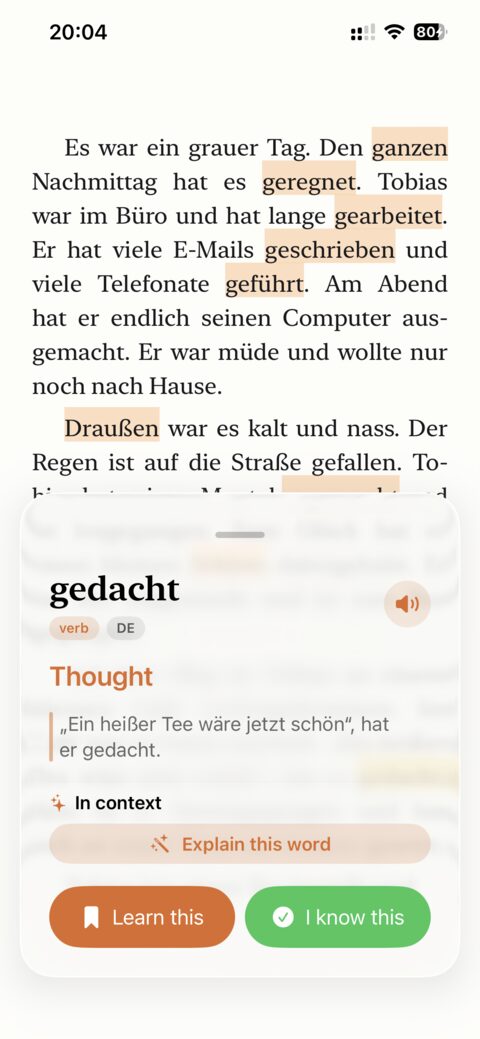
Here is where Japanese has a specific problem that reading tools solve neatly. In a European language, when you meet an unknown word you can at least pronounce it and look it up. In Japanese, an unfamiliar kanji compound can stop you dead — you may not even know how to read it aloud, let alone what it means, which makes a paper dictionary nearly useless mid-sentence. That single obstacle is why so many beginners give up on real reading. When you can tap the word and instantly see its reading and meaning in context, the obstacle disappears and reading becomes something you can actually sustain for an hour.
The three ingredients that move you fastest
- Massive input, mostly reading. Read and listen to as much understandable Japanese as you can. Volume is what converts fragile, just-learned words and grammar into automatic knowledge. This is the engine.
- Real speaking practice. Input builds a huge passive base, but you still have to produce the language to speak it. Talking with a tutor, a language partner, or even yourself turns recognition into production and surfaces the gaps you did not know you had.
- Deliberate vocabulary review. Because Japanese shares so little vocabulary with English, you cannot coast on cognates. A spaced-repetition habit makes sure the words you meet while reading actually stay.
The mistake that slows people down is spending nearly all their time on grammar drills and app streaks while getting almost no real input. Grammar study is useful scaffolding early on, but it is scaffolding, not the building. The learners who progress fastest treat grammar as a quick reference and pour the bulk of their hours into understanding real Japanese — which for most people means reading a lot, with the friction removed. To go deeper on why input-driven reading is so effective, see our full guide on learning by reading.
Try oqou free on the App Store and turn any Japanese book, article, or PDF into tap-to-translate reading with one-tap word saving and built-in review.
How do you build Japanese vocabulary that sticks?
Learn words in context and review them with spaced repetition. Meeting a word inside a real sentence you understand gives it meaning, usage, and a memory hook that an isolated flashcard cannot. Then spaced repetition brings the word back just before you would forget it, converting a one-time encounter into permanent, usable vocabulary — which matters extra in Japanese, where cognates are rare.
Vocabulary is the make-or-break area for Japanese, precisely because of that missing head start. When you learn Spanish, thousands of words are half-known before you begin. In Japanese, nearly every word is new, and many come attached to kanji you also have to learn. That sounds daunting, but it means your vocabulary method matters more here than in almost any other language, and getting it right pays off enormously.
Why context beats word lists
Memorizing bare word-to-translation pairs is slow and fragile, for reasons that hit Japanese especially hard:
- Many words have multiple readings. The kanji 生 can be read sei, shō, i, u, nama, and more, depending on the word it appears in. Learning it in context — inside 学生 (gakusei, student) or 先生 (sensei, teacher) — teaches you the reading that actually applies, instead of a confusing list of possibilities.
- Context is a memory hook. Recalling the sentence or story where you met a word gives your brain an extra path back to its meaning. An isolated word floats free; a word tied to a scene has an anchor.
- You learn how the word behaves. Seeing a verb in a real sentence teaches you which particle follows it and how it fits Japanese word order, so you learn to use the word, not just recognize it.
Let spaced repetition do the scheduling
Spaced repetition shows you each word at expanding intervals — a day later, then a few days, then a week, then a month — timed to catch you right before you would forget. Every successful recall strengthens the memory and pushes the next review further out, so well-known words stop wasting your time while shaky ones get more attention. It is one of the most reliable findings in learning science, and it is far more efficient than rereading vocabulary lists or cramming before a lesson.
The friction to avoid is the gap between where you meet a word and where you review it. If you read Japanese in one place and have to retype words, look up readings, and build cards in a separate app, the habit collapses under its own overhead. The smoother path is to save a word with its sentence the moment you tap it, and have it flow straight into your review queue. When saving takes one tap and captures the context automatically, you actually keep doing it. Our deeper dive into learning by reading covers how to run this save-and-review loop without letting it become a chore.
How do you start reading in Japanese?
Start with heavily supported material and work up. Graded readers written for learners, NHK Easy News, and manga with furigana are the ideal on-ramps, because they control difficulty or show you how to read every kanji. When you hit an unknown character, tap-to-translate handles the reading and meaning instantly, so you keep moving instead of stalling.
Reading is the highest-leverage activity in Japanese, and yet it is where beginners most often get stuck, because native text throws thousands of unlearned kanji at them at once. The fix is not to postpone reading until you “know enough” kanji — you never will, because reading is how you learn them. The fix is to choose material that meets you where you are, and to use tools that remove the kanji roadblock.
The best on-ramps for Japanese
- Graded readers. These are stories written with a controlled vocabulary and grammar for a specific level. Series designed for Japanese learners let you read whole stories comfortably from very early on, which builds confidence and fluency the way nothing else does. This is the ideal starting point.
- NHK Easy News (やさしい日本語). Japan's public broadcaster publishes simplified news with furigana over the kanji and simpler sentence structure. It is free, current, and endlessly renewing, which makes it perfect once you have a little grammar under your belt.
- Manga with furigana. A great deal of manga, especially titles aimed at younger readers (少年 and 少女 series), prints furigana above the kanji. The pictures supply context, the dialogue is natural and high-interest, and the furigana means you are never truly stuck on a reading. Reading something you genuinely enjoy is worth more than any “optimal” textbook.
- Children's books and simple blogs. As you climb, native material written simply — children's stories, personal blogs, product reviews — bridges you toward the real thing.
Aim for the comfortable-but-stretching zone
A useful guideline from reading research is to read material where you already know roughly 95 to 98 percent of the words — only a handful of unknowns per hundred. In that range, context does most of the work of teaching you new words, and you stay in flow instead of drowning in lookups. If almost every sentence stops you cold, the text is too hard for now; drop to something easier without guilt. For Japanese, “knowing” a word includes being able to read its kanji, which is exactly why furigana and tap-to-translate are so valuable at the start — they effectively raise your coverage while you learn.
How tap-to-translate changes reading Japanese
The traditional way to look up an unknown kanji was brutal: you counted strokes or hunted through radical indexes in a paper dictionary, a process that took a minute per word and shattered any reading flow. Learners either avoided real text entirely or burned out fast. Modern reading tools remove that cost completely. In an app like oqou, you tap the word and get its reading and in-context meaning right there on the page, without leaving the story. Because the friction drops to near zero, you can read text that would otherwise be out of reach, and you learn the kanji naturally through repeated, low-effort encounters. One caution: reach for full-sentence machine translation sparingly. If you translate every line into English, your brain never builds meaning directly in Japanese — rely on quick word-level lookups and save the whole-sentence translation for moments when the grammar truly stumps you.
What are the trickiest parts of Japanese?
The trickiest parts are the writing system, particles, politeness levels, counters, and pitch accent. Kanji is the biggest long-term effort. Particles feel alien at first, politeness requires choosing the right register, counters change with the object, and pitch accent is subtle. None is insurmountable — each yields to steady exposure — but they are the areas that reward extra attention.
Knowing where the difficulty lives lets you brace for it instead of being blindsided. None of these will stop you cold if you expect them, and reading a lot quietly solves most of them by showing you how native writers actually use them. Here is what each one involves.
Kanji
Already covered above, but worth naming as the number-one time sink. The challenge is not just the count but the multiple readings each character can take depending on context. The antidote is learning kanji inside words and sentences rather than as isolated characters, and letting volume of reading do the heavy lifting over time.
Particles
Particles are short markers that show a word's grammatical role, and Japanese leans on them heavily because word order is flexible. A few core ones you meet immediately:
- は (wa) marks the topic — what the sentence is about. 私は学生です (watashi wa gakusei desu, as for me, I am a student).
- を (o) marks the direct object. 水を飲む (mizu o nomu, drink water) — 水 is what gets drunk.
- に (ni) marks a destination, time, or location. 学校に行く (gakkō ni iku, go to school).
The famously slippery distinction is between は and が, which both relate to the subject but carry different nuances of emphasis and newness. Do not try to master it from a rule table — you absorb it by seeing it hundreds of times in real sentences, which is another argument for reading widely.
Politeness levels
Japanese encodes social relationships in its grammar. The same verb can appear in a plain form (食べる, taberu) among friends, a polite form (食べます, tabemasu) with strangers and in most everyday public settings, and in elaborate honorific keigo in formal or business contexts. Beginners should focus on the polite -masu forms, which are safe almost everywhere, and pick up the casual and formal registers gradually through exposure. Reading dialogue in manga and novels is a great way to develop a feel for who speaks how.
Counters
When you count things in Japanese, the counting word changes based on what you are counting. You use one counter for flat objects (一枚, ichimai, for sheets of paper), another for long thin objects (三本, sanbon, for three bottles or pens), another for small animals (二匹, nihiki), and yet another for people (一人, hitori). There are many counters, but a handful cover most daily situations, and you learn the common ones through use rather than memorizing them all upfront.
Pitch accent
Japanese distinguishes some words by pitch rather than stress. The classic example is 箸 (hashi, chopsticks) versus 橋 (hashi, bridge), which are spelled the same in kana but differ in their pitch pattern. Pitch accent is subtle, it varies by region, and context usually disambiguates, so most learners treat it as polish rather than a beginner priority. Listening to a lot of natural audio, and shadowing native speakers, does more for your pitch than any chart.
What does a realistic Japanese learning plan look like?
A realistic plan front-loads the writing system, then shifts to input and reading as fast as possible, with speaking layered in. You spend the first weeks on kana, build a core of common words and basic grammar over the next months, then read widely with tap-to-translate and daily review while adding conversation. The roadmap and table below lay out the stages.
The biggest planning mistake is spending a year in textbooks and grammar apps before touching real Japanese. A better plan gets you into supported real material within a couple of months and keeps you there, because that is where the hours actually pay off. Here is a five-step roadmap that reflects how successful self-learners tend to sequence things.
- 1Master the kana — Learn hiragana, then katakana, in your first two to four weeks. Skip romaji and get comfortable reading both scripts fluently before moving on.
- 2Build a core — Pick up the most frequent few hundred to 1,000 words, your first basic kanji, and core grammar: SOV order, は/を/に particles, and the polite -masu forms.
- 3Start reading with support — Move into graded readers, NHK Easy News, and manga with furigana. Tap unknown kanji for instant readings so a hard character never stops you.
- 4Read widely and review daily — Increase your reading volume, save new words in context with one tap, and clear a short spaced-repetition queue every day to lock them in.
- 5Speak and listen — Add conversation with a tutor or partner, plus native audio, podcasts, and shadowing, to turn your growing passive knowledge into real fluency.
A stage-by-stage plan
The exact hours will vary with your schedule, but the shape of the journey stays the same. This table turns the roadmap into concrete stages you can aim for.
| Stage | Rough timeframe | Focus | What to read | Milestone |
|---|---|---|---|---|
| Foundations | Weeks 1–4 | Hiragana, katakana, core sounds, first phrases | Kana charts, labeled pictures, single sentences | Read both kana fluently; say basic greetings |
| Core building | Months 2–6 | Basic grammar, particles, ~300–1,000 words, first kanji | Beginner graded readers, parallel texts | Follow simple stories and slow conversation |
| Reading takeoff | Months 6–18 | Growing kanji, more grammar, daily reading habit | NHK Easy News, manga with furigana, easy blogs | Read learner news; hold everyday conversations |
| Toward fluency | Years 2–3+ | Mid-frequency vocabulary, native content, output | Native novels, real news, nonfiction in your interests | Read for pleasure; converse comfortably |
How to run a daily session
Within any single sitting, a simple structure keeps you efficient and consistent:
- Warm up with review (5 minutes). Clear your spaced-repetition queue first. It is quick, it reactivates the words you are learning, and it primes you to spot them in today's reading.
- Read (the bulk of your time). Read something at your level that you actually enjoy. Guess from context, tap the kanji that block you, and save the words worth keeping — but keep moving rather than looking up everything.
- Add input or output when you can. Follow reading with a few minutes of listening, or a short speaking session, so your passive vocabulary gets a chance to become active.
Consistency beats intensity every time. Twenty focused minutes a day, six days a week, will take you further than a single marathon on the weekend, because frequent contact keeps the language warm and turns study into an automatic habit rather than a chore you have to psych yourself up for. Some days you will manage only five minutes on your phone in a waiting room — that still counts, and it keeps the streak and the language alive.
oqou is built around exactly this reading-first loop. You open any Japanese book, article, or PDF, tap any word for an instant in-context reading and meaning, save words with one tap, and review them with spaced repetition — all in one place, so a kanji you could not read this morning becomes a word you own by next week. The core features run on-device and stay private, and an optional Pro tier adds cloud AI explanations for tricky passages and premium read-aloud voices when you want to hear the language as well as read it.
Download oqou on the App Store and start learning Japanese from the first thing you actually want to read.
Frequently asked questions
Do I really need to learn kanji, or can I stick with kana and romaji?
You genuinely need kanji to read real Japanese. Native text is written mostly in kanji, and kana-only text is actually harder to read because Japanese has no spaces between words — kanji is what visually separates them. Romaji is fine for your very first days but quickly becomes a crutch. Learn kana early, then build kanji steadily; it is unavoidable but very doable.
How long until I can hold a basic conversation in Japanese?
With consistent daily study, many learners can manage simple, patient conversations about familiar topics within a few months. Basic conversation comes far sooner than reading fluency or the full FSI proficiency estimate, because everyday spoken Japanese uses a limited set of words and grammar. Speaking practice from early on, even just talking to yourself, speeds this up considerably.
Is it better to start with a textbook or with reading?
Use a light textbook or grammar guide for structure early on, but do not wait to start reading. A little grammar helps you make sense of sentences, and then supported reading — graded readers, furigana manga — is where you actually absorb vocabulary and build intuition. Think of grammar as a quick reference and reading as the main engine of your progress.
How many kanji do I need to read manga or the news?
Manga with furigana you can start with almost no kanji, since the readings are printed above every character. For simplified news like NHK Easy News, a few hundred kanji plus the furigana it provides goes a long way. Comfortable reading of unsimplified news and novels generally wants around 1,000 to 2,000 kanji, which you build gradually through reading itself.
Can an app really teach me Japanese, or do I need a teacher?
Apps and reading tools can carry the bulk of the work — vocabulary, reading, grammar exposure, and review — especially for a self-learner. What they cannot fully replace is speaking practice with a real person who corrects you and pushes you to produce the language. A strong approach pairs heavy independent reading and review with regular conversation, whether from a tutor, a language partner, or an exchange.
Learning Japanese is a long road, but it is a well-marked one: get the scripts down early, read as much understandable Japanese as you can, and capture and review the words worth keeping. If you want one place to keep that read, understand, save, and review loop together — with tap-to-translate that handles the kanji for you — oqou is built for exactly that, so you can just start with whatever you are curious to read next.