Korean has a reputation for being intimidating, and that reputation is only half earned. The writing system, Hangul, is one of the most logical alphabets ever designed, and you can learn to read it in days. The grammar and the politeness system are what take real time. This guide separates the easy parts from the hard parts, shows you where to start, and gives you a realistic plan built around reading real Korean as early as you can.
Is Korean hard to learn?
Korean is genuinely challenging for English speakers, but not uniformly. The alphabet, Hangul, is famously quick to learn, often within a week. What takes time is the grammar: verbs that pile endings onto their stems, particles that mark each word's job, sentences that run subject-object-verb, and a layered system of politeness levels you cannot ignore.
It helps to be honest about the mountain before you start climbing it, so you set expectations that survive contact with reality. The U.S. Foreign Service Institute, which trains American diplomats, sorts languages into difficulty categories based on how long its students take to reach professional working proficiency. Korean sits in Category IV, the hardest tier, alongside Japanese, Mandarin, and Arabic. Their rough estimate is around 2,200 class hours to reach that professional level. That number is an approximation, drawn from motivated full-time adult learners in an intensive classroom, so treat it as a landmark rather than a promise about your own journey.
But averages hide the interesting story, which is how lopsided Korean is. Some parts are almost free, and some parts are slow, and knowing which is which changes how you spend your energy.
The parts that come quickly
Hangul is the headline. King Sejong's court introduced it in the fifteenth century specifically so ordinary people could read and write, and it was engineered for learnability. Consonant shapes hint at how your mouth makes the sound; vowels are built from a small set of strokes. Unlike Chinese characters, there is nothing to memorize thousands of times. Once you know the alphabet, you can sound out any Korean word on a page, even if you have no idea what it means. That single fact makes Korean far more approachable than its Category IV label suggests.
Pronunciation is also friendlier than most learners fear. Korean is not tonal, so unlike Mandarin or Vietnamese, the pitch you use does not change a word's meaning. There are a few sound distinctions that take practice, like the difference between the plain, tense, and aspirated consonants in 불 (bul, fire), 뿔 (ppul, horn), and 풀 (pul, grass), but you can approximate them well enough to be understood early on.
The parts that take patience
The grammar is where the real work lives. Korean word order is subject-object-verb, so the verb comes last and you have to hold the whole sentence in your head before it resolves. Particles, small tags like 은/는 (eun/neun) and 이/가 (i/ga), attach to nouns to mark their role, and getting them right is a long project. Verbs conjugate not just for tense but for politeness and formality, so a single verb can appear in a dozen different dressed-up forms. And the honorific system means you constantly choose how polite to be based on who you are talking to. None of this is impossible. It is just cumulative, which is why steady exposure beats cramming.
How quickly can you learn to read Hangul?
Most learners can read Hangul, slowly but accurately, within a few days to a couple of weeks of focused practice. The alphabet has only 24 basic letters, 14 consonants and 10 vowels, combined into neat syllable blocks. Because the system is phonetic and consistent, once you know the letters you can decode almost any word, long before you understand what it means.
This is the single best piece of news in Korean learning, so lean into it. Learning Hangul first is the highest-leverage thing you can do, because every later step, from vocabulary to grammar to reading real texts, depends on being able to read the script fluently. Struggling through romanization forever is like trying to run in sand. A week of upfront effort saves you months of friction.
How the blocks work
Korean does not write letters in a straight line like English. It stacks them into square syllable blocks. The word 한국 (hanguk, Korea) is two blocks: 한 (han) and 국 (guk). Inside 한, you read the consonant ㅎ (h), then the vowel ㅏ (a), then the bottom consonant ㄴ (n). Each block is one syllable, and blocks are built from a predictable top-to-bottom, left-to-right pattern. Once this clicks, and it clicks fast, the writing stops looking like abstract shapes and starts looking like readable sound.
A practical way to drill it
Start with the vowels, since they anchor every block: ㅏ (a), ㅓ (eo), ㅗ (o), ㅜ (u), ㅡ (eu), ㅣ (i). Then add consonants in small batches, reading each new combination aloud. Practice on real words you will actually use, like 안녕하세요 (annyeonghaseyo, hello) and 감사합니다 (gamsahamnida, thank you), rather than random syllables. Reading things that mean something keeps you motivated and starts building vocabulary at the same time. Within a week of ten-minute daily sessions, most people can sound out a menu or a sign, even if comprehension comes later.
How long does it take to learn Korean overall?
There is no single answer, but the landmark figure is the FSI estimate of roughly 2,200 hours for an English speaker to reach professional proficiency, placing Korean in the hardest tier. For everyday conversational comfort you need far less, perhaps several hundred hours of consistent input and practice. Your real timeline depends on your habits, your exposure, and how you study.
Approx. hours to professional proficiency (FSI estimates, for native English speakers)
Look at the chart and resist the urge to be discouraged by the top bar. That 2,200-hour figure measures the distance to professional proficiency, the level where you could work, negotiate, and read the news comfortably in Korean. That is a high bar, and most learners never actually need it. The milestones you will hit along the way arrive much sooner, and each one is worth celebrating.
What the milestones actually feel like
After a week or two, you can read Hangul. After a couple of months of steady study, you can introduce yourself, order food, and follow the gist of very simple sentences. Somewhere in the low hundreds of hours, you start understanding chunks of a slow drama or a webtoon without pausing constantly. Conversational comfort, the point where you can hold a real if imperfect chat, tends to land after several hundred hours for consistent learners. Professional fluency is a multi-year project. Knowing where these markers sit keeps you patient.
Why your habits matter more than the average
FSI hours describe a classroom average, and you are not an average. Two things swing your personal timeline enormously. The first is consistency: thirty focused minutes a day beats a four-hour cram every Sunday, because language sticks through repeated, spaced exposure rather than binges. The second is the amount of comprehensible input you get, meaning Korean you can mostly understand. A learner who reads and listens to Korean daily will outpace one who only drills grammar tables, even if they log the same hours. For a fuller breakdown of the math, our guide on how long it takes walks through the variables.
Where should you start with Korean?
Start with Hangul, always, before anything else. Then learn a small set of survival phrases so you feel like you are speaking a real language, and get an early feel for the subject-object-verb sentence shape. Only after those foundations should you branch into vocabulary building and structured grammar. Trying to skip Hangul is the classic beginner mistake.
A clear sequence prevents the flailing that stalls so many beginners. Here is the order that consistently works, and why each step earns its place before the next.
Step one: read the alphabet fluently
We covered this above, but it bears repeating because it is that important. Do not move on until you can read Hangul without leaning on romanization. Everything downstream is easier when the script is automatic. Give it a dedicated week and treat it as non-negotiable.
Step two: learn survival phrases
Once you can read, memorize a handful of high-value phrases. These give you an immediate sense of progress and are genuinely useful the first time you meet a Korean speaker or visit Korea.
- 안녕하세요 (annyeonghaseyo) — hello
- 감사합니다 (gamsahamnida) — thank you
- 죄송합니다 (joesonghamnida) — I'm sorry
- 네 / 아니요 (ne / aniyo) — yes / no
- 이거 주세요 (igeo juseyo) — this one, please
- 얼마예요? (eolmayeyo?) — how much is it?
Notice that several of these end in 요 (yo). That ending is the everyday polite level you will use constantly, so hearing it in ready-made phrases plants a seed for the grammar to come.
Step three: meet the sentence shape
Before you drill grammar formally, just get comfortable with the idea that Korean verbs come last. Compare English and Korean directly: in English you say "I eat rice," but in Korean it is 저는 밥을 먹어요 (jeoneun bap-eul meogeoyo), literally "I rice eat." The subject 저 (jeo, I) comes first, the object 밥 (bap, rice) comes next, and the verb 먹다 (meokda, to eat) comes last. You do not need to master this yet. You just need your ear and eye to expect the verb at the end, so real sentences stop feeling scrambled.
What's the fastest way to learn Korean?
The fastest route combines three things: a large volume of comprehensible input, mostly through reading and listening; regular speaking practice, even out loud to yourself; and a system that turns the words you meet into long-term memory. There is no shortcut around the hours, but this mix converts each hour into far more progress than grammar drills alone.
Speed in language learning does not come from a secret method. It comes from spending your time on activities with the highest return, and from removing the friction that makes you quit. Let's look at what actually moves the needle.
Feed yourself input you can mostly understand
The engine of acquisition is comprehensible input: Korean that is a little above your level but still mostly understandable. When you can follow the gist and only a few words are unknown, your brain absorbs grammar and vocabulary almost as a side effect. This is why passive study of conjugation charts feels productive but delivers slowly. You learn the language by understanding messages in it, not by memorizing rules about it. The trick is finding material at the right difficulty, which used to be the hard part.
Read, because reading is input you control
Reading is the most controllable form of input, and it pairs beautifully with Korean's fast-to-learn script. Unlike a podcast that races ahead, a text waits for you. You can reread a sentence, sit with a particle, and look up a word without missing anything. The historical obstacle was that looking words up in a paper dictionary was so slow it killed the flow. Modern tap-to-translate tools erase that friction, which is exactly where an app like oqou fits in. You import something you actually want to read, tap any unfamiliar word for an instant in-context meaning, save it, and keep going.
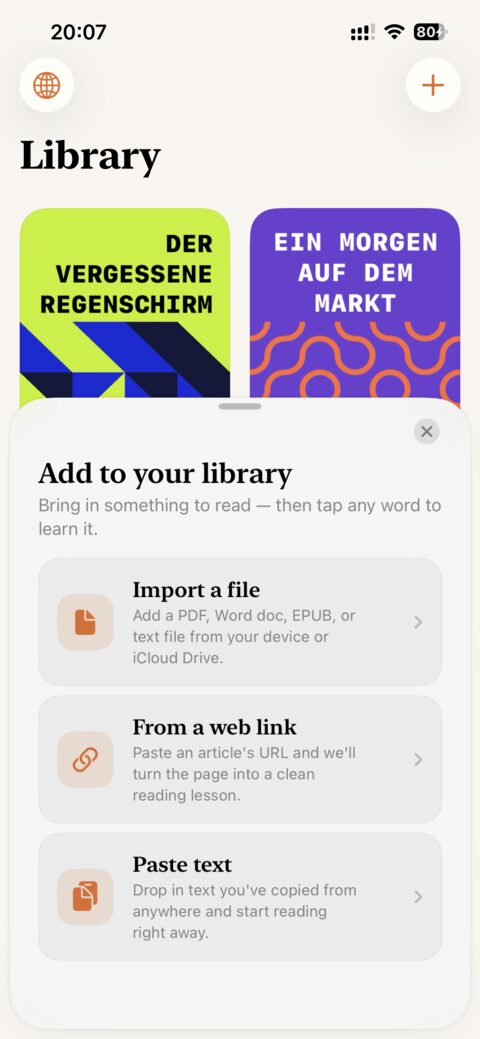
That single change, instant lookups inside real text, flips the traditional order of operations. Instead of memorizing hundreds of words before you are allowed to touch authentic Korean, you learn most of your vocabulary through reading things you enjoy. For the full case, see our deep dive on learning by reading. If you want to try this approach with Korean today, oqou is on the App Store.
Download oqou on the App Store
Speak early, even alone
Input builds comprehension, but production builds fluency, so do not wait until you feel ready to open your mouth. Read Korean sentences aloud. Shadow a line from a drama. Describe your day to yourself in simple Korean, accepting that it will be clumsy. Speaking forces you to actively retrieve words and grammar rather than merely recognize them, and that retrieval is what makes the language available when you need it. Even five minutes of talking to yourself a day compounds.
Turn encounters into memory with spaced repetition
Meeting a word once rarely makes it stick. Spaced repetition, reviewing words at expanding intervals right before you would forget them, is the most efficient way known to move vocabulary into long-term memory. When you save a word from something you read and review it on a smart schedule, you spend your review time only on the words at risk of slipping away, not the ones you already know. This is the difference between vocabulary that evaporates and vocabulary that stays.
How does Korean grammar work?
Korean grammar rests on four pillars: subject-object-verb word order, particles that tag each noun's role, verb endings that carry tense and politeness, and speech levels that adjust your formality to the situation. It works very differently from English, but it is consistent and rule-based, so once a pattern clicks it applies broadly.
English speakers find Korean grammar alien at first because it front-loads information English handles with word order and separate words. Let's take the four pillars one at a time, because understanding the logic makes the memorization far lighter.
Subject-object-verb order
The verb almost always comes last. 저는 커피를 마셔요 (jeoneun keopireul masyeoyo) means "I drink coffee," but literally reads "I coffee drink." At first this feels backwards, but you adapt faster than you expect, and it becomes second nature once you have read enough sentences. The practical upshot is that you have to listen or read to the end of a Korean sentence to know what is happening, which is one reason patient reading practice pays off.
Particles that mark each word's job
This is Korean's signature feature. Instead of relying on position alone, Korean attaches small particles to nouns to signal their grammatical role. Because these do so much work, they are worth understanding early even though mastery takes time.
| Particle | Role | Example | Meaning |
|---|---|---|---|
| 은 / 는 (eun / neun) | Topic marker | 저는 (jeoneun) | As for me… |
| 이 / 가 (i / ga) | Subject marker | 물이 (mul-i) | The water (as subject) |
| 을 / 를 (eul / reul) | Object marker | 밥을 (bap-eul) | Rice (as object) |
| 에 (e) | Location / time | 학교에 (hakgyo-e) | To/at school |
| 에서 (eseo) | Place of action | 집에서 (jip-eseo) | At home (doing something) |
Two things to notice. First, many particles come in pairs, like 은/는 and 이/가, and which one you use depends on whether the noun ends in a consonant or a vowel: 밥 ends in a consonant so it takes 을 (bap-eul), while 커피 ends in a vowel so it takes 를 (keopireul). Second, the difference between the topic marker 은/는 and the subject marker 이/가 is one of the subtlest points in all of Korean, and even advanced learners refine it for years. Do not expect to nail it fast. Expect to develop a feel for it through massive reading exposure, which is exactly what happens naturally when you read a lot.
Verb endings that carry tense and politeness
Korean verbs are built from a stem plus endings. The dictionary form of "to eat" is 먹다 (meokda). Drop the 다 and you get the stem 먹 (meok), onto which you stack endings. 먹어요 (meogeoyo) is present tense, polite. 먹었어요 (meogeosseoyo) is past tense, polite. 먹을 거예요 (meogeul geoyeyo) is future. The endings do the grammatical heavy lifting that English spreads across helper words like "will" and "did." It looks like a lot, but the patterns repeat across nearly every verb, so learning them once pays off everywhere.
Speech levels and honorifics
Korean bakes social relationships into its grammar. You speak differently to a close friend than to a stranger, an elder, or a boss, and this shows up in verb endings and vocabulary. The same idea, "did you eat?", ranges from casual 먹었어? (meogeosseo?) to polite 먹었어요? (meogeosseoyo?) to formal 식사하셨어요? (siksahasyeosseoyo?). For beginners, the good news is that the polite 요 (yo) level is safe in almost every situation, so you can be understood and respectful with just one level while you gradually absorb the others. Honorifics are real work, but they are learnable work, and reading dialogue is one of the best ways to internalize when each level fits.
How do you build Korean vocabulary that sticks?
Build vocabulary by meeting words in context and reviewing them with spaced repetition, not by grinding isolated word lists. Lean on Sino-Korean roots, the shared building blocks behind a huge share of the vocabulary, so that learning one root unlocks many words at once. Words learned inside real sentences stick far better than words learned alone.
Vocabulary is where Korean quietly rewards the patient learner, because its word-formation is more systematic than it first appears. Two strategies do most of the work.
Exploit Sino-Korean roots
A large portion of Korean vocabulary comes from Chinese roots, called Sino-Korean words, and they behave like Latin and Greek roots in English: learn one, recognize it everywhere. Take the root 학 (hak), meaning study or learning. It appears in 학교 (hakgyo, school), 학생 (haksaeng, student), 대학 (daehak, university), and 학문 (hakmun, scholarship). Or take 수 (su), water, which shows up in 수영 (suyeong, swimming) and other water-related words. Once you start noticing these roots, your vocabulary growth accelerates, because each new word is often a recombination of pieces you already know. You do not need to study the Chinese characters themselves to benefit; just noticing the recurring syllables is enough.
Learn words in context, then space your reviews
A word learned from a flashcard that says "사과 = apple" is fragile. A word learned from a sentence like 사과를 먹었어요 (sagwareul meogeosseoyo, I ate an apple) comes with grammar, a particle, and a mental image attached, so it lodges more deeply. This is why reading is such an efficient vocabulary engine. When you tap a word in a text and save it with its surrounding sentence, you capture the context along with the meaning. Then spaced repetition schedules that word for review right when you are about to forget it, so it graduates into permanent memory with minimal wasted effort. The pairing of context and spacing is the whole game.
Prioritize frequency
Not all words are worth the same effort. A small set of high-frequency words covers most of what you read and hear, and the guideline that knowing about 95 to 98 percent of the words on a page lets you read comfortably means those common words matter most. Front-load the words that appear constantly, like 하다 (hada, to do), 있다 (itda, to exist/have), 사람 (saram, person), and 것 (geot, thing), and you will feel your comprehension jump. Reading naturally exposes you to words in frequency order, since common words simply appear more often, so a reading-first approach handles this prioritization for you.
How do you start reading in Korean?
Start reading as soon as you can read Hangul, using material matched to your level: webtoons and children's stories for beginners, graded readers and simple blogs next, then news and novels. The key is a low-friction way to handle unknown words, so you spend your energy understanding rather than flipping through a dictionary. If you want to start right now, you can read free Korean short stories in your browser, no download or sign-up required.
Reading is where Korean stops being a subject you study and becomes a language you use, and the good news is that Korean has an unusually rich supply of beginner-friendly material. The trick is climbing the ladder in the right order.
Webtoons: the beginner's secret weapon
Korea invented the webtoon, the vertical-scroll digital comic, and it is arguably the best reading material for learners. The pictures give you context that supports comprehension, the dialogue is natural and conversational, the sentences are short, and the sheer variety means you can find a genre you love. Reading a webtoon you are genuinely into is the kind of input that never feels like homework, which is exactly the input that gets you to log hours without willpower.
Graded readers and simple stories
Graded readers are texts written or adapted for a specific level, keeping vocabulary and grammar within reach. Children's books and folk tales serve a similar purpose. These bridge the gap between textbook dialogues and authentic material, letting you read whole stories with a manageable number of lookups. They are not glamorous, but they build the reading stamina that makes harder material possible.
News, blogs, and novels
As you climb, Korean news sites and personal blogs offer endless, up-to-date, real-world text on every topic imaginable. News language is repetitive in a helpful way, recycling the same political and economic vocabulary, so it gets easier fast once you push through the first few articles. Eventually, novels and full webtoon archives open up, and at that point you are simply reading Korean for pleasure while still learning.
Handle unknown words without breaking flow
Whatever you read, the make-or-break factor is how you deal with words you do not know. The old way, stopping to look up each word in a dictionary, is so slow it destroys the reading habit. A tap-to-translate reading app solves this: you import the webtoon, article, or book you want, tap any unfamiliar word for an instant in-context meaning, save the ones worth keeping, and let spaced repetition handle the rest. This is precisely what oqou is built for, and because it works on-device and keeps your library private, you can read whatever you like without your material leaving your phone. An optional Pro tier adds cloud AI explanations for trickier passages and premium voices for hearing pronunciation, but the core reading loop is free.
What does a realistic Korean learning plan look like?
A realistic plan front-loads Hangul in week one, builds survival phrases and basic grammar over the first couple of months, then shifts the center of gravity to daily reading and listening while keeping up spaced-repetition review. Consistency matters more than intensity: thirty minutes a day, most days, beats occasional marathons every time.
- 1Master Hangul (Week 1) — Spend the first week learning to read the alphabet fluently. Ten minutes a day, practicing on real words like 안녕하세요, until romanization becomes a crutch you no longer need.
- 2Survival phrases and sound (Weeks 2–4) — Learn 30 to 50 high-value phrases, get comfortable with the polite 요 (yo) ending, and start listening daily to tune your ear to Korean rhythm and sounds.
- 3Core grammar and first reading (Months 2–3) — Study particles and basic verb endings in small doses, and begin reading simple webtoons and graded readers, tapping and saving new words as you go.
- 4Reading habit plus speaking (Months 3–6) — Make daily comprehensible reading the core of your routine, review saved words with spaced repetition, and start speaking aloud, even just to yourself, every day.
- 5Immerse and expand (Month 6 onward) — Move into news, novels, dramas, and conversation. Follow your interests, keep the review loop running, and let volume do the heavy lifting toward fluency.
The roadmap above is a skeleton. The table below fleshes it out with concrete weekly time, focus, and realistic outcomes, so you can picture what each phase feels like day to day.
| Phase | Timeframe | Daily focus | What you can do by the end |
|---|---|---|---|
| Foundation | Week 1 | Hangul drills, 10–15 min | Read any Korean word aloud, slowly but accurately |
| Survival | Weeks 2–4 | Phrases + listening, 20 min | Greet, thank, order, ask prices; recognize the 요 level |
| Core | Months 2–3 | Grammar + easy reading, 30 min | Follow simple webtoons; understand basic particles and tenses |
| Habit | Months 3–6 | Reading + review + speaking, 30–45 min | Read graded material comfortably; hold very simple conversations |
| Immersion | 6+ months | Native content + output, 45+ min | Enjoy dramas and news with support; converse with growing ease |
Make the plan stick
The best plan is the one you actually follow, so design for adherence, not for an impressive spreadsheet. Anchor your study to an existing habit, like reading a webtoon with your morning coffee. Keep the daily minimum small enough that you never have an excuse to skip it, because a five-minute session on a busy day preserves the streak that a planned two-hour session would have broken. And measure progress in exposure and enjoyment, not in guilt. If you are reading Korean you like most days and slowly needing fewer lookups, the plan is working, regardless of what any hour estimate says.
Where the tools fit
You do not need much: a way to learn Hangul, a source of leveled reading material, and a system that combines instant lookups with spaced-repetition review. A reading app that unifies the last two removes most of the daily friction, which is the friction that quietly ends most people's Korean journeys. Import what you want to read, tap what you do not know, save it, review it. That loop, repeated daily, is how the hours add up.
Start reading Korean with oqou on the App Store
Frequently asked questions
Do I need to learn Hangul, or can I just use romanization?
Learn Hangul. Romanization is a temporary crutch that actively slows you down, because it is inconsistent and hides how Korean actually sounds. Hangul takes only about a week to learn and unlocks everything else. Skipping it is the most common way beginners sabotage their own progress, so treat that first week as essential.
Is Korean harder than Japanese or Chinese?
They sit in the same FSI difficulty tier, around 2,200 hours, so all three are hard for English speakers, but they are hard in different ways. Korean has an easy alphabet but complex grammar and honorifics. Japanese shares similar grammar but adds three writing systems. Mandarin has simpler grammar but is tonal with thousands of characters. Korean's quick-to-learn script gives it an early edge.
How long until I can watch a K-drama without subtitles?
Realistically, comfortably following most dramas without subtitles takes a good while, often a year or more of consistent study, since natural speech is fast and colloquial. But you will catch individual words and phrases within months, and that partial understanding grows steadily. Watching with Korean subtitles you can pause and read is a great intermediate step that accelerates the process.
Can I learn Korean just by reading?
Reading is one of the most efficient ways to build vocabulary and internalize grammar, and it should be a central pillar, but it works best alongside listening and speaking. Reading gives you input and comprehension; listening trains your ear for real-time speech; speaking builds active recall. A reading-heavy approach with regular listening and some speaking practice is a strong, well-rounded strategy.
How many words do I need to read comfortably in Korean?
The common guideline is that knowing about 95 to 98 percent of the words on a page lets you read comfortably and infer the rest from context. In practice, a few thousand high-frequency words gets you a long way with everyday material, and Sino-Korean roots help you recognize many more without studying each one. Reading widely is how you get there.
Korean is a long, rewarding road, and the surest way to travel it is to spend time inside real Korean you enjoy. Learn Hangul this week, then start reading something that interests you and let every tapped word become one you keep. If you would like a private, on-device reading companion that turns any text into vocabulary practice, give oqou a try on the App Store and see how far a daily reading habit can take you.