Portuguese is one of the friendliest languages an English speaker can pick up: familiar Latin roots, a mostly phonetic spelling system, and a warm, musical rhythm you will actually enjoy imitating. The hard parts are real but few—nasal vowels, gendered nouns, and busy verb conjugation. This guide walks you through where to start, how long it takes, how to choose between Brazilian and European Portuguese, and how reading turns exposure into fluency.
Is Portuguese hard to learn for English speakers?
No—Portuguese is one of the easier languages for English speakers. The U.S. Foreign Service Institute puts it in Category I, its friendliest group, at roughly 600–750 hours to professional proficiency. You already recognize thousands of Latin-rooted words, and spelling maps to sound reliably. The genuine challenges are nasal vowels, noun gender, and verb endings.
Here is why Portuguese feels approachable. English borrowed heavily from Latin and French over the centuries, so a huge slice of Portuguese vocabulary looks like a lightly disguised English word. Importante, possibilidade, nacional, universidade, and informação need no translation once you learn a couple of spelling patterns—English "-tion" becomes Portuguese "-ção," and "-ity" becomes "-idade." From your first week you can read simple sentences and guess most of the nouns correctly.
Spelling helps too. Portuguese is far more phonetic than English. Once you learn how the vowels and a handful of consonant combinations behave, you can look at almost any word and pronounce it, even words you have never seen. There is no silent-letter chaos like English "through," "though," and "thought." That single fact removes a whole category of frustration and lets you read out loud with confidence early on.
So where does the difficulty actually live? In three specific places. First, the nasal vowels—the sounds written ã, õ, and -m at the end of words—have no English equivalent and take practice to hear and produce. Second, every noun has a gender, and the article and adjectives around it have to agree. Third, verbs change their endings for person, tense, and mood, which means more forms to absorb than English demands. None of these is exotic; they are simply new habits, and reading a lot is one of the most efficient ways to build them. If you want a broader picture of the timeline before you commit, our guide on how long it takes to learn a language sets realistic expectations.
It also helps to name the emotional hurdle honestly, because it trips up more learners than any grammar rule. The first few weeks of Portuguese can feel discouraging: the nasal sounds do not obey your mouth, the genders seem arbitrary, and you second-guess every verb ending. This is normal and temporary. The brain needs a stretch of noisy, imperfect exposure before the patterns click, and almost everyone who quits does so during that early fog rather than because the language is genuinely too hard. If you can push through the first month with low-stakes reading and listening—accepting that you will misunderstand things and mispronounce words—you reach the stage where Portuguese starts rewarding you, and momentum takes over. Portuguese is generous once you get past the doorway; the trick is simply to keep showing up while your ear and instincts catch up.
Should you learn Brazilian or European Portuguese?
Pick the one tied to your goals—the people you want to talk to, the places you want to visit, the media you enjoy. Brazilian Portuguese has far more speakers, learning materials, music, and film; European Portuguese matters for living in Portugal or the wider Lusophone world. They are one language with two accents and some vocabulary differences, and speakers understand each other.
Think of the split like American versus British English, only a bit wider. A Brazilian and a Lisbon native can read the same newspaper and follow each other's speech, but the sounds, some grammar habits, and a set of everyday words differ. The written language is largely unified, especially after the 2009 Orthographic Agreement trimmed many spelling differences, so most of what you read looks the same regardless of which variety you focus on.
For most self-learners, Brazilian Portuguese is the path of least resistance. Brazil has around 215 million speakers, and the sheer volume of accessible music, novelas, YouTube, and podcasts means you will never run short of listening material. The Brazilian accent also tends to keep vowels open and clearly voiced, which many beginners find easier to decode by ear. European Portuguese, by contrast, reduces and "swallows" unstressed vowels—Lisbon speech can sound faster and more clipped until your ear adjusts—but it is the right choice if you are moving to Portugal, have Portuguese heritage, or love Fado and Portuguese cinema.
Here are the differences that come up most often in daily life:
| Feature | Brazilian Portuguese | European Portuguese |
|---|---|---|
| "You" (informal) | Usually você with third-person verb | Commonly tu with its own verb form |
| Ongoing action | Estou falando (gerund) | Estou a falar (a + infinitive) |
| "di / ti" sounds | Softened to "jee / chee" (dia → "jee-a") | Kept hard (dia → "dee-a") |
| Train | trem | comboio |
| Bus | ônibus | autocarro |
| Cell phone | celular | telemóvel |
| Breakfast | café da manhã | pequeno-almoço |
| Bathroom | banheiro | casa de banho |
| Ice cream | sorvete | gelado |
| Juice | suco | sumo |
A practical tip: choose one variety as your "home base" for pronunciation and the small vocabulary differences, but do not build a wall around it. Read and listen widely. Because the written language overlaps so much, a Brazilian-focused learner who reads a Portuguese news site will understand nearly everything, and the occasional new word simply becomes another entry in your vocabulary. You are learning Portuguese, not one narrow dialect of it.
How long does it take to learn Portuguese?
Plan on roughly 600–750 hours of focused study to reach solid conversational-to-professional proficiency, based on FSI estimates for native English speakers. At an hour a day, that is around two years; at two focused hours, closer to one. You will hold simple conversations far sooner—often within a few months—and reach comfortable reading even faster.
Approx. hours to professional proficiency (FSI estimates, for native English speakers)
Treat these numbers as a compass, not a stopwatch. The FSI figure reflects intensive classroom training with homework, and "professional proficiency" is a high bar—handling meetings, reading reports, and discussing abstract topics. The milestones you actually care about arrive earlier. Ordering food, introducing yourself, asking directions, and understanding a slow, friendly conversation are the work of a few months, not years.
What moves the needle is not raw hours but the quality and consistency of those hours. Thirty focused minutes every day beats a single three-hour cram on Sunday, because language lives in memory that strengthens through spaced repetition and daily contact. A person who reads a little Portuguese every morning, reviews saved words, and listens on their commute will outpace someone who studies twice as long but sporadically.
Your background matters too. If you already speak Spanish, French, or Italian, you have a massive head start—the shared vocabulary and grammar can cut your timeline noticeably, though you will need to retrain your ear and unlearn a few false friends. If Portuguese is your first Romance language, be patient through the first month while the sounds and gender system settle in; the curve flattens quickly after that. For a deeper look at what drives the timeline in any language, see our full breakdown of how long it takes.
One more reason not to fixate on the total: motivation compounds. The learner who chases a number tends to burn out, while the learner who chases enjoyment—a novel they cannot put down, a band they love, a person they want to talk to—keeps going long enough for the hours to accumulate almost by accident. Portuguese makes this easy because there is so much fun material to fall into: Brazilian music alone could keep you engaged for years. Pick content that pulls you forward, and the 600–750 hours stop feeling like a mountain and start feeling like a hobby that happens to be teaching you a language.
Where should you start with Portuguese?
Start with three things at once: the vowel sounds (especially the nasals), a set of 100–200 high-frequency words, and the present tense of common verbs. Get your ear used to Portuguese from day one by listening as you read. This trio lets you build simple, real sentences quickly instead of memorizing rules in isolation.
Begin with sound, because Portuguese pronunciation rewards early attention. The nasal vowels are the signature feature. When you see ão—as in pão (bread), mão (hand), não (no), and coração (heart)—the sound resonates through your nose, a little like the "- own" in "town" but softer and rounder, with no hard "n" at the end. The related õe in lições (lessons) and põe (puts) works the same way. Do not aim for perfection; aim to hear the difference between pão and pau (stick) and to attempt the nasal honestly. Listening while you read the word cements the link between shape and sound.
Next, front-load the words you will use constantly. A small core of function words and everyday verbs does enormous work: ser and estar (both "to be," used differently), ter (to have), fazer (to do/make), ir (to go), querer (to want), plus e (and), mas (but), com (with), para (for/to), and question words like onde (where), quando (when), and por quê (why). Learn greetings and survival phrases as whole chunks—bom dia (good morning), por favor (please), obrigado/obrigada (thank you, with the ending matching your own gender), tudo bem? (all good?).
Then add the present tense, the workhorse tense. Regular verbs fall into three families by their ending—-ar, -er, and -ir. Take falar (to speak): eu falo (I speak), você fala (you speak), ele/ela fala (he/she speaks), nós falamos (we speak), eles/elas falam (they speak). Once you internalize one verb from each family, you can conjugate hundreds by pattern. Do not try to master every tense first; the present plus a few phrases like vou + infinitive ("I'm going to...") for the future will carry you through countless real conversations.
Resist the urge to build your foundation entirely out of grammar tables. Rules are useful as a map, but you learn a language by using it, so from the very first week you should be reading and hearing Portuguese in real sentences even if you understand only fragments. A children's picture book, the lyrics to a song you like, or a short dialogue with audio does more for you than a page of conjugation charts, because it shows the grammar doing its job in context. Learn just enough theory to make sense of what you are reading, then get back to the reading. The goal of these first weeks is not mastery—it is to make Portuguese familiar enough that it stops feeling like code and starts feeling like language.
What's the fastest way to learn Portuguese?
The fastest route combines lots of understandable input with a little speaking practice. Read and listen to Portuguese you can mostly follow, look up the words you do not know, review them with spaced repetition, and speak regularly—even to yourself. This loop—exposure, capture, review, produce—builds real fluency faster than grinding grammar drills alone.
The engine underneath this is comprehensible input: language that is just a bit above your current level, understandable with a little effort. When you understand a sentence, your brain quietly absorbs its vocabulary, word order, and grammar without you memorizing a rule. The trick is finding material at the right difficulty—too easy and you learn nothing new, too hard and you drown. Reading with instant word lookups keeps you in that productive zone, because you can reach for anything and still follow it.
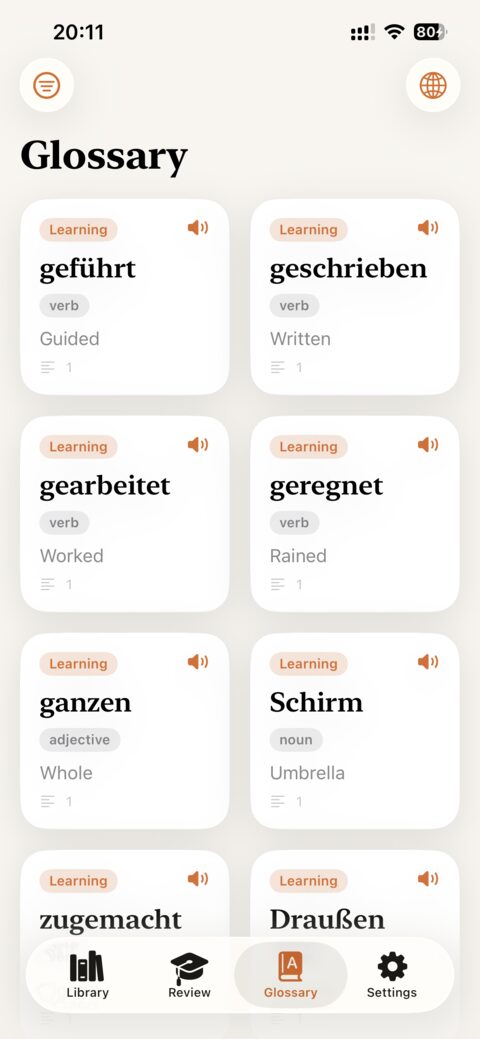
That is exactly the problem oqou is built to solve. You read whatever you want—a novel, a news article, a PDF—and tap any word to see its meaning in that specific context, not a random dictionary guess. You save the word with one tap, and it goes into a personal glossary you review with spaced repetition. Because the lookups are instant and in-context, you never break the flow of reading, so you actually finish the article and pick up dozens of words along the way.
Pair reading with listening so the sounds and the spellings reinforce each other. Listen to a podcast, a song, or an audiobook while you follow the text, and the nasal vowels and Brazilian "jee/chee" softening stop being abstract rules and become sounds you recognize. Add speaking as soon as you have a handful of phrases—narrate your day in Portuguese, repeat lines out loud, or book a cheap conversation session online. Speaking early feels awkward, but it forces your brain to retrieve words actively, which locks them in far better than passive recognition.
The honest truth is that there is no shortcut around volume and consistency. What "fastest" really means is making your exposure efficient: every reading session should teach you new words you capture and review, and every listening session should stretch your ear a little. Do that daily for a few months and you will be startled by how much you understand.
Download oqou on the App Store and start turning anything you read into Portuguese you actually remember.
How do you build Portuguese vocabulary that sticks?
Learn words from real context, then review them on a spacing schedule. Meeting a word inside a sentence you understand—and saving it with its meaning, gender, and a real example—creates far stronger memories than memorizing isolated flashcards. Spaced repetition then shows each word again right before you would forget it, moving it into long-term memory.
The 95–98% coverage guideline explains why vocabulary is the real gatekeeper. To read comfortably and guess unknown words from context, you generally need to understand about 95–98% of the words on a page. Below that, you are looking up so much that comprehension collapses and reading becomes a chore. Above it, the unknown words are sparse enough that context carries you and each new word is a small, pleasant discovery. Getting there is mostly a matter of steadily accumulating high-frequency vocabulary.
The most efficient way to grow that vocabulary is to harvest words from things you are already reading rather than working through generic word lists. When you tap a word in a story you care about, you learn its meaning inside a situation you remember—and that emotional and narrative context is memory glue. A word you looked up because you needed it to finish a gripping chapter sticks; the same word on a decontextualized list slides off.
For Portuguese specifically, always capture two extra pieces of information with each noun: its gender and a sample phrase. Learn a mesa and o livro, not just mesa and livro, so the gender rides along with the word instead of becoming a separate thing to memorize later. For verbs, save a short conjugated example—ele fez (he did), eu fui (I went)—so you meet irregular forms in context. This is the quiet power of reviewing saved words in an app like oqou: your glossary is made of your words, each with its meaning and audio, and spaced repetition schedules the reviews so you spend your effort exactly where it is needed. Reading naturally biases you toward the most common words, because frequent words appear again and again—so your vocabulary grows in roughly the order of usefulness.
A quick note on how much to review, because more is not always better. Spaced repetition is efficient precisely because it does not ask you to review everything every day; it surfaces a word right when your memory of it is about to fade. That means a sustainable daily review of your saved words—often just five or ten minutes—does more than a marathon session once a week. Keep the individual entries small and honest, too: a word, its meaning in the context where you met it, its gender if it is a noun, and one example sentence. Bloated cards with five definitions and a grammar essay are harder to review and easier to skip. Trust the reading to keep feeding you new words, trust the spacing to schedule the reviews, and your job shrinks to showing up for a few minutes and being curious about what you read.
How do you start reading in Portuguese?
Start below your comfort level and climb: graded readers and children's stories first, then simple news and blogs, then novels and literature. Song lyrics are a fantastic bridge because they are short, repetitive, and emotionally sticky. The key is a tool that lets you tap unknown words instantly, so you keep reading instead of stalling on a dictionary.
Reading is the single highest-leverage habit for a Portuguese learner, because it delivers comprehensible input on demand, exposes you to correct grammar thousands of times, and grows vocabulary in frequency order. Our full guide to learning by reading lays out the method; here is how to apply it specifically to Portuguese.
Begin with graded readers—books written with controlled vocabulary for learners—or children's stories and simple fairy tales you may already know. Familiar plots let you guess unfamiliar words, which is exactly the skill you want to build. Short bilingual stories and "easy Portuguese" collections work well here. Do not measure success by pages; measure it by understanding. If you follow the gist and enjoy it, you are reading at the right level.
Once simple stories feel easy, move to real-world text at manageable difficulty. Brazilian and Portuguese news sites often have short, clearly written articles; blogs, recipes, and product descriptions use everyday language; and Wikipedia articles on topics you already know give you context to lean on. This is where an instant-lookup reader earns its keep—news vocabulary is broad, and being able to tap a word and keep going is the difference between finishing an article and abandoning it.
Then step up to novels, short stories, and journalism written for native readers. Brazilian and Portuguese literature is rich—from accessible contemporary fiction to giants like Machado de Assis and José Saramago—and by this stage you can read for pleasure, looking up only the occasional word. Along the way, keep music in rotation. Portuguese-language songs are short, endlessly repeatable, and packed with everyday phrasing; reading the lyrics as you listen ties sound to spelling and teaches you how casual, spoken Portuguese actually flows. Bossa nova, MPB, Brazilian funk and pop, and Portuguese Fado each give you a different register to absorb.
Whatever level you are reading at, protect two habits that make the difference between reading that teaches and reading that frustrates. First, read things you genuinely want to read—interest is what keeps you turning pages long enough to absorb the language, so a mediocre article about your favorite hobby beats a great one about something you find dull. Second, do not translate every single word; let your eyes glide over the ones you can guess and only stop for the words that block understanding. The point is comprehension and flow, not a perfect decoding of every sentence. Over weeks, the same high-frequency words keep reappearing until you know them cold, the material you once found hard becomes easy, and you quietly graduate to the next level without ever feeling like you sat down to "study."
What are the trickiest parts of Portuguese?
The four hardest features are nasal pronunciation, noun gender, verb conjugation, and false friends—especially with Spanish. None is a wall; each is a habit you build through exposure. Nasal vowels take ear training, gender and conjugation take repeated contact until the patterns feel automatic, and false friends simply take awareness and a few memorable corrections.
Nasal pronunciation. This is the sound feature with no English parallel. Beyond ão and õe, watch for nasal vowels created by a following m or n: sim (yes), bem (well), um (a/one), ontem (yesterday). The m is not fully pronounced as an English "m"—it nasalizes the vowel before it. And beware the ã in words like irmã (sister) and maçã (apple). The fix is listening while reading, over and over, until your ear stops needing the "n" it expects.
Noun gender. Every noun is masculine or feminine, and articles and adjectives must agree: o carro vermelho (the red car) but a casa vermelha (the red house). The rough rule—words ending in -o tend to be masculine, -a feminine—covers a lot but has traps. O problema, o dia, and o mapa are masculine despite ending in -a; a mão (hand) is feminine despite ending in -o-ish. The reliable fix is to always learn a noun with its article, so the gender is baked in from the start.
Verb conjugation. Portuguese verbs change endings for person, tense, and mood, and the important verbs are irregular. Ser (I am = eu sou, you are = você é, we are = nós somos) and ir (I go = eu vou, I went = eu fui) do not follow the neat patterns. There is also the ever-useful ser-versus-estar distinction: both mean "to be," but ser marks permanent traits (ela é alta, she is tall) while estar marks temporary states (ela está cansada, she is tired). Reading gives you these forms in context hundreds of times, which is how they become automatic.
False friends. These trip up everyone, and they are worse if you know Spanish, because the languages look so alike. A few worth memorizing:
| Portuguese word | Actually means | What you might expect |
|---|---|---|
| puxar | to pull | English "push" (it's the opposite—a classic door trap) |
| pretender | to intend | English "pretend" |
| assistir | to watch / attend | English "assist" |
| livraria | bookstore | English "library" (that's biblioteca) |
| esquisito | weird / strange | Spanish exquisito (delicious) |
| oficina | workshop / garage | Spanish oficina (office—that's escritório) |
| borracha | eraser / rubber | Spanish borracha (drunk) |
| polvo | octopus | Spanish polvo (dust) |
The good news is that false friends are memorable precisely because they surprise you. Get burned once by pushing a puxe door and you will never forget it. Awareness plus a handful of vivid mistakes is all it takes.
What does a realistic Portuguese learning plan look like?
A realistic plan builds in layers: sounds and survival phrases first, then core vocabulary and the present tense, then daily reading and listening, then speaking practice, then real content at native difficulty. Aim for 30–60 minutes a day, keep it consistent, and let reading carry the heavy lifting of vocabulary growth over the months.
- 1Tune your ear and mouth — Spend weeks 1–4 on the vowel sounds, nasals (pão, sim, lições), and 100+ survival phrases. Listen while you read every day.
- 2Lock in the core — Learn the present tense of -ar / -er / -ir verbs plus ser, estar, ter, ir, and your first 300 high-frequency words, always saving nouns with their gender.
- 3Start reading with tap-to-translate — Move from graded readers to simple news, tapping unknown words and saving them to a spaced-repetition glossary. Read a little every single day.
- 4Add listening and speaking — Layer in podcasts, music, and short conversation sessions. Narrate your day out loud; repeat lines you read to link spelling to sound.
- 5Live in real content — Read novels, watch shows, and follow creators you enjoy. Keep reviewing saved words so new vocabulary sticks while comprehension climbs toward the 95–98% zone.
To make the layers concrete, here is roughly what each stage looks like on the CEFR scale and how long it tends to take with consistent daily effort. Treat the timeline as a guide—your pace depends on your hours, your background, and how much you enjoy the material.
| Stage | Rough level | What you can do | Typical time (30–60 min/day) |
|---|---|---|---|
| Foundation | A1 | Greet people, introduce yourself, read simple graded stories, order food | 1–3 months |
| Elementary | A2 | Handle everyday errands, read short news, follow slow speech | 3–6 months |
| Intermediate | B1 | Hold real conversations, read blogs and simple novels, understand a lot of TV | 6–12 months |
| Upper intermediate | B2 | Discuss abstract topics, read journalism and literature comfortably, work in Portuguese | 1–2 years |
| Advanced | C1+ | Nuanced discussion, near-effortless reading, humor and idiom | 2+ years of steady use |
The plan works because the stages feed each other. Your early sound work makes reading out loud possible; reading builds the vocabulary that makes listening comprehensible; listening trains the ear that makes speaking flow; and speaking reveals the gaps that send you back to read more. You do not finish one layer and abandon it—you keep all of them going, just shifting where you spend the most time as you grow. Above all, protect the daily habit. A short session every day, forever, beats any heroic weekend, and it is the single most reliable predictor of whether you will actually learn Portuguese.
Frequently asked questions
Can I understand Portuguese if I already speak Spanish? To a surprising degree, especially in writing—the shared vocabulary and grammar mean you will read a lot right away. Spoken Portuguese, particularly European Portuguese, is harder to follow at first because of the different sounds and vowel reductions. Watch out for false friends like esquisito (weird, not exquisite), and give your ear a few weeks to adjust.
Is Brazilian or European Portuguese "better" to learn? Neither is better—pick the one that fits your goals. Brazilian Portuguese has more speakers and far more learning material, music, and media, which makes it easier to immerse in. European Portuguese is the right choice for living in Portugal or connecting with Portuguese heritage. The written language overlaps heavily, so you will understand both regardless.
How do I learn the nasal sounds like "ão"? Train your ear before your mouth. Listen to words like pão, não, and coração repeatedly while reading them, and notice that the sound resonates through the nose with no hard "n" at the end. Imitate out loud, record yourself, and compare. Reading while listening—so you connect the written ão to its sound—is the fastest way to internalize it.
Do I really need to learn all the verb conjugations? Not all at once. Master the present tense first, plus the irregular forms of ser, estar, ter, and ir, and use vou + infinitive for the future. That carries you through most everyday conversation. The past and subjunctive come later—and reading exposes you to them in context so many times that they start to feel natural before you formally "study" them.
How does reading actually help me speak? Reading floods your brain with correct grammar, natural phrasing, and high-frequency vocabulary—the raw material speaking draws on. When you read a lot, words and sentence patterns become familiar, so they are available for retrieval when you talk. Reading is not a substitute for speaking practice, but it makes every speaking session more productive because you have more language to reach for.
Portuguese rewards the reader more than almost any other habit. Read a little every day, tap the words you do not know, review them until they stick, and the language quietly becomes yours. Get oqou on the App Store and start reading Portuguese today—on your phone, at your level, one tapped word at a time.