Russian opens a door to one of the world’s great literatures, to roughly 150 million native speakers, and to a language that quietly rewards patience. It looks intimidating at first, all unfamiliar letters and talk of six grammatical cases, but the part that scares people most, the alphabet, falls in about a week. This guide walks through how hard Russian really is, how long it takes, where to begin, and the fastest, most realistic way to make it stick.
Is Russian hard to learn?
Moderately, but not for the reason most people fear. The Cyrillic alphabet looks alien yet is learnable in roughly a week. The real challenge is grammar: six cases, three genders, and verb aspect. Russian sits in the U.S. Foreign Service Institute’s Category III, at a commonly cited approximate 1,100 hours for English speakers.
“Hard” is a slippery word, and it helps to separate what genuinely takes effort in Russian from what merely looks scary on day one. When you do, Russian turns out to be intimidating in ways that fade fast and challenging in ways you can plan around.
What only looks hard
A few features frighten beginners far more than they should:
- The Cyrillic alphabet. Those unfamiliar shapes are the single biggest reason people assume Russian is impossibly hard. In reality it is a small, mostly phonetic alphabet of 33 letters, several of which you already recognize, and it takes about a week of light practice to read.
- The look of long words. Russian words can seem like an intimidating wall of consonants, but once you can decode Cyrillic and hear the syllables, they break into manageable pieces like any other language.
- No cognate comfort at first. Unlike Spanish, Russian shares fewer obvious cognates with English, so early vocabulary feels like starting from zero. It does not stay that way, and there are more shared words than you expect, especially modern and technical ones.
What genuinely takes effort
Being honest about the real work saves you from frustration later. A handful of features are what actually earn Russian its Category III rating:
- The case system. Nouns, adjectives, and pronouns change their endings depending on their job in the sentence. This is the defining challenge of Russian, and we give it a full section below.
- Grammatical gender. Every noun is masculine, feminine, or neuter, and the words around it must agree.
- Verb aspect. Most verbs come in pairs, one for ongoing or repeated actions and one for completed ones, and choosing the right one is a habit you build over time.
- Pronunciation details. Rolled р, the hard and soft sign, palatalized (“soft”) consonants, and unpredictable stress that shifts vowel sounds all take some ear training.
None of these are dealbreakers. They are speed bumps, and every one of them becomes intuitive with enough exposure. The most important idea in this whole guide is that difficulty is not a fixed property of the language; it is a function of how you study. Meet Russian through material you find interesting and mostly understand, and the cases sink in almost by themselves. We will come back to exactly how that works.
How quickly can you learn the Cyrillic alphabet?
About a week of light, daily practice is enough to read Cyrillic slowly, and a few weeks of reading makes it automatic. The alphabet has 33 letters, it is largely phonetic, and several letters look and sound just like their English counterparts. It is the fastest, most encouraging win in your whole Russian journey.
Do not let the alphabet delay you or scare you off. It is genuinely the easy part, and clearing it early unlocks everything else, because from that point on you can read real Russian text. Here is how the letters break down.
Three groups of letters
It helps to sort Cyrillic into three buckets, because two of the three are nearly free:
- Old friends. Some letters look like English and sound like it too: А а (a), К к (k), М м (m), О о (o), Т т (t, in its printed form). You can read these on sight.
- False friends. A tricky set looks like English letters but sounds different: В is “v,” Н is “n,” Р is “r,” С is “s,” У is “oo,” and Х is a throaty “kh.” These need a little deliberate practice so you do not misread them.
- Brand-new shapes. The rest are genuinely new, like д (d), ж (zh, like the “s” in “measure”), л (l), п (p), ф (f), ш (sh), and я (ya). Most map to a single familiar sound, so they are just a matter of repetition.
Why it clicks so fast
Cyrillic is close to phonetic, which means letters map reliably onto sounds, so once you know a letter you can read it anywhere. Compare that to a logographic system like Chinese, where you must learn thousands of characters, or even to English, with its through, tough, and though. Within a few days you can sound out words like привет (privet, hi), спасибо (spasibo, thank you), and ресторан (restoran, restaurant), and that last one reveals a happy secret: plenty of international words are hiding in plain sight once you can read the script.
How to actually learn it in a week
Spend fifteen minutes a day for about seven days. Learn a handful of letters at a time, starting with the old friends, then the new shapes, then the false friends last so they do not muddle the others. Practice by reading real words rather than reciting the alphabet in order, and lean on transliterated words like метро (metro), такси (taksi, taxi), and кофе (kofe, coffee) that give you an instant reward. By the end of the week you will read slowly but accurately, and speed comes on its own the more you read.
How long does it take to learn Russian overall?
For an English speaker, the Foreign Service Institute puts Russian at a commonly cited approximate 1,100 hours to reach professional working proficiency, placing it in Category III. That is roughly double an easy language like Spanish, mostly because of the grammar. Expect around one to two years at a serious daily pace, with conversational comfort arriving much sooner.
Those numbers are approximations, and your real timeline depends far more on your habits than on the language itself. Still, the FSI framework is useful because it ranks languages by how long they typically take English speakers, and it places Russian in the moderately challenging tier alongside Greek and Hindi, well below the hardest group.
Approx. hours to professional proficiency (FSI estimates, for native English speakers)
What the hours actually translate to
Raw hours are abstract, so here is a rough sense of the milestones you will pass. These are ballpark, not promises, and different learners hit them at different speeds:
- First 50 hours: you read Cyrillic, greet people, count, order food, and sound out simple signs and menus.
- Around 200 to 350 hours: you hold slow conversations on familiar topics, recognize the common cases when you meet them, and read graded readers with support.
- Around 600 to 800 hours: you follow simplified news, express most everyday ideas even if imperfectly, and read short stories with regular lookups.
- Around 1,100 hours: you handle work conversations, read real literature and journalism with occasional lookups, and understand native speakers at natural speed.
The variable that matters most: consistency
Two learners with the same 1,100 hours will get wildly different results depending on how those hours are distributed. Thirty minutes a day, every day, beats a five-hour cram once a week by a large margin. Language lives in your habits, not your intentions, and Russian’s grammar in particular rewards the slow drip of daily exposure that lets patterns settle in.
The other big multiplier is exposure. Study hours where you actively read, listen, and produce Russian are worth far more than passive hours of grammar tables you forget by lunch. If you want a fuller breakdown of realistic timelines and what speeds them up or slows them down, our guide on how long it takes goes deeper. The short version: pick a pace you can sustain, then protect it.
Where should you start with Russian?
Start with the Cyrillic alphabet, then the sounds, then a few hundred of the most common words and a handful of essential verbs in the present tense. In your first weeks, aim to read Cyrillic confidently, pronounce Russian clearly, and form simple present-tense sentences. Save the deep case drills for a little later, once you have real sentences to attach them to.
A good beginning removes friction later, so it is worth spending your first sessions on foundations rather than rushing into grammar charts. Here is the order that works.
First, the alphabet and the sounds
As covered above, learn to read Cyrillic in your first week, because everything else depends on it. Alongside the letters, tune your ear to a few sounds that trip up English speakers: the rolled р (r), the throaty х (kh), and the difference between hard and soft consonants, where a following ь (the soft sign) or a “soft” vowel palatalizes the consonant before it. Also learn that stress is unpredictable and it changes vowel sounds, so an unstressed о (o) usually sounds like “a.” You do not need to master these perfectly; you need to notice them.
Then, the highest-frequency words
A small set of words does an outsized share of the work in any language. In Russian, learning the top few hundred words unlocks the connective tissue of nearly every sentence. Start with greetings and function words: да (da, yes), нет (net, no), и (i, and), в (v, in), на (na, on), это (eto, this is), я (ya, I), ты (ty, you). Add everyday verbs like быть (byt', to be), иметь (imet', to have), хотеть (khotet', to want), and мочь (moch', to be able). You will absorb most of these through the reading habit we discuss below rather than by grinding lists.
Then, simple present-tense sentences
Here is a gift Russian gives beginners: it has no articles, so there is no a or the to worry about, and in the present tense it usually drops the verb “to be” entirely. That means я студент (ya student) literally reads “I student” and means “I am a student.” You can say a surprising amount right away: это книга (eto kniga, this is a book), я хочу кофе (ya khochu kofe, I want coffee), где метрo? (gde metro?, where is the metro?). That is real, usable Russian from week one, before you have touched a single case ending.
What’s the fastest way to learn Russian?
The fastest way is to combine large amounts of comprehensible input, mostly through reading and listening you actually enjoy, with regular speaking practice and a system for reviewing new words. You learn a language by understanding messages in it, so spend most of your time consuming Russian you can mostly follow, and let grammar rules confirm patterns you have already met.
This is not a trick or a hack; it is where the most effective learners and the research behind comprehensible input converge. The idea, associated with linguist Stephen Krashen, is that you acquire language when you understand messages that sit just a little above your current level. Your brain infers the rules from meaningful context, the same way children do, without needing every grammatical detail spelled out first. For a case-heavy language like Russian, this matters even more, because you will meet the six cases in real sentences long before any chart could make them intuitive.
Why input comes first
You cannot produce what you have never taken in. If you try to speak before you have heard and read enough Russian, you are assembling sentences from grammar tables in real time, which is slow and error-prone, and doubly so when every noun might change its ending. Learners who front-load large amounts of understandable input build an intuitive feel for how Russian actually sounds and flows, so that when they do speak, the right endings are already there. Input builds the reservoir; speaking draws from it.
Reading is the most controllable input
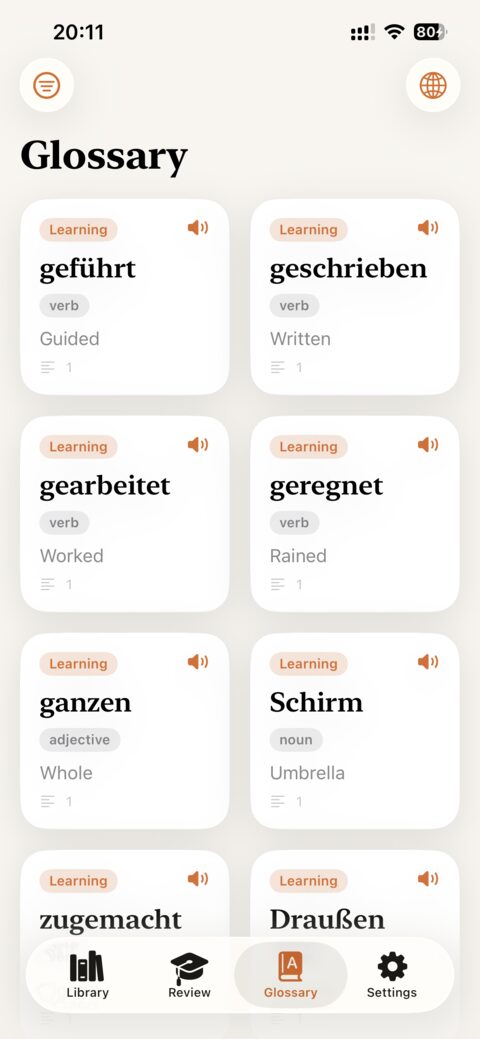
Of all the ways to get comprehensible input, reading is the one you control most completely. You set the pace, you re-read anything confusing, and you can instantly look up words without missing anything. Listening moves at the speaker’s speed and vanishes the moment it is spoken; a page waits patiently for you. For most self-learners, reading is the highest-leverage habit, and it happens to be exactly what an app like oqou is built around, letting you turn any book, article, or PDF into a lesson at your level.
Add speaking, but do not wait for perfection
Input builds comprehension; output builds fluency and confidence. Once you have some words and sentence patterns, start speaking, even badly. Talk to yourself, describe your day out loud, use a language-exchange partner or a tutor, or narrate what you are reading. The goal is not to produce flawless case endings; it is to make the language a physical habit and to discover the gaps that tell you what to study next. Speaking early feels uncomfortable, and that discomfort is exactly the sign that you are learning.
Let grammar serve, not lead
Grammar is useful, but as a confirmation tool, not a starting point. When you keep meeting the genitive case in your reading, a five-minute explanation suddenly clicks, because you have real examples to hang it on. Studying the full case system in the abstract, before you have encountered it in the wild, is the slow, discouraging road. Read first, then let a grammar note tidy up what you have already half-figured-out.
How does Russian grammar work?
Russian grammar rests on a few big pillars: six grammatical cases that change word endings, three genders, verb aspect that pairs each verb into ongoing and completed versions, no articles, and flexible word order. It is genuinely different from English, but it is regular and learnable, and exposure does most of the teaching.
Let us take the pillars one at a time, because understanding the shape of each difficulty makes it far less intimidating when you meet it in real text.
The six cases
The case system is the heart of Russian. Instead of relying mostly on word order the way English does, Russian changes the ending of a noun (and its adjectives and pronouns) to show its job in the sentence. The same word “book” takes six different forms depending on whether it is the subject, the object, the thing being given to, and so on. Here is книга (kniga, book), a feminine noun, in all six cases:
| Case | Russian name | What it marks | Example: “book” |
|---|---|---|---|
| Nominative | именительный (imenitel'nyy) | The subject; the dictionary form. Answers “who/what.” | книга (kniga) |
| Genitive | родительный (roditel'nyy) | Possession, “of,” absence, and after many numbers. | книги (knigi) |
| Dative | дательный (datel'nyy) | The indirect object, “to” or “for” someone. | книге (knige) |
| Accusative | винительный (vinitel'nyy) | The direct object; the thing being acted on. | книгу (knigu) |
| Instrumental | творительный (tvoritel'nyy) | “By” or “with” something; the means or tool. | книгой (knigoy) |
| Prepositional | предложный (predlozhnyy) | Location and “about,” always used with a preposition. | (о) книге (o knige) |
It looks like a lot, and it is real work, but keep two things in mind. First, the endings are patterned, not random, so once you internalize a few templates you can predict most of them. Second, you do not memorize six tables and then start reading; you start reading and let the tables become familiar. When you keep seeing в книге (v knige, in the book) for location and нет книги (net knigi, there is no book) for absence, the cases stop being abstract grammar and become things you simply recognize.
Gender and agreement
Every Russian noun is masculine, feminine, or neuter, and you can usually tell which from the ending: consonants are typically masculine (стол, stol, table), -а/-я endings are typically feminine (книга, kniga, book), and -о/-е endings are typically neuter (окно, okno, window). Gender matters because adjectives and past-tense verbs must agree with it, so “new” changes shape: новый стол (novyy stol, new table) but новая книга (novaya kniga, new book). Learn each noun with its gender in mind and this becomes second nature.
Verb aspect: perfective and imperfective
This is the feature with no real English equivalent, so it deserves attention. Most Russian verbs come in a pair. The imperfective describes an ongoing, repeated, or in-progress action, while the perfective describes a single completed action with a result. So читать (chitat', to read, imperfective) is the process of reading, and прочитать (prochitat', to read, perfective) is reading something all the way through. Likewise писать (pisat', to write) and написать (napisat', to finish writing), or делать (delat', to do) and сделать (sdelat', to get done). English leans on context and extra words to signal this; Russian bakes it into the verb, and picking the right member of the pair is a habit you build through exposure rather than a rule you memorize once.
No articles, flexible word order
Two features cut the other way and make life easier. Russian has no articles at all, so you never agonize over a versus the. And because case endings already mark who does what to whom, word order is flexible and used mainly for emphasis. Мама любит папу (mama lyubit papu, mom loves dad) can be rearranged for stress without changing who loves whom, because the endings carry that information. English cannot do this, which is one reason the case system, for all its difficulty, is powerful once you own it.
How do you build Russian vocabulary that sticks?
Learn words in context, then review them with spaced repetition. Meeting a word inside a real sentence gives your brain a meaning, an example, and an emotional hook all at once, which is far stickier than a bare translation. Then reviewing that word at expanding intervals, right before you would forget it, locks it into long-term memory efficiently.
Vocabulary is where most learners either soar or stall, and Russian adds a twist: words change their endings, so the form you save may not match the form you meet next. The principles below handle both problems.
Learn word roots and families
Russian is wonderfully systematic once you notice its roots. A single root spins off a whole family of related words through prefixes and suffixes, so learning one gives you a foothold on many. Take the root пис- (pis-, writing): писать (pisat', to write), письмо (pis'mo, a letter), писатель (pisatel', a writer), подписать (podpisat', to sign). Recognizing roots turns a wall of unfamiliar words into a network of guessable ones, and it makes those intimidating long words far less intimidating.
Context beats isolated lists
A word learned from a flashcard that just says мир = world is fragile, because it strips away everything that makes the word real. It is riskier still in Russian, where мир (mir) means both “world” and “peace,” and where the word will show up wearing different case endings. When you instead learn a word from a sentence you were actually reading, you capture the meaning, the case it appeared in, the words it likes to travel with, and a memory of the story it came from. That web of associations is what makes recall reliable later, which is why reading is such a powerful vocabulary engine.
Spaced repetition beats cramming
Your brain discards information it does not seem to need. Spaced repetition works with that tendency instead of against it, showing you a word again just before you would forget it, then stretching the interval each time you recall it successfully. A word you review today, then in three days, then in a week, then in a month, migrates from fragile short-term memory into durable long-term storage, with a fraction of the total reviews that blind repetition would need. The practical loop looks like this:
- Read something at your level and meet a word you do not know.
- Tap it for an in-context meaning, understand the sentence, and keep going.
- Save the word, along with the sentence it came from, so the context and the case travel with it.
- Review your saved words with spaced repetition, ideally seeing the original sentence, not just a bare translation.
An app like oqou is designed around exactly this loop, so saving and reviewing happen without breaking your reading flow. Ready to try it on your own reading? Download oqou on the App Store and turn any Russian book, article, or PDF into a tap-to-learn lesson.
How do you start reading in Russian?
Start reading the moment you can decode Cyrillic, and start easier than you think. Begin with graded readers and simple children’s stories, move to simplified news and short texts, and eventually tackle real journalism and literature. Tap-to-translate removes the dictionary friction that used to make Russian reading feel impossible for beginners.
Reading is the backbone of an efficient Russian routine, and it is where the case system quietly becomes intuitive. Here is how to get going without drowning.
Read as early as possible
You do not need a big vocabulary or a grasp of all six cases before you touch real text. In fact, the opposite is true: reading is how you build both. Once you can sound out Cyrillic, even short, simple sentences are worth reading, because every sentence shows you words in their natural cases and aspects. For a gentle on-ramp and mindset, our guide on reading as a beginner is a good companion.
Climb the ladder of difficulty
The whole strategy is to match the text to your level so you understand most of it, roughly the 95 to 98 percent reading-coverage guideline, and only need to look up a word every sentence or two. Below that comfort zone, reading stops being learning and becomes exhausting decoding. So start low and step up as you go:
- Graded readers and children’s books. Controlled vocabulary, present-tense-heavy grammar, and often pictures that carry half the meaning. Do not skip these out of pride; they are the fastest way to build a core and to meet the common cases gently.
- Simplified news and short stories. Real but bite-sized, introducing past tense, aspect pairs, and natural rhythm without a novel-length commitment. Learner-oriented news sites are ideal here.
- Full literature and unadapted journalism. The complete range of style, the trickier cases, regional and literary voice, and long sentences, once you can handle occasional lookups without losing the thread. Russian’s literary tradition is a genuine reward at this stage.
Tap-to-translate changes the math
Traditionally, learners were told to build a large vocabulary and master the cases before touching authentic Russian text. Instant, in-context lookups flip that logic: you can start reading real material far earlier and learn most of your vocabulary through reading rather than before it. When you can tap any unknown word, get the right sense for that sentence even though the ending has changed, then save it for later review, the friction that used to make Russian reading a chore disappears. That is the core idea behind learning by reading, and it is what makes reading practical from surprisingly early on, even in a language with six cases.
What does a realistic Russian learning plan look like?
A realistic plan starts with the Cyrillic alphabet and pronunciation, moves quickly into daily reading at your level with tap-to-translate and spaced-repetition review, meets the cases through exposure rather than rote charts, and steadily climbs from graded readers to native content while you add listening and speaking. The roadmap and table below give you a concrete path.
Plans work when they are specific and sustainable. Here is a sequence that has carried many self-learners from zero to comfortable, followed by a table of what to focus on at each stage.
- 1Master Cyrillic (week 1) — Spend fifteen minutes a day for a week until you can read the alphabet slowly but accurately. This is the single most encouraging win in Russian, and everything else depends on it.
- 2Sounds and a core kit (weeks 1–4) — Tune your ear to stress, soft consonants, and the rolled р. Pick up the top few hundred high-frequency words and form simple present-tense sentences, leaning on the fact that Russian drops “to be” and has no articles.
- 3Read every day (from week 2) — Start graded readers and children’s stories. Tap unknown words for in-context meaning, save them with their sentence, and keep the habit small and daily rather than long and rare.
- 4Meet the cases and review (from month 2) — Let the six cases and verb aspect settle in through the sentences you read, confirmed by short grammar notes. Run your saved words through spaced repetition, and begin speaking, even badly, with a partner or tutor.
- 5Climb to native content (months 3–18) — Graduate from simplified news to full articles, podcasts, shows, and eventually literature. Keep reading daily; the trickier cases and aspect choices become intuitive through sustained exposure.
What to focus on at each level
Your priorities should shift as you progress. Trying to master all six cases in week one is wasted effort, and still reading only children’s books after a year means you have stopped stretching. Use this table as a rough guide to keep your focus matched to your stage.
| Level | Grammar focus | What to read | What to add |
|---|---|---|---|
| Beginner (0–250 h) | Cyrillic, pronunciation and stress, gender, present tense, nominative and accusative cases | Graded readers, children’s books, dual-language stories, short dialogues | Daily tap-to-translate reading; save and review core words |
| Intermediate (250–700 h) | The remaining cases, past tense, verb aspect pairs, verbs of motion | Simplified news, blog posts, short stories, song lyrics | Learner podcasts; first conversations with a partner or tutor |
| Advanced (700–1,100+ h) | Aspect nuance, participles, complex sentences, idiom and register | Full novels, unadapted journalism, essays, classic literature | Native podcasts and shows; regular speaking on varied topics |
Fitting it into a real life
You do not need a free afternoon to make progress. Twenty to forty minutes of reading a day, plus a few minutes of review and some listening during your commute or chores, adds up faster than you expect, and it is exactly the kind of steady exposure the case system needs. The learners who succeed at Russian are rarely the ones with the most time; they are the ones who made it a small, pleasant, daily fixture. Choose material you love, keep the sessions short enough that you never dread them, and let consistency do the rest.
Frequently asked questions
Is Russian harder to learn than Spanish or French?
Yes, moderately. The Foreign Service Institute puts Russian at a commonly cited approximate 1,100 hours versus around 600 to 750 for Spanish and French, so roughly double. The extra time comes almost entirely from grammar, especially the six cases and verb aspect, plus a new alphabet and fewer obvious cognates. It is very achievable, just longer, and the reading habit shortens the real gap.
Do I really need to learn all six cases?
To speak and read comfortably, yes, but not all at once and not by memorizing tables first. You will use the nominative and accusative constantly from the start, and the others enter gradually as you read and listen. Most learners absorb the cases through thousands of real examples, confirmed by short grammar explanations, rather than by drilling declension charts in isolation.
How long does it take to learn the Russian alphabet?
About a week of light, daily practice is enough to read Cyrillic slowly, and a few weeks of actual reading makes it automatic. The alphabet has 33 letters, it is largely phonetic, and several letters already look and sound like their English counterparts. It is genuinely the easy part of Russian, so clear it early and let it unlock real text.
Can I learn Russian on my own without classes?
Yes. Plenty of people reach fluency entirely through self-study, and the ingredients are all available: comprehensible input from reading and listening, a spaced-repetition habit for vocabulary, and some speaking practice with exchange partners or affordable tutors. Classes can add structure and accountability, but they are optional. What is not optional is daily, enjoyable exposure to real Russian.
How can I practice Russian if I don’t know any native speakers?
You have more options than ever without leaving home. Read Russian books, news, and PDFs daily with a tap-to-translate reader; listen to Russian podcasts and shows; and use language-exchange apps or online tutors to speak with native speakers around the world for free or a few dollars a session. Consistent input plus a little regular output beats occasional in-person practice.
Russian asks for patience, but it repays it richly, and the fastest path is simply to start reading things you enjoy while a good tool handles the words and endings you do not know yet. Get oqou on the App Store and turn your next Russian book, article, or PDF into a lesson built around you.