Spanish is one of the most rewarding languages an English speaker can pick up. It is spoken by roughly half a billion people, it is written almost exactly as it sounds, and it shares thousands of words with English. This guide walks you through the whole journey: how hard it really is, how long it takes, where to begin, and the single fastest way to make Spanish stick. No shortcuts that do not exist, just a realistic plan you can start today.
Is Spanish hard to learn for English speakers?
Not especially. Spanish is one of the easiest languages for English speakers, ranked by the U.S. Foreign Service Institute in its fastest category, at a commonly cited approximate 600 to 750 hours to reach professional working proficiency. The spelling is phonetic, thousands of words are cognates, and the grammar, while different, is learnable and consistent.
“Hard” is relative, and it helps to be honest about what actually makes a language difficult versus what only feels intimidating at the start. Spanish scores low on most of the real difficulty factors and higher on a few specific ones you can plan around.
What makes Spanish genuinely easy
Several features work strongly in your favor from day one:
- Phonetic, transparent spelling. English is a mess of through, tough, and though. Spanish is not. Once you learn a small set of rules, letters map cleanly onto sounds, every time. You see biblioteca and you can say it correctly without ever having heard it.
- A huge store of cognates. English borrowed heavily from Latin and French, and Spanish descends directly from Latin, so the overlap is enormous. You already half-know words like nación, animal, hospital, familia, and importante.
- The same alphabet. No new writing system to learn, unlike Japanese, Arabic, or Russian. You start reading real text on day one.
- A predictable structure. Word order broadly resembles English (subject-verb-object), and there are very few truly alien concepts.
What takes a bit more effort
Being honest, a handful of features will slow you down at first, and pretending otherwise would set you up for frustration:
- Grammatical gender. Every noun is masculine or feminine, and the words around it must agree. English has nothing like this.
- Verb conjugation. One verb can wear dozens of endings depending on who is acting and when. Hablar (to speak) becomes hablo, hablas, habló, hablaré, and more.
- Two verbs for “to be.” Spanish splits to be into ser and estar, and choosing between them trips up almost everyone early on.
- The subjunctive mood. A whole set of verb forms for wishes, doubts, and hypotheticals that English handles more loosely.
None of these are dealbreakers. They are speed bumps, and every one of them becomes intuitive with enough exposure. The key insight is that difficulty is not a fixed property of the language; it is a function of how you study. Meet Spanish through material you find interesting and mostly understand, and the hard parts sink in almost by themselves. We will come back to exactly how that works.
How long does it take to learn Spanish?
For an English speaker, roughly 600 to 750 hours of focused study reaches solid professional proficiency, according to commonly cited Foreign Service Institute estimates. That is around six months to a year at a serious pace, or two to three years at a relaxed hour a day. Conversational comfort comes much sooner, often within a few months.
Those numbers are approximations, and your real timeline depends far more on your habits than on the language itself. Still, the FSI framework is useful because it ranks languages by difficulty for English speakers, and Spanish lands in the easiest tier, Category I, right alongside French, Italian, and Portuguese.
Approx. hours to professional proficiency (FSI estimates, for native English speakers)
What the hours actually translate to
Raw hours are abstract, so here is a rough sense of the milestones you will pass on the way. These are ballpark, not promises, and different learners hit them at different speeds:
- First 50 hours: you can greet people, order food, ask basic questions, and read very simple adapted text with support.
- Around 150 to 250 hours: you can hold slow conversations on familiar topics, follow the gist of easy podcasts, and read graded readers comfortably.
- Around 400 to 500 hours: you can read real news articles, watch shows with subtitles, and express most everyday ideas even if imperfectly.
- Around 600 to 750 hours: you handle work conversations, read novels with occasional lookups, and understand native speakers at natural speed.
The variable that matters most: consistency
Two learners with the same 600 hours will get wildly different results depending on how those hours are distributed. Thirty minutes a day, every day, beats a five-hour cram once a week by a large margin. Language lives in your habits, not your intentions. A daily streak of small, enjoyable sessions builds the memory and the reflexes that occasional marathons never do.
The other big multiplier is exposure. Study hours where you actively read, listen, and produce Spanish are worth far more than passive hours of grammar drills you forget by lunch. If you want a fuller breakdown of realistic timelines and what speeds them up or slows them down, our guide on how long it takes goes deeper. The short version: pick a pace you can sustain, then protect it.
Where should you start with Spanish?
Start with the sounds, then a few hundred of the most common words, then the present tense of a handful of essential verbs. In your first weeks, aim to pronounce Spanish confidently, recognize everyday vocabulary, and form simple present-tense sentences. Skip the grammar deep-dives; they come naturally once you have material to attach them to.
A good beginning removes friction later, so it is worth spending your first sessions on the foundations rather than rushing ahead. Here is the order that works.
First, get the sounds right
Because Spanish spelling is phonetic, a little pronunciation work at the very start pays off for the entire journey. The vowels are the anchor: a, e, i, o, u are pure and consistent, roughly “ah, eh, ee, oh, oo,” and they do not slide around like English vowels do. Nail those five and you are most of the way there.
A few consonants behave differently than you expect. The letter h is silent (hola sounds like “ola”). The letter j and the g before e or i make a throaty sound (jefe, gente). The double ll sounds roughly like an English “y” in most regions (llamar). And ñ adds a “ny” sound, as in español or año (year), which is worth learning carefully, because año and ano mean very different things. Because the system is so regular, getting the sounds down early means that when you read a word, you can also say it and remember it.
Then, the highest-frequency words
A small set of words does an outsized share of the work in any language. In Spanish, learning the top few hundred words unlocks the connective tissue of nearly every sentence. Start with function words and everyday verbs: el, la, de, que, y, en, un, ser, estar, tener, hacer, ir, poder, querer. Add greetings, numbers, days, colors, and common nouns from your daily life. You do not need to grind these in isolation; you will absorb most of them through the reading habit we discuss below.
Then, the present tense
You do not need all fourteen Spanish tenses to start communicating. The present tense alone lets you describe what you do, what things are, and what you want, which covers an enormous amount of daily life. Focus on the present of the essentials: ser and estar (to be), tener (to have), ir (to go), and a few regular -ar, -er, and -ir verbs so you internalize the standard endings. From there, you can say things like tengo hambre (I am hungry, literally “I have hunger”), voy al mercado (I am going to the market), and quiero aprender español (I want to learn Spanish). That is real, usable Spanish from week one.
What’s the fastest way to learn Spanish?
The fastest way is to combine large amounts of comprehensible input, mostly through reading and listening you actually enjoy, with regular speaking practice and a system for reviewing new words. You learn a language by understanding messages in it, so spend most of your time consuming Spanish you can mostly follow, and let grammar rules confirm patterns you have already met.
This is not a trick or a hack; it is how the most effective learners and the research behind comprehensible input converge. The idea, associated with linguist Stephen Krashen, is that you acquire language when you understand messages that are just a little above your current level. Your brain figures out the rules from meaningful context, the same way children do, without needing every grammatical detail spelled out first.
Why input comes first
You cannot produce what you have never taken in. If you try to speak before you have heard and read enough Spanish, you are inventing sentences from grammar tables, which is slow and error-prone. Learners who front-load huge amounts of understandable input build an intuitive feel for how Spanish actually sounds and flows, so that when they do speak, the right words are already there. Input builds the reservoir; speaking draws from it.
Reading is the most controllable input
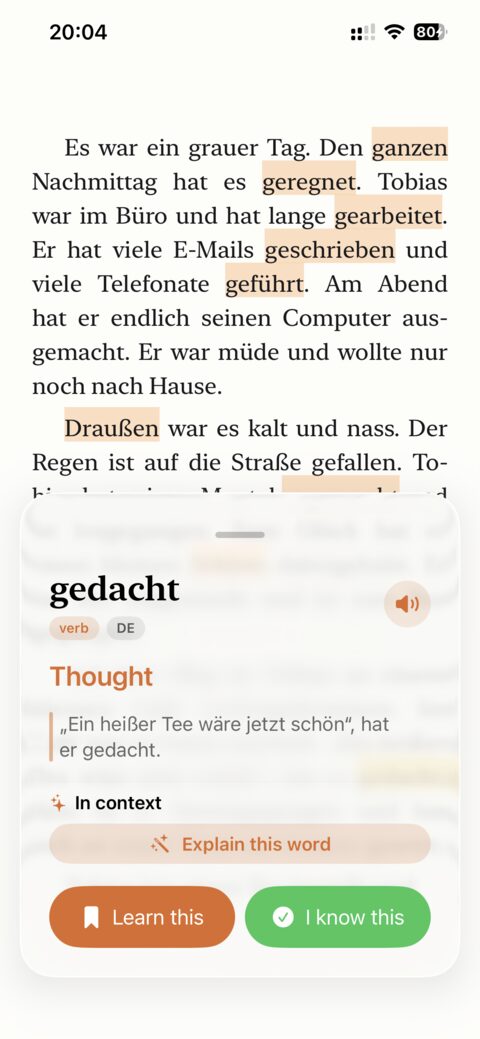
Of all the ways to get comprehensible input, reading is the one you control most completely. You set the pace, you re-read anything confusing, and you can instantly look up words without missing anything. Listening moves at the speaker’s speed and disappears the moment it is spoken; a page waits patiently for you. For most self-learners, reading is the highest-leverage habit, and it happens to be exactly what an app like oqou is built around, letting you turn any book, article, or PDF into a lesson at your level.
Add speaking, but do not wait for perfection
Input builds comprehension; output builds fluency and confidence. Once you have some words and sentence patterns, start speaking, even badly. Talk to yourself, describe your day out loud, use a language exchange partner or a tutor, or narrate what you are reading. The goal is not to be correct; it is to make the language a physical habit and to discover the gaps that tell you what to study next. Speaking early feels uncomfortable, and that discomfort is exactly the sign that you are learning.
Let grammar serve, not lead
Grammar is useful, but as a confirmation tool, not a starting point. When you keep meeting a pattern in your reading, a five-minute grammar explanation suddenly clicks, because you have real examples to hang it on. Studying grammar in the abstract, before you have encountered it in the wild, is the slow road. Read first, then let a grammar note tidy up what you have already half-figured-out.
How do you build Spanish vocabulary that sticks?
Learn words in context, then review them with spaced repetition. Meeting a word inside a real sentence gives your brain a meaning, an example, and an emotional hook all at once, which is far stickier than a bare translation. Then reviewing that word at expanding intervals, right before you would forget it, locks it into long-term memory efficiently.
Vocabulary is where most learners either soar or stall, so this deserves care. The two principles below do most of the heavy lifting.
Context beats isolated lists
A word learned from a flashcard that just says tiempo = time is fragile, because it strips away everything that makes the word real. In Spanish this is especially risky, since tiempo also means weather (hace buen tiempo, the weather is nice). When you instead learn tiempo from a sentence you were actually reading, you capture the meaning, the surrounding words it likes to travel with, and a memory of the story it appeared in. That web of associations is what makes recall reliable later. This is why reading is such a powerful vocabulary engine: every word arrives pre-wrapped in context. Our deep dive on learning Spanish by reading covers this in more detail.
Spaced repetition beats cramming
Your brain discards information it does not seem to need. Spaced repetition works with that tendency instead of against it, showing you a word again just before you would forget it, then stretching the interval each time you recall it successfully. A word you review today, then in three days, then in a week, then in a month, migrates from fragile short-term memory into durable long-term storage, with a fraction of the total reviews that blind repetition would need.
The practical workflow that ties both principles together looks like this:
- Read something at your level and meet a word you do not know.
- Tap it for an in-context meaning, understand the sentence, and keep going.
- Save the word, along with the sentence it came from, so the context travels with it.
- Review your saved words with spaced repetition, ideally seeing the original sentence, not just a bare translation.
An app like oqou is designed around exactly this loop, so saving and reviewing happen without breaking your reading flow. If you want the theory behind why the timing works, our piece on spaced repetition lays it out, and the companion on vocabulary in context explains why the sentence matters as much as the word.
Ready to try it on your own reading? Download oqou on the App Store and turn any Spanish book, article, or PDF into a tap-to-learn lesson.
How do you start reading in Spanish?
Start easier than you think, then climb. Begin with graded readers and children’s books, move to simplified news and short stories, and eventually tackle real novels and journalism. Spanish is unusually kind to beginning readers, because cognates let you understand more than your studied vocabulary suggests, and tap-to-translate removes the dictionary friction. If you want to start today, you can read free Spanish short stories in your browser, no download required.
Reading is the backbone of an efficient Spanish routine, and Spanish makes the on-ramp gentler than most languages. Here is how to get going without drowning.
Cognates give you a running start
Thousands of Spanish words are close cousins of English ones, and a few reliable patterns let you decode hundreds you have never studied. English words ending in -tion usually become -ción: nación, información, educación. Words ending in -ty often become -dad: universidad, ciudad, libertad. Adjectives in -ous tend toward -oso: famoso, curioso, generoso. Internalize a handful of these and even a beginner reading a real article understands far more than the raw word count implies, which keeps motivation high.
Just watch for false friends, the small number of words that look familiar but mean something else. The classic is embarazada, which means pregnant, not embarrassed. Others: éxito means success, not exit; ropa means clothing, not rope; librería is a bookstore, not a library; and sensible means sensitive, not sensible. These are rare enough to be charming rather than a real obstacle, but knowing the famous few saves confusion.
Climb the ladder of difficulty
The whole strategy is to match the text to your level so you understand most of it, roughly the 95 to 98 percent reading-coverage guideline, and only need to look up a word every sentence or two. Below that comfort zone, reading stops being learning and becomes exhausting decoding. So start low and step up as you go:
- Graded readers and children’s books. Controlled vocabulary, present-tense-heavy grammar, and often pictures that carry half the meaning. Do not skip these out of pride; they are the fastest way to build a core.
- Simplified news and short stories. Real but bite-sized, introducing past and future tenses and natural rhythm without a novel-length commitment.
- Full novels and unadapted journalism. The full stylistic range, the subjunctive, regional voice, and complex tenses, once you can handle occasional lookups without losing the thread.
Tap-to-translate changes the math
Traditionally, learners were told to build a big vocabulary before touching authentic text. Instant, in-context lookups flip that logic: you can start reading real material far earlier and learn most of your vocabulary through reading rather than before it. When you can tap any unknown word and get the right sense for that sentence, then save it for later review, the friction that used to make Spanish reading a chore disappears. That is the core idea behind learning by reading, and it is what makes reading practical from surprisingly early on.
What are the trickiest parts of Spanish?
The parts that give English speakers the most trouble are grammatical gender, the split between ser and estar, verb conjugation, the subjunctive mood, the pair por versus para, and a handful of false friends. None are impossible; each becomes intuitive with exposure. Knowing them in advance means they surprise you less.
Let us look at each, because understanding the shape of a difficulty makes it far less intimidating when you meet it in the wild.
Grammatical gender
Every Spanish noun is masculine or feminine, and the articles and adjectives around it must agree: el libro rojo (the red book) but la casa roja (the red house). The reliable trick is to learn each noun with its article from the start, la mesa rather than just mesa, so the gender travels with the word. Most nouns ending in -o are masculine and most in -a are feminine, but watch the traps: el día (day) is masculine despite the -a, and la mano (hand) is feminine despite the -o.
Ser versus estar
Spanish has two verbs for to be, and choosing between them is one of the most persistent beginner puzzles. The rough rule: ser is for essential, permanent qualities (identity, origin, characteristics), while estar is for states and locations that can change. Soy alto (I am tall, a lasting trait) uses ser; estoy cansado (I am tired, a passing state) uses estar. The distinction can even change meaning: ser aburrido means to be boring, while estar aburrido means to be bored. It feels fuzzy at first and becomes second nature with reading.
Verb conjugation and the subjunctive
A single Spanish verb can appear in dozens of forms depending on person, number, tense, and mood. Hablar yields hablo, hablas, habló, hablaré, hablaría, and many more. Early on this is disorienting, because the conjugated word can look nothing like the dictionary infinitive. You do not need to memorize full charts to read; you need to recognize that tuvo, tenía, and tendrá all belong to tener, and reading a lot builds that pattern recognition naturally. The subjunctive mood, used for wishes, doubts, and hypotheticals (quiero que vengas, I want you to come), is the last big piece and clicks best after you have seen it in context many times.
Por versus para
Both often translate to for, which is why they tangle English speakers. Broadly, por covers cause, exchange, duration, and movement through (gracias por tu ayuda, thanks for your help), while para covers purpose, destination, and deadlines (un regalo para ti, a gift for you). Rules help, but the fastest way to internalize the pair is to notice how they behave across dozens of real sentences until the right one simply sounds correct.
False friends
As noted above, a small set of familiar-looking words mean something unexpected. Keep the famous ones on your radar, embarazada (pregnant), éxito (success), sensible (sensitive), ropa (clothing), librería (bookstore), and you will sidestep the most common and most memorable mistakes. Everyone tells a story about their first embarazada mix-up; now it will not be yours.
What resources should you use to learn Spanish?
Use a small, balanced toolkit rather than a pile of apps: a reading tool for input and vocabulary, something for listening, a way to speak with real people, and a light grammar reference for when patterns need explaining. The best resource is the one you will use daily, so favor whatever fits your routine and interests.
You do not need a dozen subscriptions. A focused stack covering the core skills beats app-hopping every time. Here is what each slot should do.
For reading and vocabulary
This is your engine, and it deserves the best tool. You want something that lets you read material you actually care about, tap any word for an in-context meaning, save it, and review it with spaced repetition, all without leaving the page. That is precisely what oqou does: it turns your own books, news, and PDFs into leveled reading, keeps everything on-device and private, and offers an optional Pro tier with cloud AI explanations and premium voices when you want deeper help. Because you supply the content, your reading is never boring, which is the real secret to sticking with it.
For listening
Pair reading with plenty of listening so the sounds and rhythm sink in. Slow, learner-oriented podcasts are ideal at the start; graduate to native podcasts, YouTube channels, and Spanish shows with subtitles as you improve. A powerful trick is to read something first and then listen to the same content, so the audio maps onto text you already understand.
For speaking
At some point you have to open your mouth. Options range from free (language-exchange apps where you trade practice with a native speaker learning English) to paid (one-on-one tutors on marketplace sites, often for a few dollars a lesson). Even talking to yourself, narrating your day in Spanish, is genuinely useful. The point is regular, low-stakes production.
For grammar reference
Keep one clear grammar resource on hand, a good beginner book or a reputable free website, but use it as a lookup, not a curriculum. When a pattern keeps appearing in your reading, spend five minutes reading the relevant explanation, then get back to real Spanish. Grammar confirms; it should not consume your study time.
A note on doing it all in one place
The fewer tools you juggle, the more likely you are to keep going. If a single reading app can handle your input, your vocabulary saving, and your spaced-repetition review, that removes most of the friction that makes people quit. Simplicity is a feature, not a compromise.
What does a realistic Spanish learning plan look like?
A realistic plan starts with pronunciation and core words, moves quickly into daily reading at your level with tap-to-translate and spaced-repetition review, adds listening and speaking as you grow, and steadily climbs from graded readers to native content. The roadmap below and the level table give you a concrete path you can follow from your first week to fluency.
Plans work when they are specific and sustainable. Here is a sequence that has carried many self-learners from zero to comfortable, followed by a table of what to focus on at each stage.
- 1Nail the sounds (week 1) — Spend your first few sessions on the five pure vowels and the handful of tricky consonants (j, ll, ñ, silent h). Because Spanish is phonetic, this small investment pays off for the entire journey.
- 2Learn a core kit (weeks 1–4) — Pick up the top few hundred high-frequency words and the present tense of ser, estar, tener, and ir. Aim to form simple sentences about your daily life.
- 3Read every day (from week 2) — Start graded readers and children’s books. Tap unknown words for in-context meaning, save them, and keep the habit small and daily rather than long and rare.
- 4Review and speak (from month 2) — Run your saved words through spaced repetition, and begin speaking, even badly, with a partner, a tutor, or yourself. Let the gaps you find guide what you study next.
- 5Climb to native content (months 3–12) — Graduate from simplified news and short stories to full novels, podcasts, and shows. Keep reading daily; the subjunctive and complex tenses settle in through exposure.
What to focus on at each level
Your priorities should shift as you progress. Trying to master the subjunctive in week one is wasted effort, and still reading only children’s books after a year means you have stopped stretching. Use this table as a rough guide to keep your focus matched to your stage.
| Level | Grammar focus | What to read | What to add |
|---|---|---|---|
| Beginner (0–150 h) | Pronunciation, present tense, gender and articles, ser vs estar basics | Graded readers, children’s books, dual-language stories, short dialogues | Daily tap-to-translate reading; save and review core words |
| Intermediate (150–450 h) | Past tenses (preterite and imperfect), future, common irregular verbs, por vs para | Simplified news, blog posts, short stories, song lyrics, recipes | Learner podcasts; first conversations with a partner or tutor |
| Advanced (450–750+ h) | Subjunctive mood, conditional, compound tenses, nuance and idiom | Full novels, unadapted journalism, essays, literary short fiction | Native podcasts and shows; regular speaking on varied topics |
Fitting it into a real life
You do not need a free afternoon to make progress. Twenty to forty minutes of reading a day, plus a few minutes of review and some listening during your commute or chores, adds up faster than you expect. The learners who succeed are rarely the ones with the most time; they are the ones who made Spanish a small, pleasant, daily fixture. Choose material you love, keep the sessions short enough that you never dread them, and let consistency do the rest.
Frequently asked questions
Can I learn Spanish on my own without classes?
Yes. Plenty of people reach fluency entirely through self-study, and the ingredients are all available: comprehensible input from reading and listening, a spaced-repetition habit for vocabulary, and some speaking practice with exchange partners or affordable tutors. Classes can add structure and accountability, but they are optional. What is not optional is daily, enjoyable exposure to real Spanish.
How many words do I need to know to be conversational in Spanish?
Roughly the most common 1,000 to 2,000 words cover a huge share of everyday conversation, because high-frequency words do most of the work. You can hold basic conversations well before that, and comfortable everyday fluency arrives somewhere around 3,000 to 5,000 words. Learning them in context through reading is the most efficient path, since each word arrives with meaning and examples attached.
Should I learn Spain Spanish or Latin American Spanish?
Either is a fine choice, because the varieties are mutually intelligible; a speaker from Madrid and one from Mexico City understand each other easily. The differences are mainly accent, some vocabulary, and the vosotros form used in Spain. Pick whichever matches your goals, travel plans, or the media you enjoy, and do not worry: learning one gives you near-total access to the other.
Is Spanish or French easier for English speakers?
They are very close, both in the Foreign Service Institute’s easiest category at a commonly cited 600 to 750 hours. Spanish edges ahead for many learners thanks to its transparent, phonetic spelling and simpler pronunciation, while French has trickier sounds and spelling but a slightly higher cognate overlap with English. For most beginners, Spanish feels a touch more forgiving early on.
How can I practice Spanish if I don’t know any native speakers?
You have more options than ever without leaving home. Read Spanish books, news, and PDFs daily with a tap-to-translate reader; listen to Spanish podcasts and shows; and use language-exchange apps or online tutors to speak with native speakers around the world for free or a few dollars a session. Consistent input plus a little regular output beats occasional in-person practice.
Spanish rewards the reader more than almost any other language, and the fastest path is simply to start reading things you enjoy while a good tool handles the words you do not know yet. Get oqou on the App Store and turn your next Spanish book, article, or PDF into a lesson built around you.