French is one of the best first languages an English speaker can pick, and not because it is easy in the cartoon sense. It rewards you almost immediately: you already know thousands of French-derived words, the alphabet is familiar, and a huge world of books, news, and film opens up fast. This guide walks you through where to start, what actually makes French tricky, and a realistic plan you can follow without burning out.
Is French hard to learn for English speakers?
Not really. French is officially one of the easiest languages for English speakers, rated Category I by the U.S. Foreign Service Institute, roughly the same tier as Spanish and Italian. English borrowed so heavily from French that you start with a large hidden vocabulary. The real challenges are pronunciation and spelling, not grammar or word count.
It helps to separate two very different feelings. There is the feeling of a language being foreign, and there is the feeling of it being hard. French can feel foreign at first because it looks like it should be pronounced one way and is actually pronounced another. But underneath that surface, French and English are unusually close relatives. That closeness is why French consistently lands in the friendliest bucket for native English speakers.
You already know a shocking amount of French
After the Norman conquest in 1066, French became the language of England's ruling class for centuries, and English absorbed a torrent of French vocabulary. Linguists estimate that a very large share of English words trace back to French or Latin roots, and the overlap is especially dense in formal, academic, and abstract vocabulary. Words like nation, important, information, possible, question, table, animal, and impossible are spelled identically or nearly so in both languages. You will not pronounce them the same way, but you will recognize them instantly on the page.
This is a genuine head start that speakers of, say, Japanese or Arabic simply do not get. When you open a French newspaper for the first time, you will understand more than you expect, because the abstract and technical vocabulary is largely shared. That recognition keeps motivation high in the fragile early weeks.
The grammar is manageable
French grammar has real features to learn, but nothing exotic to an English speaker. Word order is broadly similar: subject, verb, object. There are only two grammatical genders, not three or four. Verb tenses map reasonably well onto English concepts, even when the endings differ. Compared with the case systems of German or Russian, or the writing systems of Mandarin and Japanese, French grammar is a gentle slope, not a cliff.
So what makes it feel hard?
Almost all of the early difficulty is pronunciation and spelling. French does not read the way it is spelled, at least not by English rules. Letters go silent, vowels turn nasal, and words blend into one another when spoken. We will tackle each of these directly, because once you understand the logic, the apparent chaos becomes a set of learnable, repeatable patterns.
How long does it take to learn French?
For a native English speaker, professional working proficiency in French takes roughly 600 to 750 hours of focused study, according to Foreign Service Institute estimates. That places French among the fastest languages to learn. Casual conversational comfort arrives much sooner, often within a few hundred hours of consistent, enjoyable practice spread over months.
The FSI figures come from intensive government language training, so treat them as a benchmark, not a promise. What they capture well is relative difficulty: French sits in the easiest group for English speakers, while languages with unfamiliar scripts and sound systems take three to four times as long. If you want a fuller breakdown of the math, our guide on how long it takes digs into what actually moves the number.
Approx. hours to professional proficiency (FSI estimates, for native English speakers)
What those hours look like in real life
Hours are only useful when you convert them into a schedule you can sustain. Consider a few honest scenarios. At 30 minutes a day, you accumulate roughly 180 hours a year, so reaching solid professional proficiency purely at that pace could take a few years. At an hour a day, you are looking at closer to 365 hours a year, which brings that milestone within two years. Someone doing an intensive immersion program, several hours daily, might get there in well under a year.
The encouraging part is that the milestones you care about most arrive far earlier than the finish line. Ordering food, following a simple conversation, reading a graded novel, understanding the gist of a news article: these are reachable in the first several months. The 600-plus hour figure is for polished, professional-grade command, not for being able to enjoy and use the language.
Consistency beats intensity
A learner who does 20 focused minutes every single day will almost always beat one who crams three hours every other Sunday, even if the raw hour counts match. Language lives in habit and memory, and memory responds to frequent, spaced contact far better than to occasional marathons. This single principle, protecting a small daily habit, is the highest-leverage decision you will make.
Where should you start with French?
Start with pronunciation and a small core of high-frequency words. Spend your first week or two learning how French letters actually sound, especially silent final consonants and nasal vowels, then layer on the most common 100 to 200 words. Getting the sound system right early prevents habits that are painful to unlearn later.
Most people rush past pronunciation to get to vocabulary and grammar, and then spend years mispronouncing words they memorized wrong. French makes this mistake especially costly because its spelling and sound diverge so much. A little upfront investment pays off for the entire journey.
Silent letters are a system, not chaos
The most jarring thing for beginners is that French does not pronounce many of the letters it writes. Final consonants are frequently silent. The word petit (small) is pronounced roughly "puh-TEE," with no audible t. Grand (big) loses its d. Beaucoup (a lot) drops the final p. Plural endings in -s are almost always silent, so les chats (the cats) sounds the same as a single le chat except for the article.
There is a rough memory aid, the word CaReFuL, whose consonants (c, r, f, l) are the letters most often pronounced at the end of a word: avec (with), bonjour (hello), neuf (nine), animal. It is not airtight, but it points you in the right direction. The key mental shift is to stop expecting written letters to be spoken, and instead learn the sound of whole words.
Nasal vowels take practice
French has a set of nasal vowels that English lacks, where air passes through your nose as you voice the vowel. They appear in extremely common words, so you cannot avoid them. Listen for the difference between on (as in bon, good), an/en (as in blanc, white, or enfant, child), in (as in vin, wine, or pain, bread), and un (as in un, one). To your ear at first, several of these will sound identical. With focused listening and imitation, the distinctions come. Do not try to master them intellectually; train them by ear.
Your first words
Once the sounds feel less alien, anchor yourself with a small set of workhorse words and phrases. These give you immediate footing:
- Greetings and courtesy: bonjour (hello), merci (thank you), s'il vous plaît (please), pardon (excuse me), au revoir (goodbye).
- Core verbs in the present: être (to be), avoir (to have), aller (to go), faire (to do/make). These four appear constantly and power countless expressions.
- Question words: qui (who), quoi (what), où (where), quand (when), pourquoi (why), comment (how).
- Glue words: le, la, un, une, de, et, mais (but), parce que (because). The connective tissue of every sentence.
Notice you do not need much grammar to start using these. A handful of nouns, four present-tense verbs, and some question words let you build real sentences within days, which is exactly the kind of small early win that keeps a habit alive.
What's the fastest way to learn French?
The fastest route combines large amounts of understandable input with regular speaking practice. Read and listen to French you can mostly follow, look up what you cannot, and speak as early as you dare. Reading is the most scalable input source because you control the pace and can meet words in real context, again and again.
There is no secret shortcut that skips the hours, but there is a smarter way to spend them. The learners who progress fastest are not the ones grinding grammar drills. They are the ones getting a steady stream of French that is slightly above their level but still comprehensible, and using it constantly. This is the idea of comprehensible input: language you can understand most of, which stretches you just enough to grow.
Why reading carries the load
Among all input sources, reading is the one you control completely. A podcast moves at the speaker's pace; a film will not pause politely while you puzzle out a phrase. Text waits for you. You can reread a sentence three times, sit with an unfamiliar construction, and look up a word without missing anything. That control is precisely what a beginner needs. It is why we treat learning by reading as the backbone of an efficient approach, especially for a language like French where the written form is so accessible to English speakers.
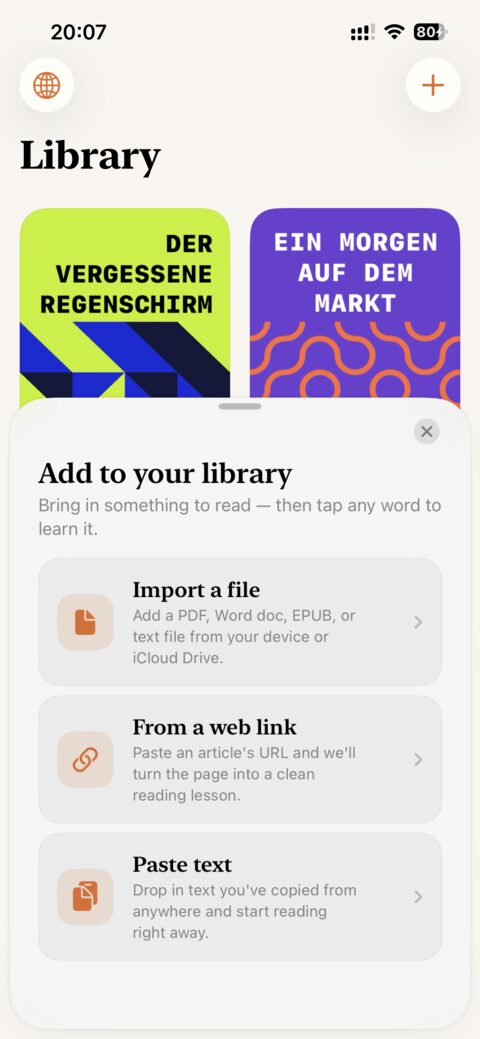
The old friction with reading was lookups. Flipping through a paper dictionary for every third word turned a page of French into a chore, and most learners quit. Modern tools remove that friction entirely. This is where an app like oqou changes the equation: you import a real French text, tap any word, and get an instant in-context meaning without leaving the page. The reading stays fluid, so you actually keep going.
Speak earlier than feels comfortable
Input builds comprehension and vocabulary, but production needs its own practice. You do not have to wait until you feel ready, because you never will. Start speaking with whatever you have. Read French aloud to train your mouth on the sounds. Narrate your day in simple sentences. Use a language exchange, a tutor, or even a patient friend. Early speaking will feel clumsy, and that is completely normal; the clumsiness is the practice working.
The efficient daily loop
A high-yield daily routine looks something like this: read a passage of French at your level, tapping unknown words as you go; save the words worth keeping; review your saved words with spaced repetition; and spend a few minutes listening or speaking. That loop touches comprehension, vocabulary, memory, and production every day, which is exactly the balanced diet that moves you forward fastest.
How do you build French vocabulary that sticks?
Learn words in context, then review them with spaced repetition. Meeting a word inside a real sentence gives it meaning, tone, and usage that a bare translation cannot. Saving that word and reviewing it at expanding intervals, just before you would forget, is the single most efficient way to move vocabulary into long-term memory.
The failure mode most learners fall into is memorizing isolated word lists. You cram 50 French nouns, ace a self-quiz, and forget 40 of them within a week because they had no hooks to hang on. Two principles fix this: context and spacing.
Context gives words meaning
A dictionary tells you that temps means "time." But temps also means "weather," and only context tells you which. Je n'ai pas le temps means "I don't have the time," while Quel temps fait-il? means "What's the weather like?" If you learned temps from a flashcard that just said "time," the weather usage would blindside you. Meeting the word inside real sentences teaches you its actual range, its register, and the words it likes to travel with. That is a far richer, stickier kind of knowing.
Spaced repetition fights forgetting
Human memory follows a predictable decay curve: you forget most new information quickly unless you revisit it. Spaced repetition schedules each review at the moment you are about to forget, which is when a reminder does the most good. Review a word today, then in a few days, then in a week, then in a month, and each successful recall pushes the next review further out. Over time, the word becomes effortless. Our deeper dive on spaced repetition explains why the timing matters so much.
The beauty of pairing reading with spaced repetition is that your review deck fills itself with words you actually encountered, in sentences you actually read. Those words are, by definition, relevant to what you like to read, which makes them worth remembering. An app like oqou stitches this together automatically: tap to understand, save with one more tap, and the word flows into a review queue timed to your memory.
Prioritize frequency
Not all words deserve equal effort. A relatively small set of high-frequency words accounts for the overwhelming majority of everything you will read or hear. The 95 to 98 percent comprehension you want on a page comes mostly from mastering these common words cold. When you are deciding what to keep and review, favor words that show up again and again over rare, specialized ones you may never meet twice.
How do you start reading in French?
Start with material at your level and climb gradually: graded readers first, then simple news and blogs, then real literature. Because English shares thousands of French-derived words, you will recognize more than you expect from day one. Match the text difficulty to your comprehension, use instant lookups for the gaps, and let the level rise as you do. If you want to start today, oqou has free French short stories you can read in your browser, no download or sign-up required.
French is a wonderful language to learn through reading precisely because of that shared vocabulary. Where a beginner in Chinese faces a wall of unfamiliar characters, a beginner in French faces a page sprinkled with words that are already half-familiar. That recognition is a gift; use it.
The cognate advantage, and its trap
Thousands of French and English words share Latin roots, which means free vocabulary. Words ending in -tion are usually identical in spelling and meaning: nation, information, situation, condition. Words ending in English -ty often become -té in French: liberté, université, réalité, société. Adjectives frequently overlap too: important, possible, difficile, social. Learn a few of these patterns and you can decode hundreds of words you never formally studied.
But be alert to false friends, words that look familiar and mean something else. These are famous traps in French. Actuellement does not mean "actually"; it means "currently" or "at the moment" (to say "actually," use en fait). Librairie is not a library; it is a bookshop (a library is a bibliothèque). Assister à means "to attend," not "to assist." Sensible means "sensitive," not "sensible." Attendre means "to wait for," not "to attend." Rester means "to stay," not "to rest." A tap-to-translate tool that shows the in-context meaning is invaluable here, because it catches exactly these mismatches before they mislead you.
A reading ladder for French
Climb one rung at a time. Each stage should feel mostly comprehensible with a manageable trickle of new words. The table below maps levels to concrete French material you can go find today.
| Level | What to read | French examples | Why it works |
|---|---|---|---|
| Beginner | Graded readers, children's books, dual-language short stories | Simplified classics, Petit Nicolas-style stories, illustrated tales | Controlled vocabulary and short sentences keep comprehension high |
| Upper beginner | Simple news, learner blogs, easy web articles | Slow-news sites for learners, straightforward lifestyle blogs | Real language, but written plainly, with familiar cognate-heavy topics |
| Intermediate | Mainstream news, opinion pieces, young-adult novels, short stories | National newspapers, popular YA fiction, magazine features | Longer clauses and more tenses stretch you without overwhelming |
| Advanced | Literary novels, long-form journalism, essays | Camus, Saint-Exupéry, contemporary literary fiction, in-depth reportage | Full stylistic range builds nuance, idiom, and cultural depth |
The Le Petit Prince by Saint-Exupéry is a beloved bridge text: it is short, gentle, and written in accessible French, yet it is real literature rather than a simplified reader. Many learners use it as their first "real" French book. If you are brand new to reading in another language, our beginner's guide on reading as a beginner covers how to ease in without drowning.
How to handle a page in practice
Read for the gist first, not for perfect understanding. Let your eyes move at a comfortable pace, tapping only the words that block meaning. Resist the urge to look up every unfamiliar word; if you can infer it or if it does not stop you from following the thread, keep going. Save the words that feel worth keeping, and let the rest wash over you. Volume matters more than precision at this stage, because the sheer quantity of French passing through your eyes is what builds intuition.
What are the trickiest parts of French?
The genuinely hard parts of French are pronunciation and liaison, grammatical gender, verb conjugation, the formal-informal distinction, and the subjunctive mood. None of them is insurmountable. Each is a known obstacle with known solutions, and most of them yield to exposure and practice rather than to memorizing rules.
Knowing where the difficulty lives helps you spend your effort wisely. Here is an honest tour of the five things that trip up most learners, and how to approach each.
Pronunciation and liaison
We covered silent letters and nasal vowels above, but there is one more twist that surprises beginners: liaison. Normally-silent final consonants come back to life when the next word begins with a vowel, linking the two words together. Les amis (the friends) is not "lay ah-mee" but "lay-zah-mee," because the silent s reappears as a z sound before the vowel. Vous avez (you have) becomes "voo-zah-vay." Un petit enfant links the t: "un puh-tee-tahn-fahn." Liaison is why spoken French sounds like one continuous stream rather than separate words. You learn it by listening and imitating far more than by studying rules.
Grammatical gender
Every French noun is either masculine or feminine, and there is often no logical reason why. Le livre (the book) is masculine; la table (the table) is feminine. Le soleil (the sun) is masculine; la lune (the moon) is feminine. Worse, gender affects the words around the noun: articles (le/la, un/une) and adjectives shift to agree. The only reliable strategy is to learn each noun with its article, so you store une voiture rather than just voiture. There are some patterns, endings like -tion and -té tend to be feminine, but exposure through reading does most of the work.
Verb conjugation
French verbs change their endings based on subject and tense, and there are three main groups plus a pile of irregulars. Regular -er verbs like parler (to speak) follow a tidy pattern: je parle, tu parles, il/elle parle, nous parlons, vous parlez, ils/elles parlent. Notice that several of those endings sound identical when spoken, even though they are spelled differently, which is actually a small mercy for listening. There are also -ir verbs (finir, to finish) and -re verbs (vendre, to sell), plus irregular heavyweights like être, avoir, aller, and faire. Start with the present tense of the most common verbs, then add the passé composé (past) and futur as you go. Conjugation feels heavy at first and becomes automatic with use.
Formal versus informal
French distinguishes between formal and informal "you." Tu is informal, for friends, family, children, and peers. Vous is formal or plural, for strangers, elders, and professional settings. Using tu with someone who expects vous can come across as overly familiar, while over-using vous with close friends feels stiff. English lost this distinction centuries ago, so it takes conscious attention. When in doubt with a new adult, start with vous and let the other person invite you to switch.
The subjunctive mood
The subjunctive is a verb mood used after certain expressions of desire, doubt, necessity, or emotion. It appears in phrases like il faut que tu sois là (you need to be there), where sois is the subjunctive of être. Beginners can safely ignore it for a while; you will be understood without it. As you read more, you will start noticing it in fixed patterns, and it will gradually become intuitive. Do not front-load the subjunctive. Let reading introduce it to you naturally, then reinforce it once the patterns feel familiar.
What resources should you use?
Use a mix: a reading tool for input, a spaced-repetition system for vocabulary, audio for your ear, and a speaking partner for output. No single app or book does everything well. The most effective setup pairs a rich source of comprehensible reading with a memory system and regular conversation, so all four skills grow together.
Resist the temptation to collect a dozen apps you never open. A small, well-chosen toolkit that you actually use daily beats an elaborate one that sits idle. Here is how to think about each category.
For reading and vocabulary
You want to read real French with as little friction as possible, and to capture the words worth keeping. This is the heart of the method. A tool that lets you import any text, tap for instant in-context meanings, and feed saved words into spaced-repetition review collapses what used to be three separate tools into one flow. That is exactly what oqou is built for, and because it runs on-device and keeps your library private, you can read anything, a novel, a news article, a PDF, without your material leaving your phone.
For listening
Your ears need their own training. French podcasts made for learners, slow-news audio, French music, and films or series with French subtitles all help you connect the sounds you have learned to real speech. Early on, listen to material with transcripts so you can see and hear at once. Later, wean yourself off the text and let your ear do the work.
For speaking
Nothing replaces talking to a person. Language-exchange apps pair you with native French speakers who want to learn your language. Professional tutors, available cheaply by the hour online, give you structured practice and correction. Even talking to yourself in simple French while you cook counts. The point is to move French from recognition into production, which only happens when you use it.
For grammar reference
Keep grammar as a reference, not a curriculum. A good grammar book or website is worth having so you can look up a construction when it puzzles you. But do not try to learn French by working straight through a grammar text. Grammar makes far more sense when you meet it in context first and then check the rule, rather than memorizing the rule in a vacuum. For a fuller argument on why input-first beats app-only study, see our take on whether one app is enough.
What does a realistic French learning plan look like?
A realistic plan builds in phases: first pronunciation and core words, then reading and daily vocabulary review, then speaking and richer material, then real literature and unscripted conversation. Spread over months of consistent daily practice, this sequence takes you from zero to comfortable, using reading as the engine and spacing as the memory.
Plans fail when they are too ambitious to sustain. The one below assumes a modest, repeatable daily commitment rather than heroic bursts. Adjust the pace to your life, but keep the sequence, because each phase builds the foundation for the next.
- 1Sounds first (weeks 1–2) — Drill French pronunciation: silent final letters, nasal vowels, and liaison. Learn the sounds before the spellings so bad habits never form.
- 2Core words and present tense (weeks 3–6) — Absorb the 200 most common words plus the present tense of être, avoir, aller, and faire. Enough to build real sentences.
- 3Start reading daily (months 2–4) — Read graded readers and simple articles, tapping unknown words and saving keepers. Review them with spaced repetition every day.
- 4Add speaking and listening (months 3–6) — Layer in podcasts, French subtitles, and weekly conversation with a partner or tutor. Read aloud to train your mouth.
- 5Real French, real conversations (months 6+) — Move to novels, mainstream news, and unscripted talk. Keep reading widely and reviewing; let breadth replace drills.
Mapping the plan to proficiency levels
It helps to see where each phase lands you on the standard European scale (CEFR), which runs from A1 (absolute beginner) to C2 (near-native). The table gives realistic expectations, though your timeline depends heavily on daily consistency and exposure.
| Level | What you can do | Rough hours | What to read |
|---|---|---|---|
| A1–A2 | Handle basics: greetings, simple questions, everyday phrases | ~100–200 h | Graded readers, children's books |
| B1 | Follow familiar topics, get the gist of news, hold simple conversations | ~350–450 h | Simple news, YA novels, blogs |
| B2 | Understand most media, express ideas fluently on many subjects | ~500–650 h | Mainstream news, popular fiction |
| C1–C2 | Operate professionally, grasp nuance, read literature comfortably | ~700 h+ | Literary novels, essays, long-form journalism |
These hour ranges echo the FSI benchmark of roughly 600 to 750 hours for solid professional proficiency in French. The exact number matters less than the trajectory. If you protect a daily habit and keep your input comprehensible and enjoyable, you will move up this ladder steadily. The learners who stall are almost always the ones who stopped showing up, not the ones who lacked talent.
The habit that ties it together
If you take one thing from this plan, make it this: read a little French every single day, in something you genuinely want to read, with instant lookups so you never stall. That daily reading feeds your vocabulary, tunes your ear when paired with audio, and gives your speaking practice something to say. It is the flywheel that keeps everything else turning.
Frequently asked questions
Can I learn French entirely on my own?
Yes. Plenty of people reach a high level of French without ever setting foot in a classroom. Self-study works well when you combine large amounts of comprehensible input, especially reading, with a spaced-repetition habit and regular speaking practice through exchanges or tutors. What you cannot skip is output: at some point you must speak, even if only with an online partner, to turn recognition into real fluency.
How many words do I need to read French comfortably?
To read most everyday French comfortably, you want to know roughly the 3,000 to 5,000 most common words, which is enough to hit the 95 to 98 percent coverage that makes reading feel smooth. Because so many French words are cognates with English, you effectively start with a partial head start. Reading itself is the most efficient way to close the gap, since it teaches high-frequency words in context, repeatedly.
Is French pronunciation really that hard?
It is the hardest early part, but it is not endless. The tricky elements, silent letters, nasal vowels, and liaison, are a finite set of patterns, not random chaos. Once you understand the logic and train your ear through listening and imitation, French pronunciation becomes predictable. Investing a week or two upfront on sounds, before you memorize a pile of words wrong, pays off across your entire learning journey.
Should I learn grammar rules or just read?
Do both, but lead with reading. Grammar makes far more sense when you have already seen a construction in real sentences and then check the rule to confirm what your intuition suspected. Front-loading grammar in a vacuum is slow and forgettable. Use a grammar reference to answer specific questions as they come up, and let a steady stream of comprehensible reading build the intuition that rules alone never quite give you.
How does oqou help with learning French?
oqou lets you import any French text, a book, a news article, a PDF, or a web page, and read it with instant, in-context word lookups on tap. Words you save flow into a spaced-repetition review queue timed to your memory. Everything runs on-device and stays private, and an optional Pro tier adds cloud AI explanations and premium voices. It turns any French text you actually want to read into a personalized lesson.
Ready to start? Pick a French text you would genuinely enjoy, open it in oqou, and read a little every day, tapping the words you do not know yet. The habit is small; the payoff compounds. Download oqou on the App Store and begin reading French today.